


About Bomb the Castle
Most artillery games bolt the gun to the ground. Bomb the Castle puts it on wheels, and then tells you that the gun is also the thing you are defending.
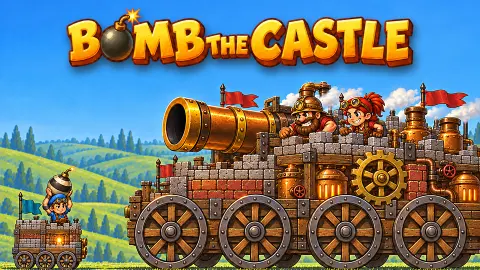
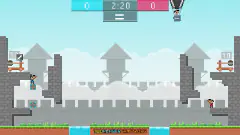
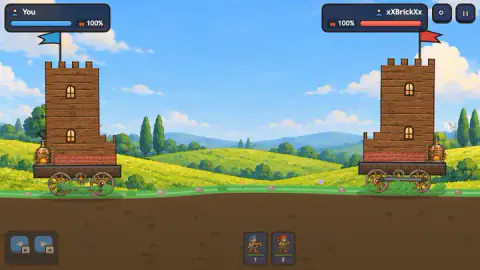
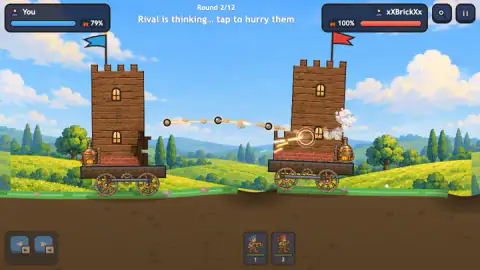
You and a rival each own a wooden tower with battlements, standing on a flatbed wagon with spoked iron wheels and a brass boiler bolted to the deck. Your crew live inside it, one to a floor, each with their own small health bar. Every shot you fire leaves from a figure standing on that structure, and every shot the rival fires arrives at it. There is no separate base to guard.
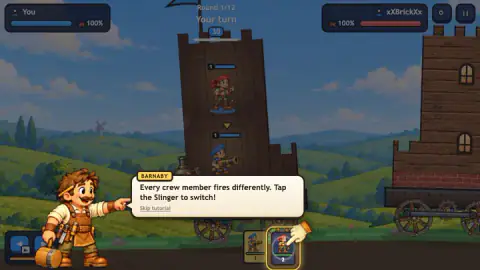
Firing is a pull and a release, and the game says so in its own words the first time you reach for it: Drag back from your Slinger to aim, let go to fire. The shot leaves in a long, shallow arc you can watch hanging in the air as a line of cannonballs trailing smoke. The scoreboard above is two percentages — yours in blue on the left, the rival's in red on the right — with the round counter between them. Twelve rounds. Thirty seconds a turn.
Now the ledger, because it shapes everything below. We played two battles and lost both. In the first, our castle fell through seventy-nine and sixty-four to fifty-one per cent while the bar opposite never moved at all. The second ended with our tower gone and a single crew member in a red bandana standing on a bare wagon.
The castle is the gun, and the target, and the scoreboard
The single percentage over your head is your castle, and watching it fall is how you learn what a hit does. Ours went in steps: seventy-nine, then sixty-four, then fifty-one. The damage is drawn as well as counted — by the middle of that battle our tower had a bite taken out of its upper corner that you could see from the other side of the field.
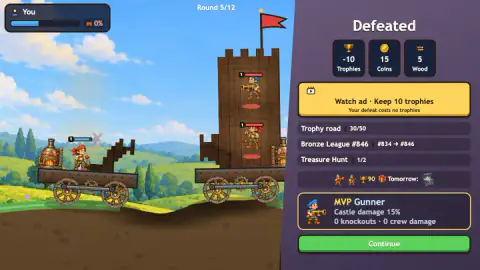
The last hit is the one that explains the design. In our second battle the bar reached zero and the tower was gone — not smoking, not leaning, gone — leaving the wagon, the boiler, a stump of staircase and one crew member standing on the boards. Across the valley the rival's tower was whole, flag up, with their two crew still tucked inside it, bars full.
That is why a percentage is the right scoreboard here rather than a count of hits: the structure is the health bar, and every plank you take off the other castle is a plank between you and the people inside it.
Why you pull back instead of pointing
A cannon is aimed. A trebuchet is not, and the difference is the one this game is built on.
The counterweight trebuchet arrived at European sieges in the twelfth century, after a long history in China of a simpler machine that a team of people pulled down by hand. It had no sights to look through. Range came from the weight hung on the short arm and the instant the sling let go, and when neither could be adjusted far enough, the crew moved the whole engine. Edward I had a famous one built for the siege of Stirling Castle in 1304 and named it Warwolf; the chroniclers say the garrison offered to surrender before it was finished and he made them wait until it had been tried on them.
Turning that into arithmetic took another two centuries. Niccolò Tartaglia printed the first mathematical treatment of gunnery in 1537 and worked out that a shot thrown at forty-five degrees travels furthest — the rule every artillery game has run on since.
Bomb the Castle hands you that pair of levers and no others. You cannot point: you set the angle and the force together in one drag, and when the arc is wrong in a way no drag can fix, you move the engine. The advice the tutorial gives you is the siege engineer's — closer is easier to hit, further is safer — and the wheels are there so you can act on it every turn.
What a defeat actually costs
The screen that follows a loss is purple, reads Defeated, and settles the account in three tiles: ten trophies off, fifteen coins on, five wood on.
Under them the game shows you where that leaves you: a trophy road sitting at thirty of fifty, a treasure hunt barely started, and a row naming the Bronze League with our place in it sliding from one number to a worse one.
At the bottom of the panel, a card picks out the most valuable member of your crew. Ours was the Gunner, credited with fifteen per cent castle damage and with no knockouts and no crew damage at all. We never once saw the rival's bar read less than full while the battle was running, so that figure is the game telling us we had landed something after we had stopped looking.
Above all of it sits a yellow button: Watch ad · Keep 10 trophies, with a smaller line promising that your defeat costs no trophies. We left it alone, so what it opens is not ours to describe. The listing is open about the rest of the money: optional videos that grant bonus coins, double the resources from a win or shorten a chest timer, and optional purchases for gems, a starter pack, or permanently removing the adverts that come between battles. It also states that all battles stay free to play, which matched the two we were given.
Between battles there is a camp with tabs for your crew, your castle, a market and a quest list, and a chest that opens on a timer. We opened a Timber Chest and it paid out coins, wood and two cards for the Gunner — the currency of making a crew member stronger rather than of buying a new one.
Who it is for, and what we never reached
This is a bright, patient game that asks one question a turn and gives you half a minute to answer it. There is no twitch in it: there is a clock, an arc, and a decision about whether to stand closer. A child can play it with one finger, and an older player gets a trade-off between range and accuracy that stops being abstract within a round.
Now the honest inventory. We never won, never saw a rival's castle drop below full while we were watching, never knocked out a crew member, never left Arena 1 or the Bronze League. The listing promises sixteen crew to unlock and train, power strips to drive onto, swinging gates to time your shots through, floating crates and a shell called a Rainmaker that splits when you tap it in flight. We saw none of those work, so they are the game's claims and not our report. And we played on a computer, so everything above about tapping is the game's interface talking rather than a phone in our hands.
More castles to knock down
If what pulls you here is the arc rather than the duel, Knight Launch is the same physics with a trebuchet and a volunteer, and Sky Kingdoms: Castle Siege spends its levels toppling fortresses instead of trading turns with one. For the opposite chair, Siege Clash puts you on the wall with the attackers coming at you, and Clash of Tanks keeps the two-bases-one-field shape without the arc. The rest are under strategy games.
Screenshots
How to play Bomb the Castle
- Start a battle from the Battle tab. The match screen puts your two crew against the rival's, and the first round opens with the header reading Round 1/12.
- Read that header first. It names the round, says whose turn it is, and holds a boxed number counting the seconds you have left.
- Choose who shoots. Tap a crew card at the bottom, or press its number. The tutorial is blunt about why this matters: Every crew member fires differently. Tap the Slinger to switch!
- Press on that crew member, drag backwards and let go. The length and direction of the pull are the angle and the force; there is nothing else to set.
- Drive if the arc will not reach. The two arrow buttons in the bottom left roll your whole castle along the field, and each wears a picture of the key that does the same job.
What only sitting in front of it teaches:
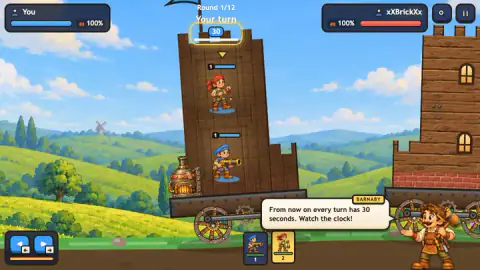
- The clock is the first opponent. It starts at thirty, and we watched it reach the twenties while we were still deciding and the low teens while we were dragging. The tutorial's warning is not decoration.
- Driving is not always on offer. The two arrow buttons share a single orange bar, and between turns they go grey and the bar disappears. Moving is something the turn gives you, not something you always have.
- A bad angle is a reason to change the gunner, not the plan. Switching crew costs a tap. The one standing high on the tower and the one standing low throw differently, and the high one is also the first to be hit.
- You can skip the rival's thinking. When it is their move the header reads Rival is thinking... tap to hurry them, and it means it.
- The tutorial gives away the whole tactical idea in one line. Closer is easier to hit, further is safer. That sentence is the entire argument for having wheels.
Controls
| Drag back from a crew member, then let go | Aims and fires. The pull sets both the angle and the force, and the game spells it out the first time you try |
|---|---|
| Left and right arrow buttons, or A and D | Drives your whole castle along the field. The on-screen buttons wear the arrow keycaps, so the game names the keys for you |
| 1 and 2, or a tap on a crew card | Chooses which crew member takes the shot. Each card carries that member's own health bar |
| W and S, or the up and down arrows | Aims without the drag, per the game's listed controls |
| Q and E | Trims the power of the shot up or down, per the game's listed controls |
| Space or Enter | Fires. Z zooms the view and P pauses, both declared by the game rather than tested by us |
Features
- A battle is twelve rounds long and each turn is capped at thirty seconds, with the number counting down in a box at the top of the screen
- Your castle is the gun and the target at once: every shot leaves from a crew member standing on your tower, and every shot the rival takes lands on it
- The crew live inside the tower, one to a floor, and the losing castle simply is not there any more — ours ended as a bare wagon with one survivor on it
- Both castles roll on wheels, so range is changed by driving rather than by sighting, and the two drive buttons share one orange bar
- Each crew member fires differently, and switching between them costs nothing but the tap, so a bad angle is a reason to change the gunner rather than the plan
- Losing costs ten trophies and pays fifteen coins and five wood, and the end screen names your most valuable crew member with the damage they did
- Progress runs through trophies, a trophy road, a numbered Bronze League place and arenas, the first of which is called Clover Meadow
Game details
- Developer
- Partner studio
- Release date
- October 2026
- Last updated
- October 25, 2026
- Added here
- October 2026
- Technology
- HTML5 (2D)
- Platforms
- Browser (desktop), Browser (mobile & tablet, touch)
- Saved progress
- Saving, when available, is managed by this game. Mava cannot confirm your level.
FAQ
How do you play Bomb the Castle?
You and a rival each own a wooden castle built on a wheeled wagon, and you take turns firing at each other. To shoot, press on one of your crew members, drag backwards and let go — the pull sets the angle and the power in one gesture. A battle runs to twelve rounds and each turn is capped at thirty seconds. The first castle to be knocked down loses.
How do you aim in Bomb the Castle?
You never point the gun. You drag back from the crew member who is firing and release, and the shot leaves in a long shallow arc that you can see hanging in the air as a line of cannonballs and smoke. If the arc is wrong in a way the drag cannot fix, you drive the whole castle closer or further away with the two arrow buttons in the corner. The tutorial puts the trade-off plainly: closer is easier to hit, further is safer.
How long is a turn in Bomb the Castle?
Thirty seconds. The game tells you so itself at the start of the first battle, in a tutorial line that reads "From now on every turn has 30 seconds. Watch the clock!", and the number sits in a box at the top of the screen counting down while you aim. We watched ours fall into the teens more than once while we were still working out an angle.
How many rounds are there in a Bomb the Castle battle?
Twelve. The counter at the top of the screen reads Round 1/12 at the start and climbed to Round 5/12 in our second battle before we were knocked out. Neither of our two battles reached the twelfth round, because both of them ended early with our castle at zero per cent.
What happens when you lose in Bomb the Castle?
A purple screen reading Defeated slides in and settles the account: ten trophies off, fifteen coins and five wood on. Underneath it are rows for the trophy road, your numbered place in the Bronze League and a treasure hunt, and a card naming the crew member who did most for you. There is also a yellow button offering to let you keep the ten trophies in exchange for watching a video, which we did not press.
Who are you playing against in Bomb the Castle?
Named rivals with the trappings of other players — ours were called xXBrickXx and Sir Steamknight, and the second one came with a steam-powered castle to match. The game's own listing describes the league as a climb against computer-controlled rivals rather than real opponents, so those names are opposition the game provides rather than people waiting on the other side of a connection.
Can you knock out the crew instead of the castle in Bomb the Castle?
The game's listing says a battle is won by destroying the opposing crew or the castle, and each crew card carries its own health bar separate from the castle's percentage. In the final screen of our second battle the rival's crew were still standing inside their tower with their bars intact, and our end card read zero knockouts. So the second route exists on paper; we never managed it.
Is Bomb the Castle free, and who made it?
It is free and runs in a browser with nothing to install. The game's listing says all battles remain free to play and that purchases are optional — gems, a one-time starter pack, or permanently removing the adverts that come between battles. The studio behind it is not recorded anywhere we can check, so this sheet names no author rather than guessing one.