

About Wheelchair parkour: No limits
A head, a shoe and a wheel, all travelling in different directions at once. That is one of the pictures on this page, taken while the chair was still in the air over a stack of tyres. Nothing on screen says the run is over yet. The game simply draws what is happening to you.
Most endless runners handle a crash with a fade and a number. Wheelchair parkour: No limits handles it like a cartoon: the chair sheds a wheel, the rider comes apart, and the loose pieces land on the roof and stay there. We know they stay because the same green and brown pieces that are spinning through the air in one of our pictures are lying on the rooftop in the next one.
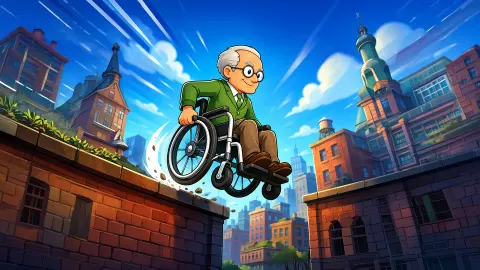
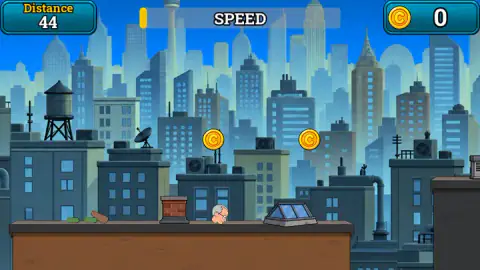
The game underneath that is simple and side-on. An elderly man in round glasses and a green jacket sits in an ordinary manual wheelchair, the kind with big spoked wheels, and crosses a city skyline of water towers, satellite dishes, brick chimneys and glass skylights. Hold the right arrow and he gains speed. Press the space bar and he jumps. Three readouts sit along the top and never move: a distance counter on the left, a yellow SPEED bar in the middle, a coin count on the right.
Two of those three moved for us. The coin count did not. It reads 0 in every picture on this page, and it read 0 on every end card we saw.
The game is credited to VaiYa Team. It went up in August 2026.
Here is how our afternoon went, which you should know before you trust anything below. We played for about four minutes on a desktop and started over thirty-one times. Our best run reached 59. Most ended on 52, the same number again and again. So this page can tell you what the game asks of you and exactly what being wrong looks like. It cannot tell you what the coins buy, or whether the rooftops ever stop.
The chair comes apart, and the pieces stay on the roof
Three of the four pictures on this page are a crash in progress, and they are worth reading in order.
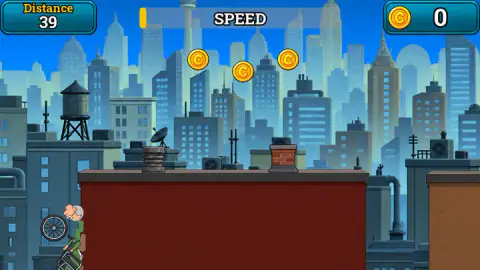
At distance 39 the man is in the bottom-left corner, below the roof line, tipped over against a wall of dark red brick. One wheel is already off and floating beside him. Three coins hang in the sky ahead, untouched, which is roughly the story of our entire session.
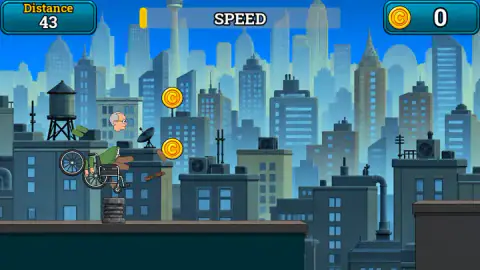
At 43 the break-up is complete and airborne. The chair is tilted nose-down over a stack of tyres with the green-jacketed body still across it, and the man's head — grey hair, round glasses, entirely unbothered — is flying above it on its own. A green piece and a brown piece spin away to either side.
At 44 the same figure is standing on a flat roof as a small pink shape with no chair at all, and the brown and green pieces from the previous picture are lying on the tiles beside him. That is the detail worth having: the parts are not a flash of animation that vanishes. They are objects, they fall, and they land where physics puts them.
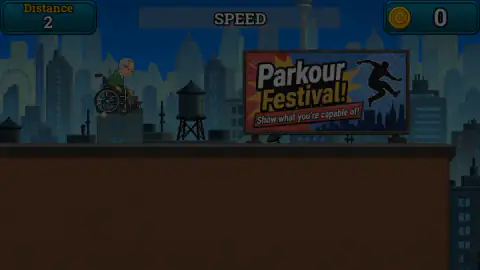
Then the card comes up. RUN ENDED, sometimes with NEW RECORD over it, your distance and your coins underneath, and four buttons: Revive and Double Coins, both wearing an advert icon, then Restart and Back. Press Restart and you are on the opening rooftop again, beside a billboard that reads "Parkour Festival! Show what you're capable of!", with the counter on 3.
Wheelchair parkour is a real sport, and it is called WCMX
The premise is not invented. WCMX is a sport in which wheelchair athletes ride skateparks and perform tricks adapted from skateboarding and BMX. The name is a mash-up of wheelchair and BMX, and both the sport and the name come from one rider: Aaron Fotheringham, born with spina bifida, who started dropping into skateparks as a child because his BMX-riding brother told him to.
He landed the first wheelchair backflip in 2006, at fourteen. Guinness recorded it as a world record two years later. A double backflip followed when he was eighteen.
The trick this game hands you on the jump button took much longer. The world's first wheelchair frontflip was landed on 9 February 2011, in New Zealand, on a Nitro Circus tour — five years after the backflip. The game gives you the harder one for free, on the first screen, before you have cleared a single gap.
What it does not give you is the equipment. A WCMX chair is purpose-built: reinforced frame, suspension on all four wheels to absorb landings, a bar for grinding, a seatbelt. Riders wear a full-face helmet and pads, and add a neck brace for flips. Fotheringham's own chair, built for him by Box Wheelchairs, is one he has described as "pretty much indestructible".
The chair in this game is the exact opposite, and that is the joke it is making. It is an everyday chair with spoked wheels, no straps, no helmet and no suspension, and it comes apart on the first bad landing. The sport is real and the athletes are serious. The cartoon is doing what cartoons do.
The coins hang over the gaps, which is why ours stayed on zero
Look at where the game draws its pickups. At 39 there are three in a row, well above the rooftops, over open air. At 43 and 44 there are two more, high and out past the edge. Not one coin in any of our pictures sits somewhere you could roll over without leaving the ground.
That tells you what the economy is for. The distance counter rewards survival; the coins reward risk. You cannot have both on the same jump, and a run that plays it safe collects nothing — which is exactly what thirty-one of our runs did.
One more thing about that top bar, because it is easy to misread. The distance figure carries no unit of any kind. The game writes the bare number, so 52 is not 52 of anything: it is a score with a sensible name. There is no level title, no stage count and no end-of-course flag on any screen we reached.
More from VaiYa Team, and other roofs to run
The studio's shelf is short. Fat Hedgehog Boris is the only other game they have, and it swaps rooftops for a side-on platform course with a hedgehog in it. For the same idea in three dimensions, Rooftop Run puts you inside the runner's head and only asks you to steer, while Impossible Parkour 3D turns parkour into a set of numbered courses in the sky instead of one endless one. And if what you want is the distance counter rather than the stunts, Yeti Run is the same chase for a bigger number on a ski slope. The rest of the shelf is in arcade games.
Screenshots
How to play Wheelchair parkour: No limits
- Clear the card first. The game opens with the screen dimmed behind a panel of instructions. Nothing moves until you dismiss it, which is why our first picture is darker than the rest.
- Hold the right arrow before you need the speed. The yellow bar in the middle of the top bar starts empty, lights a notch as you roll, and fills completely if you keep going. A gap you cannot clear is usually a gap you approached too slowly.
- Jump before the edge, not at it. The space bar is the whole jump. Press it while you still have roof under the wheels.
- Hold the jump down in the air for the trick. That is the one instruction the opening card gives you. We never saw a flip land cleanly, so we cannot tell you what it pays.
- Take Restart, not the two buttons above it. When the run ends, the orange Restart puts you straight back at the start with the counter on 3.
What our run actually taught us:
- The coins are bait. They are strung in the air over the gaps, two or three in a row, at a height you only reach at speed. Nothing worth having is drawn on the safe part of the roof.
- Falling off is not the only way to lose. We lost most often with roof still ahead of us, which means the obstacles on the surface — a chimney, a skylight, a stack of tyres — count as much as the holes between buildings.
- Two of the four buttons on the end card cost you an advert. Revive and Double Coins are both marked as adverts. Restart and Back are free, and Restart is instant.
- Doubling nothing is still nothing. Double Coins was on offer at the end of every run we played, each of which had collected zero coins.
Controls
| Right arrow | Roll forward. Hold it and the yellow SPEED bar in the middle of the top bar fills |
|---|---|
| Left arrow | Back the other way. We used it far less than the right one |
| Space | Jump. Press it before the gap, not over it |
| Space, held in the air | The flip. It is the one trick the opening card asks for; we never got one to land cleanly |
| Restart | The orange button on the end panel. Puts you back at the start with the counter on 3 |
| Back | The other free button on the end panel. We did not press it, so we cannot tell you where it goes |
Features
- A side-on rooftop course for one player, with an elderly man in an ordinary manual wheelchair as the runner
- Three readouts and no more: a distance counter on the left, a yellow SPEED bar in the middle, a coin count on the right
- The crash is drawn, not summarised: the chair sheds a wheel, the rider sheds his head, and the loose pieces land on the roof and stay there
- Coins are strung in the air over the gaps rather than on safe ground, which is why ours stayed on zero for 31 attempts
- The end panel offers two paid-for favours, Revive and Double Coins, both behind an advert, next to a free Restart
- Our best run reached 59 and earned a NEW RECORD card; most attempts ended on 52, the same number again and again
- Made by VaiYa Team
Game details
- Developer
- VaiYa Team
- Release date
- August 2026
- Last updated
- August 26, 2026
- Added here
- July 2026
- Technology
- HTML5 (2D physics)
- Platforms
- Browser (desktop, keyboard), Browser (mobile & tablet, touch)
- Classification
- Arcade
- Saved progress
- Saving, when available, is managed by this game. Mava cannot confirm your level.
FAQ
How do you play Wheelchair parkour: No limits?
You roll right and try to keep rolling. Holding the right arrow builds speed, the space bar jumps, and holding the space bar in the air is meant to turn the jump into a flip. The course is a row of city rooftops with gaps between them, and the run ends the moment you miss one.
What are the controls in Wheelchair parkour: No limits?
A keyboard is enough. We drove it entirely with the right arrow to build speed and the space bar to jump, holding the space bar down in the air for the trick. The game is listed for phones and tablets as well, where the same two jobs fall to an on-screen stick and a jump button, but we only played it on a desktop.
What happens when you crash in Wheelchair parkour: No limits?
The game takes the whole thing apart. In our pictures a wheel leaves the chair on its own, the man's head leaves his shoulders, and a moment later those loose pieces are lying on the rooftop beside him. Then a card reads RUN ENDED, with your distance, your coins and four buttons under it.
What are the coins for in Wheelchair parkour: No limits?
We cannot tell you, because we never picked one up. Our counter read zero in every single picture and on every end card across 31 attempts. The coins are drawn in the air above the gaps rather than on the safe parts of the roof, so reaching them means committing to the jump that is most likely to end your run.
How far can you go in Wheelchair parkour: No limits?
Further than we managed. Our best was 59, which the game marked with a NEW RECORD card. Far more often the end card read 52, the same figure run after run, which suggests most of our attempts died at the same obstacle rather than at a random one.
Is Wheelchair parkour: No limits based on a real sport?
There is a real one behind it, called WCMX, in which wheelchair athletes ride skateparks and perform tricks taken from skateboarding and BMX. Aaron Fotheringham, who was born with spina bifida, landed the first wheelchair backflip at fourteen and invented both the sport and its name. The game is a cartoon version of it, not a simulation.
Who made Wheelchair parkour: No limits?
VaiYa Team, according to the game's listing. It was published in August 2026. We found no studio website to check the name against a second source, so it rests on the portal alone.
Are there ads in Wheelchair parkour: No limits?
Yes, and the end-of-run card is where they live. Two of its four buttons, Revive and Double Coins, are marked as adverts; Restart and Back are free. Once, between runs, a panel told us it was skipping the advert that time and offered a button to carry on playing.