










About John is a lifeguard
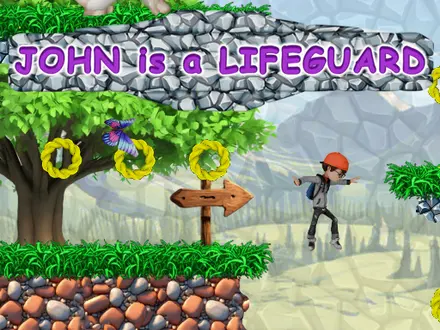
The title promises a beach. There is none. No whistle, no tower, no swimmer waving for help; the only water in sight is a stream painted into the scenery far below the path. John is a lifeguard is a side-scrolling platformer in which a boy in an orange cap and a backpack walks across grass and stone, jumps over white yetis, ducks the reach of spiked maces and picks up golden rings.
What turns the walk into a game is a quota. Every stage opens with a card that sets a goal, 50% of the rings in the first one, and a counter in the top-left corner climbs as you collect. Meet the goal and reach the far end, and a wooden board says Victory and hands out up to three stars. Your safety net is a separate thing: a row of ten hearts across the top of the screen, and every yeti or mace you touch turns one grey.
Studio7A published it on 7 April 2025. We found no ratings for it anywhere and no studio website. We played it through twice, once to clear the opening pair of stages and once letting the stage beat us, and the second run taught us more about the game than the first.
The title promises a beach it never delivers
If you arrived looking for a beach rescue game, this is not it. The stages we played are hillsides of grass and cobbled earth, with snowy peaks in the background, palm trees, sunflowers, a tree with orange and purple leaves and a creek running under the path. The villains are white, hunched yetis and spiked maces on wooden handles. The map between stages is a dark sky with meteors on fire.
The store text on the game's listing talks about saving the planet, which fits the meteors better than the title does. If you came for a short keyboard platformer with a clear goal on every stage, that is what you get.
Rings are a quota here, not a shield
Golden rings in a platformer bring one series to mind. In Sonic the Hedgehog (Sega, 1991) rings are your protection: get hit while carrying at least one and you drop them all instead of losing a life, and a hundred of them give you an extra life. Every ring you hold changes how safe you are.
John's rings do none of that. They are a target, counted as a percentage of all the rings in the stage, and they never leave you once collected. Protection lives in the hearts. The two systems pull in opposite directions: rings reward you for going out of your way, hearts punish you for touching what is in the way. The whole game is that trade, one ledge at a time.
It also explains why a run can fail slowly. Nothing takes your rings, so the counter looks healthy right up to the end, while the hearts quietly run out. Our losing run never came near the 50% goal: it ran out of hearts at 28%, with every ring it had picked up still on the counter.
Every stage twice: first for rings, then against maces
The map alternates large nodes, drawn as meteors, with small ones marked by a spiked mace and joined by a chain. After we cleared stage 1-1 with three stars, the star counter read three and the small node opened as Level 1-2.
It is the same stage with a different job. The signposts, trees and final wall are where they were, but the rings are gone and the counter starts at 100%. In their place come more spiked maces, some swinging from posts and others drifting through the air above the path, and the only goal left is to reach the wall with hearts to spare. We did it in about 45 seconds and reached the end with three hearts left.
Every stage starts again with all ten hearts, so a bad mace run never carries over. The next large meteor stayed locked after our first pair; we have not played further, so we cannot promise every later stage follows the same pattern.
Three stars and the draining ring
The stars in the bottom-left corner are not a score you see only at the end. The first two are yours as long as you finish. The third sits inside a ring that starts green and drains, turning orange as it empties. On our quick clear, holding right and jumping often, we finished the first stage in about 55 seconds and kept all three. On the slow run, the third star had gone grey by the time the GAME OVER board came down.
Stars are what open the padlocks on the map, so a hurried clear with the goal met is worth more than a careful one that picks up every ring.
Before you start
The game is in English. The level cards and the pause screen each show a motivational quote, but you never need to read them to play. There is a music button and a settings gear in the top-right corner. It has no touch controls and it is listed as not ready for phones, so it needs a keyboard.
More platformers
For a platformer with a harder price on mistakes, Brazen Ball makes every continue cost orbs. Super Onion Boy and One Bit are level-by-level 2D platformers with their own limits on lives and checkpoints, and Mini Switcher swaps jumping for flipping gravity. More games like this live in our adventure category.
Screenshots
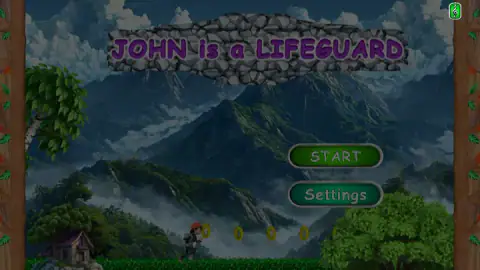
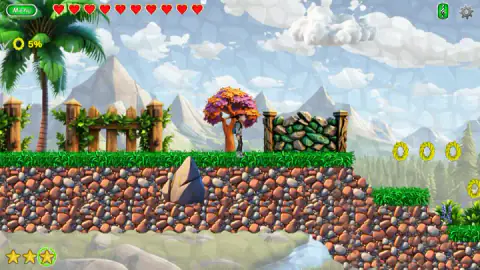
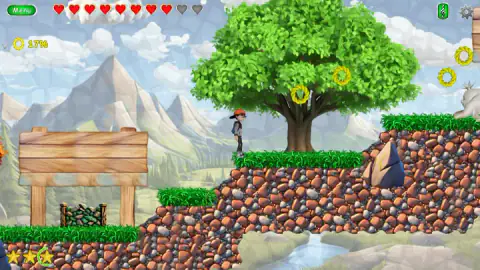
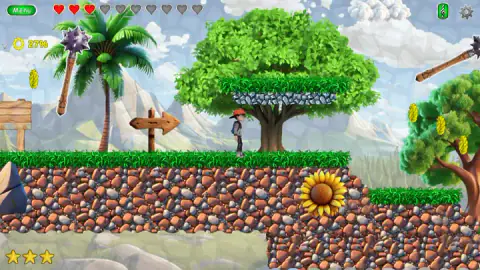
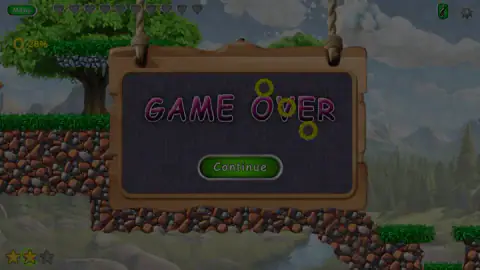
Taken by opening the game ourselves and letting it run — not supplied by the publisher, and not the same picture every other site shows.
How to play John is a lifeguard
- Press START, then pick a stage on the map. The first meteor node is open; the rest show padlocks until you have earned enough stars.
- Read the level card. It shows a quote, the keys and the ring goal. Click PLAY.
- Walk with A and D, jump with W. The Menu button in the top-left corner pauses the game on a card with MAP and PLAY.
- Collect rings until the tick beside the counter turns green. Many of them float above the path or sit inside tree canopies, so you have to jump for them.
- Keep heading right. The stage ends at a wall on the far side, where the Victory board shows your stars. Continue takes you back to the map.
Tips from playing it:
- Keep moving. The maces keep swinging while you stand still. In our slow run the boy lingered by signposts and crates for long stretches, and the hearts kept draining: by the time the counter reached 27%, only three were left.
- A hit costs a heart, never rings. The counter only goes up. That makes a ring near a yeti a fair trade early on, when you still have most of your hearts.
- Use W, not Space. Space did nothing when we tried it. W jumps at once.
- The arrow signposts are the route. Wooden arrows point right along the path. Empty wooden boards and crates are scenery; clicking them or waiting next to them does nothing.
- Go past the goal. Half the rings wins the first stage, but it is a floor. Our clean clear finished on 61% without detours.
Controls
| A / D | Walk left and right |
|---|---|
| W | Jump |
| Shift | Shown on the controls card; we never saw it change anything |
| Mouse click | START, map nodes, PLAY, Continue and the Menu button that pauses the level |
Features
- Every stage opens with a card that sets a ring goal, 50% in the first one, and a tick beside the counter turns green once you pass it
- Ten hearts across the top of the screen; a yeti or a mace greys one out, and the rings you hold are never taken back
- Lose the tenth heart and a GAME OVER board drops in; Continue sends you back to the map with nothing banked
- Up to three stars per stage, and the third sits inside a ring that drains from green to orange while you dawdle
- The map is a night sky of burning meteors, each followed by a small padlocked node marked with a spiked mace
- The level card and the pause screen each carry a short motivational quote in English, a different one each time
Game details
- Developer
- Studio7A
- Release date
- April 2025
- Added here
- October 2023
- Technology
- HTML5 (Unity WebGL)
- Platforms
- Browser (desktop)
- Download size
- 18.8 MB
- Ad requests
- 2 (few)
- Has a save
- Yes
- Saved progress
- Saving, when available, is managed by this game. Mava cannot confirm your level.
Measured by opening the game ourselves on 2026-09-10, not taken from the feed. Twelve seconds on a phone-sized screen, with ad requests counted and blocked rather than loaded.
FAQ
Is John is a lifeguard about being a lifeguard?
No. There is no beach, pool or swimmer to rescue. The only water is a stream painted into the background. It is a side-scrolling platformer about collecting golden rings, set under a map sky full of meteors.
How do you play John is a lifeguard?
Walk with A and D and jump with W. Collect enough rings to meet the goal on the level card, avoid the white yetis and the spiked maces, and keep heading right until the Victory board appears. Menus and map nodes are clicked with the mouse.
What happens when you get hit in John is a lifeguard?
One of your ten hearts turns grey and the boy flashes red. The rings you have already collected stay counted. Lose all ten hearts and the stage ends in GAME OVER, which returns you to the map.
How do you get three stars in John is a lifeguard?
Finish the stage with the ring goal met, and do it fast. The third star is circled by a ring that drains as the level goes on. We kept all three with a clear of about a minute, while a run that wandered for several minutes had already lost the third star.
How do you unlock the next level in John is a lifeguard?
Clear a stage with stars. After our first three-star clear, the small mace node beside it opened as Level 1-2. The large meteor nodes further along stay padlocked until you have collected more stars.
Does Space jump in John is a lifeguard?
Not when we tried it. Space did nothing, while W jumped straight away. The controls card shows W, A, S, D and Shift, and those are the keys to use.
Who made John is a lifeguard?
The developer is listed as Studio7A, which also has two puzzle games in its catalogue. We found no studio website and no ratings for the game on any portal.
Can I play John is a lifeguard on a phone?
It is marked as not mobile ready, and there are no on-screen buttons. It is meant for a keyboard and a mouse.