


About Dark Boy
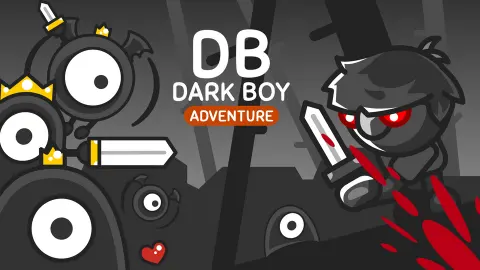
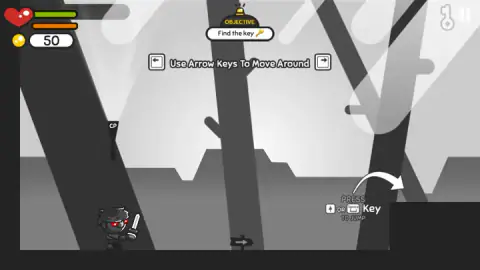
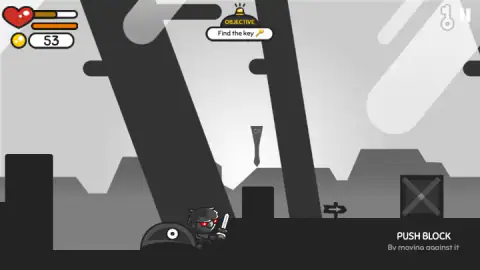
Take the colour out of a game and you have to decide what to put back. Dark Boy puts back almost nothing. A red heart in the corner. A green bar and an orange one beside it. A gold coin with a number next to it. A yellow key in the banner across the top. And two red dots, which are the eyes of the small figure you are moving. The trunks, the ground, the sky, the crates and the thing sitting at your feet are all grey.
Underneath that is a side-on platformer with a short list of verbs. You walk, you jump, you swing a sword, you shove crates out of the way, and you pick up coins that the game says are for its shop. The level does not hand you a menu of any of this. It writes each move on a card and plants the card where you need it, so you learn to jump at the first gap and to attack the first time something is in your way.
The objective is written where you cannot miss it. A small lamp hangs over the middle of the screen with a banner under it, and the banner says what this level wants. Ours said Find the key. In the opposite corner sits the outline of a key, empty, which is the game telling you exactly how far along you are.
The game is credited to Beedo Games, lists seventeen titles under that name. We found no studio site and no second portal carrying it, so that credit is the listing's rather than something we could check twice.
So here is what this page is. One run, about four minutes, on a desktop keyboard, through the first level. We never found the key, never reached what the game calls the end line, and closed on a game over card with the green bar empty. Everything below either happened on the screen in front of us or is marked as something the game itself says.
The only colour left is the colour you need
Strip a picture of colour and you have not taken anything away from how clearly it reads. You have taken away a competing channel. What remains is light and dark, which is what human eyes are best at.
There is a physical reason for that. Your eye carries two kinds of light sensor. One kind reads colour and needs decent light to work. The other reads only brightness, keeps working as the light fails, and outnumbers the first kind by roughly twenty to one. The colour sensors are packed into the centre of your gaze; the brightness ones spread out towards the edges. That is why astronomers catch a faint star by looking slightly to one side of it, and why everything turns grey at dusk long before it turns dark.
Dark Boy is drawn the way that second system sees: flat blacks, mid-greys and a pale sky, with light falling through the trees in bands. It stays perfectly legible, because your eye never needed the colour to tell the shapes apart.
Which is what makes the coloured things so loud. Apart from the character's own eyes, they are the only work your colour sensors have, and they all sit in the top corners where the interface lives. You read your own state without looking away from the ground. In a game that asks you to watch the floor, that is not a style choice, it is the reason the style works.
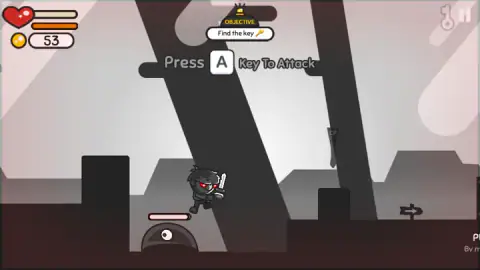
And then the game turns the same trick against you. The creature we met is a low dark mound, the same tone as the ground it sits on, with one small white eye. In a world with no colour, one white dot is the brightest thing for several feet. That eye is the only warning you get, and it is the only one you need — if you are looking at the floor.
The crate we never pushed, and the thing that actually killed us
We lost the run standing still, and the way it happened is the most useful thing we can pass on.
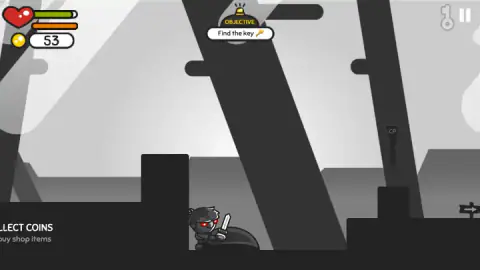
The level sets a crate in the path, marked with an X, with a card beside it that says to push the block by moving against it. We did that. We held the right arrow against the crate for most of the run and it did not move a pixel. We cannot tell you whether that takes a run-up, a different key, or a move the first level had not handed us yet — only that walking into it, which is what the game asks for, did nothing for us.
What we missed was the other thing in the frame. Sitting on the ground to our left, almost flush with it, was the one-eyed mound. The life bar tells the story better than we can: full green and full orange while we were still working out the crate, then most of the green gone, then the green empty with only orange left and rain falling across the whole screen. Then it was over.
So the lesson is not that the crate is broken. It is that Dark Boy is a game where standing still is a decision, and where the thing punishing you is coloured exactly like the floor. The next person in should solve the crate while moving, or kill what is next to them first.
For the record, hits are loud even without colour: the whole screen washes over in pink-red for the instant you take one, and the creature we had landed next to carried a small bar of its own above its head. So the enemies have health, and attacking is meant to empty it. We never saw one of those bars go down.
What the game says it has, and we did not see
Two of the keys the game lists are for things we never got near, and they are why this is worth a second run.
W toggles bullet time. Slowing time down, in a platformer this small, would change the whole shape of the crate-and-creature problem above: it is the difference between reacting to that white eye and planning around it. We pressed a great many keys in four minutes and never saw the world slow.
Q selects between the boys. Plural. Somewhere past the level we played there is more than one character to switch between, which in a game with no palette is an interesting problem for whoever had to draw them apart. We only ever had the one.
Both come from the game's own key list, not from us. Treat them as the two promises this page has not been able to check.
More games to play next
One Bit is the closest neighbour we have: a black-and-white pixel platformer built on twenty key-and-door levels, the same objective Dark Boy opens with, and it lets you plant your own checkpoint instead of finding one. Stickman Ghost Online keeps the side-on sword and spends the coins properly — eight stages, a three-hit combo, ten fighters to buy. John is a lifeguard is the brighter version of the same platforming: a quota to fill, ten hearts, hazards to spot early. And if it is the dark you came for rather than the jumping, Diner in the Storm is a stick-figure horror story in a roadside diner with eight endings. The rest are in adventure games.
Screenshots
How to play Dark Boy
- Walk with the left and right arrows. The first thing the level does is tell you so, on a card that hangs in mid-air until you move.
- Jump with the up arrow or the space bar. The second card arrives at the first gap, with a curved arrow drawn over it.
- Attack with A. The third card appears the first time something is close enough to hit.
- Push the crates by walking into them. They are marked with a large X and the card says, in so many words, to move against them.
- Pick up the coins. They hang in threes over the ledges, and the card tells you what they are for: shop items.
What the run taught us:
- You do not start broke. The purse opened on 50 coins before we had touched one. Whatever the shop sells, it expects you to arrive with money.
- Your life is two bars, and they come back. Green over orange, green first. Ours emptied, refilled on its own while we were out of reach of anything, and emptied again. Backing off is a move.
- The key does not show up until you have it. That empty outline in the top corner is a progress bar with one step in it.
- Checkpoints are labelled. Small pins marked CP are planted along the way, some hanging from the trunks, some stuck in the ground.
- The signposts are not decoration. Little arrow signs on the ground point the way through, which matters more than it sounds when every surface is the same colour.
- The level stops itself if you look away. A card reading Click to keep playing drops over the screen; one click in the middle and you are moving again.
- Watch the floor, not the scenery. This one cost us the run, and it has its own section below.
Controls
| Left and right arrows | Walk; the level's first card on screen tells you so |
|---|---|
| Up arrow or Space | Jump |
| A | Attack with the sword |
| W | Toggle bullet time, per the game's own key list; nothing we pressed made it show |
| Q | Switch between the boys, per the same key list; we only ever had the one |
| Walk into a crate | Push it, which the game teaches as a move in its own right |
| On-screen buttons | The same actions on a touch screen |
| Pause button (top right) | Stops the level |
Features
- A world drawn in greys, where the only colour left belongs to the things you have to watch: a red heart, a green life bar, an orange one under it, gold coins and a yellow key
- A life bar in two layers, green over orange, that drains when something reaches you and fills back up when nothing does
- An objective written across the top of the screen rather than hidden in a menu; ours read Find the key, with an empty key slot in the far corner waiting for it
- Five moves taught by cards as you walk into them: move, jump, attack, push a crate, pick up coins
- Coins that the game says buy shop items, and a purse that starts at 50 rather than at zero
- Checkpoints marked CP, planted on trunks and in the ground along the way, and signposts that point you through
- Made by Beedo Games
Game details
- Developer
- Beedo Games
- Release date
- December 2025
- Last updated
- August 10, 2026
- Added here
- October 2025
- Technology
- HTML5 (2D)
- Platforms
- Browser (desktop, keyboard), Browser (mobile & tablet, touch)
- Saved progress
- Saving, when available, is managed by this game. Mava cannot confirm your level.
FAQ
How do you play Dark Boy?
You walk a side-on level with the left and right arrows, jump with the up arrow or the space bar, and swing a sword with A. The top of the screen names the objective for that level; ours was to find a key. Along the way the game teaches you two more things, pushing crates by walking into them and picking up coins to spend in its shop.
Is Dark Boy black and white?
Almost. The forest, the ground, the sky, the crates, the character and the creatures are all greys, and the handful of coloured things on screen are the ones that matter: the red heart, the green and orange life bars, the gold coins, the yellow key in the objective banner, and the character's two red eyes.
What is the key for in Dark Boy?
It is the objective of the level. A banner at the top of the screen reads Find the key, and an outline of a key sits in the far top corner, empty, waiting to be filled. We spent about four minutes on the first level and never filled it, so what the key opens is something this page cannot tell you.
How do you push the blocks in Dark Boy?
The game says to walk into them: a card reads PUSH BLOCK, by moving against it, and the crates are marked with a large X. We held the right arrow against the same crate many times over several minutes and it did not move for us. Whether that needs a run-up, a different key, or a move the first level had not handed us yet, we could not work out.
How much health do you have in Dark Boy?
A red heart in the top-left corner with two bars beside it, a green one over an orange one. The green one takes the damage first. It is not a one-way slide: across our four minutes it emptied, filled back to the top on its own, and emptied again, which is the game telling you that staying out of trouble is itself a way of healing.
Does Dark Boy have a shop?
Yes. One of the tutorial cards reads COLLECT COINS, buy shop items, and the coin count sits under the heart. Our run opened with 50 coins already in the purse and ended on 53. We never got a look inside, so we cannot tell you what is in it or what it charges.
What is bullet time in Dark Boy?
The game's own key list gives W as the key that toggles bullet time, and the description it is published with talks about handling the dark creatures in your way. We never saw it happen. It is the clearest reason to go back in with the key list in front of you.
Who made Dark Boy and is it any good?
The game is credited to Beedo Games. The game was published in December 2025 and last updated in August 2026. We found no studio site and no second portal to confirm the credit against, so the attribution is the listing's.