

About Bottle Bottle
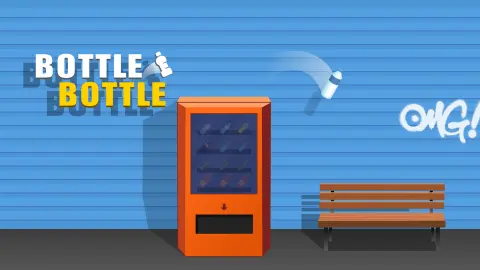
Most one-tap jumping games keep the route to themselves. You get a gap, a guess and a sound effect when you are wrong. Bottle Bottle draws the whole thing on the wall before you touch anything: a line of dashed white arcs, each one finished with an arrowhead, curling up and over the furniture to a yellow X on the far side.
The wall is blue and made of horizontal slats, like the side of a shed. In front of it somebody has left a flat-screen television standing on two cardboard boxes, a slab of grey concrete and a single orange brick ledge hanging in the air. The floor is a strip of pale sand. A small water bottle tumbles across all of it, throwing a dark shadow onto the slats just below itself, which turns out to be the easiest way to tell where it actually is.
What makes it a game rather than a diagram is that the arcs show you the path and never the rotation. The bottle turns as it flies — you can see it at a different angle in every frame — and the game does not draw that part, mark it, or count it anywhere on screen. That is the half it keeps back.
The game is credited to minigame studio and has been available since February 2026, with an update last August.
We played one session on a desktop. Our best score was 70, the game kept it on the card as HIGHEST for the rest of the sitting, and we finished with exactly as many coins as we started with.
The route is drawn for you. The spin is not.
Here is the thing we were slowest to work out, and it changes how the game reads.
Those dashed arcs look like a trail — the ghost of a bottle that has already flown. They are not. We caught the same corner of the same level twice in one sitting, once with the score on 10 and once with it on 50, and the two pictures are the same picture: the same television on the same boxes, the same brick hanging in the same place, and the arcs in exactly the same spots on the wall.
A trail cannot do that. A trail changes when the throw changes. These do not change, which means the level draws them, and what you are looking at is a plan rather than a memory.
So the game has split the problem in half and handed you the easy half. Where the bottle goes is settled before you arrive. What the bottle is doing while it gets there — turning, over and over, at a rate nothing on screen reports — is the part left to you and the part nothing will help you with. For a game named twice after a bottle, that is a pointed choice.
Why a half-full bottle lands on its base
The trick the game is named after had a very specific moment. A clip of a teenager called Mike Senatore flipping a water bottle at a school talent show — Ardrey Kell High School, in Charlotte, North Carolina — spread far enough in 2016 to turn a bit of lunchroom fidgeting into a thing the whole internet did for a summer. He popularised it rather than invented it; people had been filming the same stunt for years before.
The interesting part is that it only works if you get the water wrong on purpose. A full bottle will not do it. An empty one will not either. The bottle has to be part-filled, and the folk rule that circulated with the craze was about a third.
Physicists went and checked. A group at the University of Twente published the working in the American Journal of Physics in 2018. When a part-filled bottle leaves your hand it is spinning fast, but the water inside does not stay in the bottom. It spreads along the inside of the bottle as it turns, which pushes the mass away from the centre of the spin, and a spinning thing with its mass pushed outwards turns more slowly. In the paper's own words, the bottle's spin "decreases dramatically" in mid-air. By the time it comes down it has almost stopped turning, which is why it can land flat on its base. Their model puts the best fill somewhere between a fifth and two fifths of the bottle.
Which brings it back to the blue wall. The real trick is entirely about rotation: you cannot aim a flip, you can only load it correctly and let the water do the slowing. This game inverts that. It gives you the arc for nothing, draws an X on the landing spot, and leaves the spin undrawn in the one place a real flipper would be looking.
HIGHEST, SESSION, and a percentage that would not move
The card that ends a level stacks four things on top of each other, and two of them are easy to confuse.
A percentage sits at the top, then the word COMPLETED, then HIGHEST in red and SESSION in blue, each with a number under it.
Two cards from the same sitting sort out which is which. The first read 70 against both labels. The next read 70 for HIGHEST and 30 for SESSION. So HIGHEST is the record and keeps standing, SESSION is only the run you just finished, and nothing you do to one touches the other.
The percentage is the odd one out. It read 63% on both of those cards, including the one where the run score had collapsed from 70 to 30. Whatever that figure is tracking, it is not the run, and the game never says what it is.
Nine bottles, one key, and a counter that would not move
Press the green button with the bottle on it and you get the shop, which is the best-looking screen in the game: a dark grid with one bottle lit up above it, a green banner reading UNLOCK FOR COIN, and nine bottles laid out three by three. One has a green outline and is yours. The other eight wear padlocks. Three page dots underneath say there is more than this.
They are all different and none of them is anybody's brand: a ribbed clear one, a dark blue one with a yellow cap, a deep green glass bottle, a gold one.
Then the honest part. Our coin counter read 200 on the title screen, and it still read 200 in the shop, on both end cards and when we stopped. We never saw playing produce a single coin. The only thing on screen offering any was a pink button marked +500 FREE with a small video icon on it, sitting right next to the locked grid it would pay for.
That is worth knowing before you start counting on unlocking the gold one.
More games that give you one tap and a gap
If the hop-and-land rhythm is the bit you want more of, Chubby Duck Jump is the closest relative we have — one button, charge and release, and a line of floating planks that punish both over and under. Hop Ball does the same thing along a road of coloured tiles, and Bridge Bounce: Jump Challenge keeps the tall portrait shape and asks you to chain jumps without stalling. Bounce Up! is the one to take if the coins-and-unlocks half is what caught you rather than the jumping. The rest are in arcade games.
Screenshots
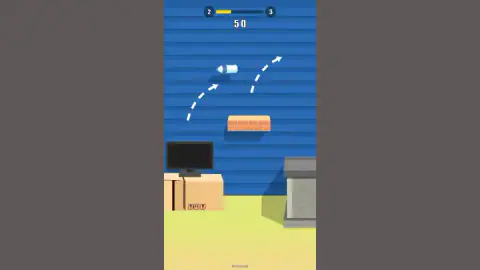
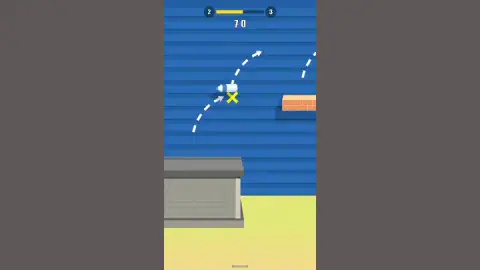
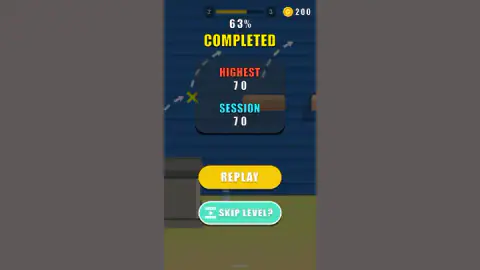
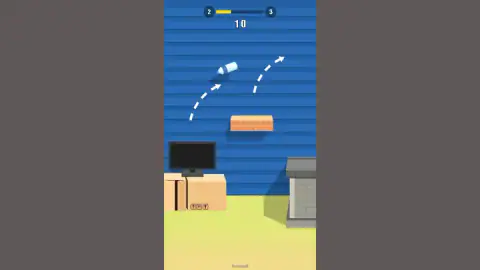
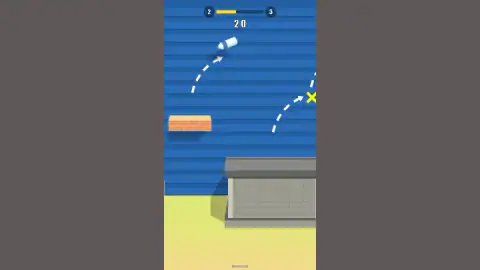
Taken by opening the game ourselves and letting it run — not supplied by the publisher, and not the same picture every other site shows.
How to play Bottle Bottle
- Click or tap to send the bottle. That is the entire control scheme. It works on the title screen, in the bottle shop and in the level itself.
- Read the arcs before you move. They are drawn across the wall in dashed white, two per hop, each ending in an arrowhead. The yellow X is where the bottle is meant to come down.
- Watch the shadow, not the bottle. The bottle is small and busy spinning. The dark shape it casts on the slats underneath is steadier, and it tells you how far along the arc you really are.
- Land, and the number goes up by ten. The score sits under the bar at the top. Every figure we saw all session was a multiple of ten.
- Take REPLAY, not SKIP. When a level ends you get a yellow REPLAY and a teal SKIP LEVEL?. The second one carries a small video icon.
What one session taught us:
- The padlocked bottles do not respond to being clicked. The way out of that screen is the green play button in the corner, and nothing else on it moves you forward. We lost more time there than in any level.
- The page pauses itself if you click away. A banner comes up asking you to click to keep playing and the game freezes behind it. It is easy to mistake for a crash.
- There is an unfinished label on every screen. Down at the bottom, in the middle, where a version number belongs, the game simply prints the word
#version#. It is on the title screen, in the shop, in the levels and on the end card. - SKIP LEVEL? works, and it is a trap worth naming. We used it, more than once. Levels went by, the score did not, and the card kept showing the same best we had already earned.
Controls
| Click or tap | Launches the bottle. It is the only input we needed all session, on the title screen, in the bottle grid and in the level itself |
|---|---|
| Green play button | Takes you out of the bottle grid and into the level. Clicking a padlocked bottle does nothing, which costs most people a few seconds |
| REPLAY (yellow) | Runs the level again from the card that ends it |
| SKIP LEVEL? (teal) | Moves you past the level instead. It carries a small video icon |
| Green home button | Top left of the bottle grid, back to the title screen |
| Red speaker button | Top left of the title screen, the sound |
Features
- A tall portrait playfield, so on a desktop the game sits in a column down the middle of the window with grey bars either side
- Dashed white arcs drawn across the wall, each ending in an arrowhead and running two to a hop, with a yellow X on the spot the bottle is meant to reach
- A score under the top bar that climbs in tens, kept twice over on the end card — HIGHEST survives the session, SESSION resets with every run
- A level built out of household junk - a flat-screen television standing on two cardboard boxes, a floating brick ledge, a block of grey concrete - against a wall of blue slats
- Nine bottles on the first of three pages in the shop, one of them yours and the other eight padlocked under a banner reading UNLOCK FOR COIN
- It has been available since February 2026
- Ad slots that genuinely stop the game between levels, both of which came back empty in our session with a purple button offering to carry on
Game details
- Developer
- minigame studio
- Release date
- February 2026
- Last updated
- August 10, 2026
- Added here
- December 2025
- Technology
- HTML5 (2D)
- Platforms
- Browser (desktop), Browser (mobile & tablet, touch)
- Classification
- Arcade
- Saved progress
- Saving, when available, is managed by this game. Mava cannot confirm your level.
FAQ
How do you play Bottle Bottle?
You send a water bottle hopping along a blue wall from one piece of furniture to the next, and a single click or tap is the whole control scheme. The route is already drawn on the wall as a line of dashed arcs with a yellow X at the end, so the game is asking you for timing rather than for aim. A card appears when a level ends, showing a score, your best and two buttons.
What are the dotted arcs on the wall in Bottle Bottle?
They are the route, not a trail. We caught the same stretch of the same level twice at different scores, and the arcs sat in identical places both times, which a record of the bottle's flight could not do. Each arc ends in an arrowhead, they come two to a hop, and a yellow X marks where the bottle is supposed to land.
What do HIGHEST and SESSION mean on the Bottle Bottle end card?
HIGHEST is your record and SESSION is the run you just finished. We have two end cards from one sitting that prove it - the first read 70 for both, and the next read 70 for HIGHEST with 30 for SESSION. The number itself climbs in tens as you go.
How do you unlock new bottles in Bottle Bottle?
The shop shows a grid of bottles under a banner reading UNLOCK FOR COIN, with one already yours and the rest behind padlocks, and three page dots underneath. Coins are the currency. We never unlocked a second one, because our coin total did not move for the whole session.
Does Bottle Bottle have ads?
The ad slots are real and the game stops in them at the end of a level. In our session both came back with nothing in them - one said the ad had been skipped and the other said none was available - and each left a purple button to carry on. The SKIP LEVEL button and the free-coins button both carry a small video icon, which usually means a clip stands between you and the reward.
Who made Bottle Bottle?
The game is credited to minigame studio, and no studio name appears anywhere on screen while you play. It has been available since February 2026 and last updated in August of the same year. We have no other game by that studio in our catalogue.
Is Bottle Bottle based on the real bottle flip challenge?
It shares the subject and it is filed under bottle flip, but the flipping craze and the game are not the same thing. The real trick turns on how much water is in the bottle, because a part-filled one slows its own spin in mid-air and can come down on its base. Whether this game asks the same of you is something we could not confirm in our session.
Can you play Bottle Bottle on a phone?
It is listed for desktop, mobile and tablet, and the game is built tall rather than wide, which is the shape a phone screen wants. On a desktop that leaves a column of game down the middle with grey bars on either side. We played on a desktop, so we can tell you how it looks but not how it answers to a thumb.