



About Viaducts
Most puzzles about joining up a track let you spin the pieces as often as you like. Turn one, look, turn it back, try the next. Viaducts charges for every one of those turns, including the turn that puts a piece back where it was.
The price is written on the board. A large grey number stands upright on the grass like a piece of scenery, and each time a block of track turns it drops by one. On the second level it read 6 when we arrived. Four clicks later it read 2, the track looked exactly as it had at the start, and the level was still unsolved.
That is the whole game in one sentence: a few blocks of railway track sit in a gap, each can be turned and none can be moved, and you have a handful of turns to make the rails line up.
We played for about four minutes with a mouse. We lost the first level once, then won it, and ran out of time on the next. We saw two levels and never caught the train on screen.
The game is credited to FYG Game. It has been available since March 2026.
The number on the grass is your budget
Here is the second level turn by turn, because it shows how the counter behaves.
It opens on 6. The longer block is on the left, with its rails running away from you. The shorter one is on the right, tucked against the right-hand ramp.
Turn one, the long block. It swung flat and lay left to right across the gap. The counter read 5, and an orange UNDO button appeared in the top left corner. From where we sat the bridge looked finished. It was not, and nothing happened.
Turn two, the long block again. It swung back to where it began. Counter: 4.
Turn three, the short block. This one did not swing sideways. It stood up, and became a red column taller than the ramps with a short piece of track on its top. Counter: 3.
Turn four, the short block again. It lay back down. Counter: 2, and the board looked exactly like the one we had started with.
So four of six turns went on finding out what the two blocks do. That is the lesson of the level, and probably of the game: a turn spent looking is a turn gone. We stopped there, with two turns left and no solution, and we do not know what the game does when the number reaches zero.
Two blocks that touch are not yet a track
The moment that fooled us is worth a closer look. After the first turn the long block lay neatly between the two ramps, and its right end met the short block. Seen as shapes, the gap was closed.
Seen as railway, it was not. The long block's rails ran from left to right. The short block's rails still ran from front to back. Two pieces of track met at a right angle, which no train can follow.
This is what the game asks you to check before each click. Every block has a top face with two pale rails and a row of orange sleepers, the bars that lie across a real track. The sleepers are the quick tell: on a joined line they all lie the same way. If the sleepers on one block run across the screen and those on the next run up it, the line is broken, however tidy the blocks look.
The standing column adds height to the problem. A block can end up with its rails in the right direction and still be on the wrong floor.
Losing, winning and the stars
We lost the first level before we understood it. The screen said "LOSE!" over the level's name, with a 3 standing behind the letters. We cannot tell you what caused the loss.
After it the game paused for an advert break, and when that cleared a banner asked for a click to keep playing. We gave it one, in the middle of the board, and the next thing the screen showed was "GREAT!" with two yellow stars. We cannot say which of our clicks did the work.
Two stars and not three suggests the game grades how you win. Our guess is that it counts turns left over, but we did not win a second time to compare, so that stays a guess.
Why it is called Viaducts
A viaduct is a long bridge made of many short spans, built to carry a road or a railway across a valley at a steady height. The word was coined on the model of aqueduct, from the Latin for "way" and "to lead": an aqueduct leads water, a viaduct leads a road.
The game borrows more than the name. A real viaduct is not one heroic span. It is a row of modest ones, each resting on its own pier, and it only works when every one of them is in line. That is the puzzle here: several short pieces, each on its own base, and a crossing that exists only when all of them agree.
Who it is for
Players who like to stare at a small puzzle and solve it in their head before touching it. There is no clock, a level fits on one screen, and the rule takes one click to learn.
It is less suited to anyone who solves by trial and error, because the counter punishes exactly that. And we cannot tell you how far it goes or how hard it gets: two levels and two blocks are all we saw.
More puzzles about joining a line
Connect Line is the flat version of the same idea, turning pieces until two ends join. Railway Traffic Jam! Untangle the Trains! keeps the trains and swaps turning for order: you choose which one leaves the crossing first. Draw Bridge - Brain Game and Draw The Road hand you a pen and let you draw the crossing yourself. The rest are under puzzle games.
Screenshots
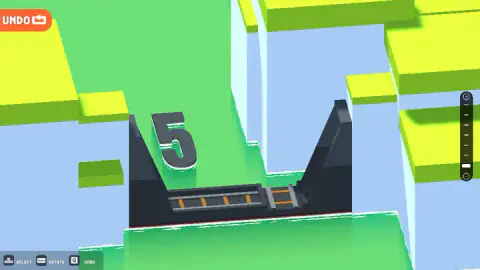
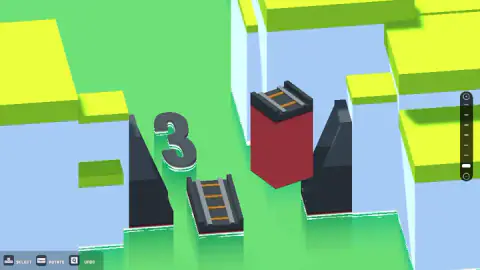
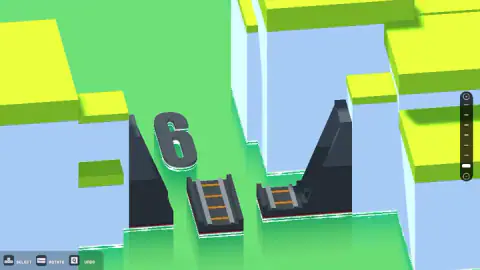
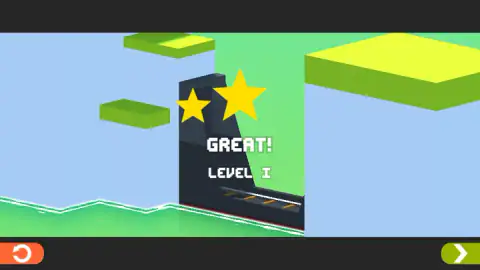
Taken by opening the game ourselves and letting it run — not supplied by the publisher, and not the same picture every other site shows.
How to play Viaducts
- Look at the gap before you touch anything. Two dark ramps face each other, and the blocks of track sit between them.
- Click a block to turn it. It stays on its spot; only its direction changes.
- Watch the big number. It falls by one with each turn.
- Leave the rails in one unbroken line. A win shows "GREAT!" and a row of stars.
- Press the green arrow in the bottom right corner for the next level, or the orange round arrow on the left to play the same one again.
What four minutes taught us:
- Dragging is wasted effort. We spent more than a minute trying to pull one block towards the other. Nothing moved and the counter stayed at 6. A block turns when you click it, and that is all it does.
- The big number is not a clock. It sat on 6 the whole time we were dragging. It only counts turns, so thinking is free.
- Putting a block back costs a turn too. Two clicks on the same block returned it to its first position and took two off the counter.
- Read the rails, not the blocks. Two blocks can sit end to end and still not join, because the rails on one run across the rails on the other.
- Clicks that miss are free. We clicked the number itself once. The counter did not move.
Controls
| Left click on a block of track | Turns that block once and takes one off the big number |
|---|---|
| Left click anywhere else | Nothing; a click on the number or the grass cost us no turn |
| Orange UNDO button, top left | Appears once you have turned a block; we did not press it |
| Arrow keys, space bar and Q | Listed on screen as SELECT, ROTATE and UNDO; we played with the mouse |
| Slider on the right edge, plus and minus | Looks like zoom; we left it alone |
| Green arrow and orange round arrow, after a win | Next level and play the level again |
Features
- Blocks of railway track that stay on their spot and can only be turned
- A large 3D number standing on the grass that drops by one with every turn
- One block that rises into a red column taller than the ramps when you turn it
- An UNDO button, plus a key legend for playing without the mouse
- No clock; the number held at 6 for a minute and a half while we worked the level out
- A star rating on the win screen; our first level earned two
Game details
- Developer
- FYG Game
- Release date
- March 2026
- Last updated
- August 10, 2026
- Added here
- January 2026
- Technology
- HTML5 (3D)
- Platforms
- Browser (desktop)
- Saved progress
- Saving, when available, is managed by this game. Mava cannot confirm your level.
FAQ
How do you play Viaducts?
Each level is a gap with a few blocks of railway track in it. Click a block and it turns; the aim is to leave the rails running in one unbroken line. Blocks never leave their spot, so dragging does nothing. Every turn takes one off the large number standing on the board.
What does the big number in Viaducts mean?
It is the number of turns you have left. On the second level we played it started at 6 and fell by one with each block we turned, down to 2. Clicking the number itself or the scenery did not lower it.
Is there a time limit in Viaducts?
Not one we could find. The counter stayed at 6 for about a minute and a half while we tried things that did not work. It only moved when a block turned, so you can look at a level for as long as you like before spending anything.
Can you undo a move in Viaducts?
An orange UNDO button appears in the top left corner after your first turn, and the on-screen legend also assigns undo to the Q key. We did not press either, so we cannot say whether an undo gives the turn back. Turning a block a second time put it back for us and cost a second turn.
How many levels does Viaducts have?
We do not know. We won the first level, started the next one and did not solve it. The game shows no level map or total on the screens we reached.
Can you play Viaducts on a phone?
It is listed for PC, Android and iOS, in landscape and portrait. We played on a desktop with a mouse only, so the phone version is the listing's word and not something we tested.
Who made Viaducts?
The game's listing credits FYG Game. Viaducts was published on 11 March 2026 and was last updated in August 2026.