


About Nexusorbiter
A dashed circle sits in the middle of the screen. Inside it, a space station drawn as a white-and-cyan coil, something like a snail shell with running lights. On the circle itself, a satellite no bigger than a thumbnail, four solar panels out, going round and round. Out in the dark at the edges, grey rocks drift inwards, each with a short orange bar floating above it.
One line of small caps along the bottom of the play area tells you everything this game will ever ask of you: Click to flip the drone's direction.
That is the whole control. You do not steer the drone, because it is on rails and the dashed circle is the rail. You do not fire either: it shoots on its own when something comes close, which we only learned by catching it mid-shot, red flash at the hull, bolt on its way. All you decide is which way round it travels. The game is a question of where your gun is standing, not where it is pointing.
Nexusorbiter is credited to hygerg8 Games, lists it as published in May 2026 and last updated that August. Our own session ran about four minutes on a desktop across two stages, First Watch and Drift Patrol. We cleared one, lost the station several times, and never got anywhere near the end. Nothing below pretends otherwise.
One control, and the thing it controls is nowhere
Most games built around a single button spend that button on something that moves you: a jump, a thrust, a brake. Nexusorbiter spends it on a sign change. Your drone keeps its speed, its height and its path whatever you do. All you can alter is the sense of its travel.
That sounds thin until you watch the ring for half a minute. The station is a fat, immobile target; the drone is a thin shield that can only be in one place on the circle. Every rock that drifts in asks the same question — is the shield nearer going this way or that way — and the clock on it is the rock itself.
The second thing you learn is that the ring has no corners to hide behind. Flipping to meet one threat sends you away from the opposite side of the station, which in Drift Patrol is where the next one is. In the two captures we published from that stage, the drone has company in three directions at once. There is no answer that covers everything; there is only an order to do things in.
The automatic gun is what holds this together. Hand the player a trigger and the game becomes reflex and aim; take the trigger away and it becomes geometry, which anyone can read off the screen at a glance.
Turning around is the most expensive thing a real satellite can do
The flip is the one move an actual spacecraft could never make, and the numbers behind that are why this is a cartoon rather than a simulation.
Something in low Earth orbit is travelling at roughly 7.8 kilometres a second, which is around 28,000 kilometres an hour. To send it the other way round the same circle, you do not slow it down and turn it; you have to cancel all of that speed and then build the same amount again in the opposite sense. The change needed is twice the orbital speed. That is a bigger change in motion than it took to get off the ground and into orbit in the first place.
Which is why going backwards is treated as a last resort. Satellites are normally launched in the direction the Earth is already turning, because, as the standard account has it, the spin is free propellant and using it minimizes the amount of propellant required to reach orbit. Go the other way and you pay for the rotation instead of being paid by it. Israel is the famous exception, and not for any orbital reason: its Ofeq satellites are launched westward over the Mediterranean because an eastward launch would drop spent stages on its neighbours. Geography beat physics, and the rocket carries less for it.
Nexusorbiter takes the most expensive manoeuvre in spaceflight and makes it instant and free. That is the right call, because the cost has simply been moved somewhere a player can feel. You do not pay in fuel, you pay in being on the wrong side, and that bill arrives about a second after the click.
Three dots, a thin blue bar, and a counter that keeps climbing
Above the station sit three dots. In both of our Drift Patrol captures all three are lit; in both First Watch captures only the first one is, which is exactly as alarming as it looks. They are the station's health, not the drone's, and that is the quiet cruelty of the thing — you can fly perfectly and still be the reason it dies.
In the top-left corner, a blue badge carries the stage number, the stage name and a thin cyan bar beneath it, barely started in everything we captured. Opposite it, in the top right, a red button with a white flag that we never pressed and cannot explain, and a counter with a small grey nut for an icon. That counter is the one number that only goes up. Ours read 185 in the middle of First Watch, 269 a little later, and 399 by the last thing we saw. Clearing a stage dropped 178 into it in one lump, on a green STAGE CLEAR banner.
What none of that includes is a score. There is no points total, no combo, no multiplier. You are not being graded, you are being asked whether the station is still there, and the answer is a yes or a no.
What the later stages are supposed to hold
We played two stages. The game's description claims more than thirty, and the specifics it lists are worth repeating as theirs rather than ours: bombs that glue you and must be shot at range, homing drones that cannot be dodged, drones that silence your automatic fire on contact, and orbiters that heal a boss while you work on it. Every one of those attacks the same single resource, which is where your drone happens to be.
The clue that something like this is coming sits in the bottom-left corner of the Drift Patrol screen — three dashed slots, empty every time we looked. The game's listing mentions consumable rockets and six upgrade tracks paid for with the currency we had been quietly accumulating, so those slots are presumably where a stocked player keeps an answer to the stages we never reached.
One honest caveat: between attempts the game goes to a break, so a retry costs a pause. And our session began on stage two rather than stage one, which we cannot account for and will not invent a reason for.
More games that run on one control
If the ring is what brought you here, Orbit Shift is the nearest thing we have: two lanes around a dying star, one tap to switch between them, and no other verb. Orbit Ring 2 keeps the single button and turns it into a high-score chase rather than a stage list.
Void Shot shares the other half of the idea — a turret that fires on its own while you worry only about where it stands. And if the physics above is the part you want to play, The long way home is built on it: a stranded astronaut, a finite tank, and the rule that every burn is spent for good while drifting is free. The rest is in arcade games.
Screenshots
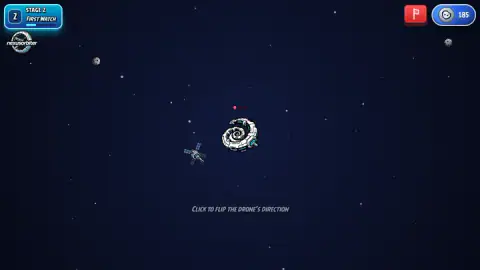
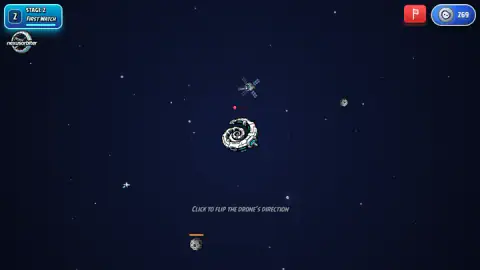
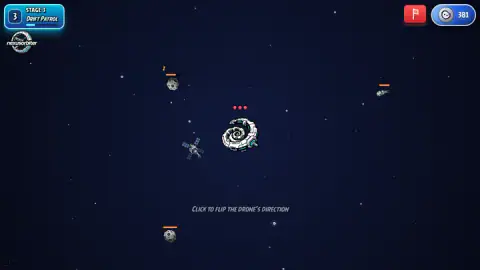
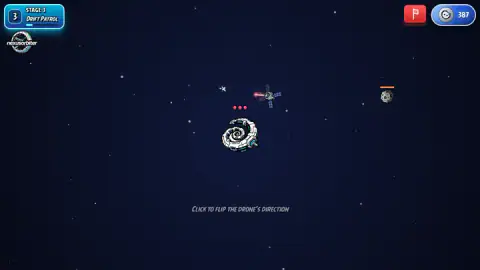
Taken by opening the game ourselves and letting it run — not supplied by the publisher, and not the same picture every other site shows.
How to play Nexusorbiter
- Click once to begin. The opening card says tap anywhere to start the orbit, a countdown runs, and the drone starts moving on its own.
- Click again to reverse it. There is no steering and no speed control. Each click swaps clockwise for anticlockwise, instantly.
- Read the edges, not the middle. Hazards enter from off-screen, and once one is near the ring it is too late to come round the long way.
- Let the gun work. It fires at what is near it. Your job is to park the drone between the station and whatever is arriving.
- Watch the three dots above the station. They are its health. When they run out you get STATION LOST, a red STATION DOWN, and an offer to retry the stage.
What the session taught us:
- A flip is not free, it just looks free. The direction changes at once, but the drone still has to travel. Reversing when a rock is already inside the ring is how we lost most of our stations.
- Rocks do not die in one pass. The orange bar over an asteroid drains a little at a time, so a hazard you have "handled" is often still coming.
- Position early, not accurately. Because the gun aims itself, the skill is arriving before the threat does. Think of it as closing a door rather than firing a shot.
- Stage names are a warning. First Watch sent one rock at a time; Drift Patrol had four objects on screen at once.
- The keyboard is not in this game. Arrow keys, space bar, nothing we could see or hear. One hand on a mouse is the entire setup.
Controls
| Click or tap anywhere | Reverses the drone's orbit. Clockwise becomes anticlockwise and back again. This is the whole control |
|---|---|
| No fire button | The drone shoots by itself. We saw the muzzle flash and the bolt leaving it without touching anything |
| Three dots above the station | What the station has left. All three were lit at the start of a stage and one was lit when we were in trouble |
| Three dashed slots, bottom left | Empty every time we looked. The game's listing says a rocket button launches consumable rockets |
| Arrow keys and the space bar | Nothing we could see or hear. Everything in our session happened because of a click |
Features
- One control and one decision — the drone's track is a fixed dashed circle, so direction is all you own
- The gun is automatic and short-ranged, which turns the game into a question of position rather than aim
- Asteroids carry a small orange bar that drains, so a rock takes several passes rather than one
- Three dots over the station are the whole health bar, and losing them puts STATION DOWN on the screen
- Stages are named as well as numbered — stage two is First Watch, stage three is Drift Patrol
- A counter in the top right climbed from 125 to 399 in four minutes, with a clearing bonus of 178 in one lump
- Available since May 2026 and offered in eight languages
Game details
- Developer
- hygerg8 Games
- Release date
- May 2026
- Last updated
- August 10, 2026
- Added here
- March 2026
- Technology
- HTML5 (2D)
- Platforms
- Browser (desktop), Browser (mobile & tablet, touch)
- Download size
- 1.4 MB
- Ad requests
- 3 (few)
- Has a save
- Yes
- Saved progress
- Saving, when available, is managed by this game. Mava cannot confirm your level.
Measured by opening the game ourselves on 2026-09-11, not taken from the feed. Twelve seconds on a phone-sized screen, with ad requests counted and blocked rather than loaded.
FAQ
How do you play Nexusorbiter?
You do one thing. Click or tap to reverse the direction your drone is orbiting in. The drone is locked to a dashed circle around the space station and cannot leave it, and it fires at hazards by itself without any button from you. Your whole job is to be on the right side of the station when something arrives, which means flipping early rather than accurately.
What is the control in Nexusorbiter?
A single click, anywhere on the screen. The game prints the instruction along the bottom of the play area in small caps — "Click to flip the drone's direction" — and that is the complete list. We tried the arrow keys and the space bar and nothing we could see or hear happened, so a mouse or a finger is all you need.
Do you have to aim or shoot in Nexusorbiter?
No. There is no fire control and no crosshair. In one of our captures the drone is caught mid-shot, with a red flash at the hull and a bolt flying away from it, and we had pressed nothing. The game's own listing says the satellite only fires at asteroids that come close, which matches what we saw, since rocks at the far edge of the screen were ignored until they drifted in.
What does STATION DOWN mean in Nexusorbiter?
It is the losing screen. A banner reads STATION LOST, the words STATION DOWN come up in red, and underneath you get "TAP TO RETRY THE STAGE" and "CLICK TO CONTINUE". The station has three dots above it that serve as its health, and when they are gone the stage ends. Retrying puts you back at the deploy card for the same stage.
How many levels does Nexusorbiter have?
We cannot confirm a total from our own session, because we only played two of them, stage two, First Watch, and stage three, Drift Patrol. The game's description claims more than thirty stages with multi-boss waves. The stages carry names as well as numbers, which suggests a designed run rather than an endless score chase.
Who made Nexusorbiter?
The game is credited to hygerg8 Games. No studio name appears on screen while you play; the only branding in the play area is a small circular "nexusorbiter" logo in the top-left corner. It is listed as published in May 2026 and last updated in August 2026.
Is Nexusorbiter free to play in a browser?
Yes. It runs in the browser with no download and no account, and it is listed for PC, Android and iOS in both landscape and portrait, with the interface available in eight languages. Between one attempt and the next the game goes to a break, so expect a pause when you retry a stage rather than an instant restart.
What are the coins for in Nexusorbiter?
The counter in the top-right corner, next to a small grey nut-shaped icon, climbed from 125 to 399 during our four minutes, including a bonus of 178 handed over on the stage-clear screen. The game's description says the currency feeds six upgrade tracks and that a daily challenge pays a bonus. We never spent any, so we can tell you it accumulates but not what it buys.