

About Orbital
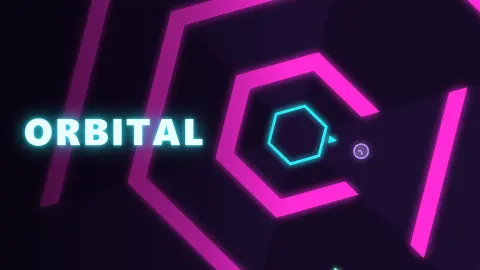
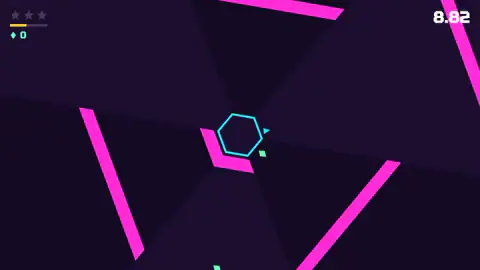
Most dodging games give you a body to move and a screen full of space to move it in. Orbital takes the space away. Your ship is a small cyan triangle stuck to the edge of a hexagon in the middle of the screen, and the only thing you can do is slide it round, left or right. Magenta walls close in from the edges. Find the side they leave open.
That is the whole rule, and it is enough. The walls come as single bars, as bent chevrons, and as three-sided brackets with one gap, and they arrive faster than you can read them at first. The clock in the top right counts up. Your best time sits under it.
Orbital comes from Mio Games and was published on 4 November 2026. We played it two days later on a computer with a keyboard, for about ten minutes and many short runs, all in the first world. Our best was 13.28 seconds. We did not earn a single star, and we say so up front because it tells you how hard the opening is.
About twenty seconds for the first star, by our estimate
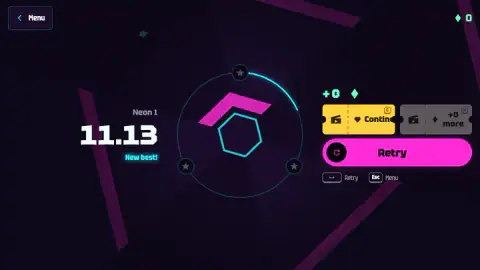
Each world has three stars, and they come from one thing only: how long you survive in a single run. The results screen draws them on a ring around the hexagon, with a cyan arc that grows with your time.
Under the stars at the top left sits a thin yellow bar. It is the most useful thing on the screen, because it fills as the clock runs. In our runs it was about two-fifths full at 8.82 seconds, and at the same pace it would reach its end at around 20 seconds. The arc on the results screen agrees: at 13.28 seconds it had gone a little under a quarter of the way round, and the stars sit a third of the way apart.
So, by our estimate, the first star asks for a run of about twenty seconds, and the full ring for about a minute if the pace holds. That is our reading of the bar and the arc, not a number the game prints, and we never reached a star to confirm it. It does give you something to aim for.
Most of our runs ended inside the first few seconds. Getting from there to the first star is the real game.
"Click to keep playing" is not a pause
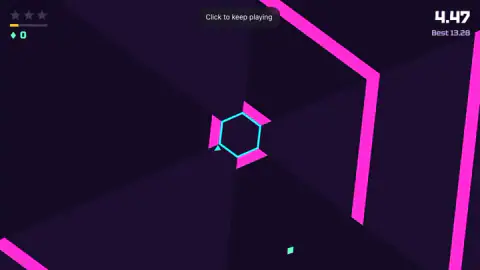
Every so often a small grey tag reading Click to keep playing appears at the top of the screen. It looks like the game has stopped and is waiting for you. It has not.
In our runs the clock kept counting under it and the walls kept coming. One of our runs went from 3.08 to 12.58 seconds with the tag on screen the whole time, and ended at 13.28, our best. In another we even picked up a crystal while it was showing.
So if you see it, click once on the game and keep your eyes on the walls. Do not take your hands off the keys and wait for the game to freeze, because it will not.
Crystals stay with you, and the two yellow buttons are ads
Green crystals drift in among the walls, often right beside one. When you touch one, the counter under the stars goes up by one. The useful part is what happens when you crash: the results screen adds it with "+1" and your total keeps it. We ended the session with seven.
That changes how you treat them. A crystal grabbed in the first two seconds is banked even if the very next wall ends the run. The publisher says crystals pay for upgrades and skins; we did not get that far.
The results screen has three buttons. Retry is the big pink one, also on Space; Esc goes to the menu. Above it sit two ticket-shaped buttons, each with a small film icon, because each is a video ad. Continue (the C key) carries a heart and offers a second life. +N more (the X key) offers that run's crystals again, and it only lights up yellow when you caught one; otherwise it stays grey at "+0". Twice the game answered with "No ad available right now. Try again later", so a run that ends is usually a run that ends.
Who it is for, and what we did not see
Orbital suits anyone who likes short, sharp runs and a clock to beat. A run lasts seconds, Retry is one key, and the rule needs no reading. Younger players will get it at once; whether they enjoy dying every few seconds is another matter.
It is not a game with levels to finish or a story. The goal is a number, and then a slightly bigger one.
We played only Neon 1, on a keyboard. The publisher lists two more worlds, Lava and Ice, unlocked with stars, plus a Focus ability on Shift that slows time after an upgrade, skins, daily missions and a daily chest. We saw none of these, and we did not try the mouse buttons or a touch screen.
More reflex games
Geometry Vibes is another one-input test of nerve: hold to climb, let go to dive through spikes. In Fit in the Wall the wall is coming too, and you have to match its cutout before it arrives. Neon Ball Slope keeps the neon and two arrow keys, on a slope that keeps getting steeper. More quick-reaction games are in arcade games.
Screenshots
Taken by opening the game ourselves and letting it run — not supplied by the publisher, and not the same picture every other site shows.
How to play Orbital
- The first run opens with the controls on screen: the arrow keys, A and D, and a mouse, next to the word "Move".
- Slide the triangle around the hexagon. Left goes one way round, right the other.
- Watch the walls coming in from the edges and move to the side with the gap.
- Touch the green crystals when you can reach them safely.
- When a wall catches you, press Space to retry at once.
Tips from our runs
- Glance at the yellow bar under the stars now and then. As far as we can tell it tracks your progress to the first star, which the clock alone does not show.
- Look at the shape, not the nearest bar. A bracket closed on three sides has one exit: be there before it lands.
- Do not chase a crystal across a closing wall. It is worth one crystal; the run is worth more.
- Keep your eyes on the screen after Retry. An ad break sometimes appears right as the fresh run starts.
Controls
| Left / Right arrow keys, or A / D | Move the triangle around the hexagon, anticlockwise or clockwise (shown on the start screen) |
|---|---|
| Mouse | Also moves the triangle, per the start screen icon; the publisher says left and right buttons steer left and right (we did not test it) |
| Space | Retry from the results screen |
| Esc | Back to the menu from the results screen |
| C | Continue, a video ad that offers a second life (shown on the results screen) |
| X | The "+N more" crystals button on the results screen, also a video ad |
Features
- One rule: keep the small triangle out of the way of the magenta walls closing in on the hexagon
- A clock that counts up, and a best time kept under it
- Three stars per world, earned by surviving, with a yellow bar under them that fills as your time grows
- Green crystals floating among the walls, which you keep even when the run ends
- A results screen with a star ring, Retry on Space and two optional video-ad buttons
- Walls that come as single bars, bent chevrons and three-sided brackets with one way out
Game details
- Developer
- Mio Games
- Release date
- November 2026
- Added here
- November 2026
- Technology
- HTML5 (2D)
- Platforms
- Browser (desktop), Browser (mobile & tablet, touch)
- Saved progress
- Saving, when available, is managed by this game. Mava cannot confirm your level.
FAQ
How do you play Orbital?
A cyan hexagon sits in the middle of the screen and a small triangle sits on its edge. That triangle is you. Press the left and right arrow keys, or A and D, to slide it around the hexagon, and keep it out of the way of the magenta walls that close in from the edges. The clock counts how long you last.
How do you get stars in Orbital?
By surviving. The three stars at the top left fill as your time grows, and a yellow bar under them shows progress to the next one. Our best run was 13.28 seconds and earned none. By the pace of that bar we estimate the first star at around 20 seconds of one run, but we never reached it to check.
Does Orbital pause when it says Click to keep playing?
Not in our runs. The small Click to keep playing tag at the top of the screen stayed up while the clock kept running and walls kept coming, and our best time of 13.28 seconds was set with it showing. Click on the game to clear it, but do not treat it as a pause.
What are the crystals for in Orbital?
They are the green diamonds that float in among the walls. A crystal you touch stays in your total even if a wall catches you a second later: the results screen adds it with a plus sign. The publisher says crystals pay for upgrades and skins, which we did not reach.
What do Continue and more do on the Orbital results screen?
Both are video ads, marked with a small film icon. Continue, on the C key, carries a heart and offers a second life; the more button, on X, offers the crystals from that run again and only lights up when you caught at least one. Twice the game told us no ad was available, so do not count on either.
How many worlds does Orbital have?
The publisher lists three, Neon, Lava and Ice, unlocked with stars. We only played the first, Neon 1, and did not earn the stars to see the others.
Who made Orbital?
The game is credited to Mio Games and was published on 4 November 2026. We found no other page about the game.