






About Nexus Override
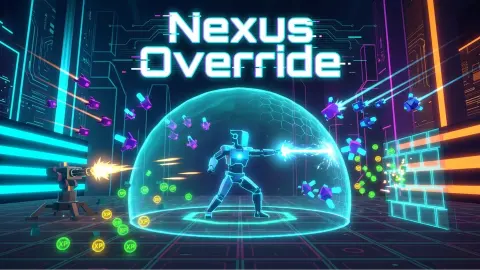
Most games of this shape hand you a weapon and spend the next five minutes asking whether you can aim it. Nexus Override takes the trigger away before the first enemy arrives. The gun fires by itself, at whatever is closest, from the first second to the last, and the tutorial says so flatly under the word AUTO-ATTACK. You are not a marksman. You are a thing that shoots, and the only question is where that thing is standing.
Everything the game asks of you follows from that. A ring of light sits on the floor around your core and marks how far the gun reaches, so picking a target means walking until something is inside the ring. Enemies leave two things behind when they break: green orbs that are experience, and small coins the game calls Bits. Bits are spent during the fight, not after it, on the two structures along the bottom of the screen — a wall for ten and a turret for twenty-five.
The other half is the level-up. Enough orbs and the arena freezes, three cards slide in, and you take one. At level two ours read Speed Boost, Triple Shot and Cyber Vampirism; at level three the game dealt a different three, which is how you learn the pool is bigger than one screen of it.
EvoLabX made it, and it was published on 17 August 2026. We played it on 24 October. The objective says survive five minutes; we managed a little over ninety seconds of them, reached level three, and went out on a screen that reads SYSTEM COMPROMISED.
The skill is standing in the right place
Take away aiming and reloading and what is left is geometry. Your core is a fixed turret that happens to walk, so a crowd in front of you is being shot at and a crowd behind you is not. The ring on the floor is the whole interface: inside it, things die; outside it, they close in.
That makes the three cards matter in a way they would not elsewhere. Speed Boost is not a convenience here, it is the difference between outrunning a wave and being caught by it. Triple Shot widens the cone, so the ring stops being a circle you must centre yourself in and starts being an arc you can sweep.
It also explains why the walls and turrets exist at all. You cannot shoot in two directions, so you buy a second direction. A turret keeps firing at the spot where you left it while you go and stand somewhere else — the one thing a game without a trigger cannot otherwise give you.
Three currencies, and only one of them survives the run
The status panel in the corner names them in the game's own joke vocabulary. Health is core integrity. Experience is a buffer uplink. Bits sit under the heading revenue, and the enemy count under viruses.
XP is the fast one. Orbs are everywhere, levels come quickly, and the ladder steepens as you climb: a hundred points for the second level, two hundred for the third, three hundred for the fourth. Each one resets the bar to zero and hands you a card.
Bits are the slow one, and they do not carry over. They exist to be spent in the next forty seconds, on a wall or a turret, in the place where you are about to be in trouble.
Credits are the ones that outlive the run. The sector map promises three hundred of them as an uplink bounty for taking Sector 01, and even the screen that killed us paid out fifty for having reached level three. According to the game's own description, that is the money you spend between runs on permanent upgrades and on other characters — which makes a failed run less of a waste than it looks while it is happening.
Six sectors, five of them locked
The map that opens the game is a honeycomb of six hexagons, and five wear a padlock. Only SEC-01 OUTPOST is lit. Select it and a panel on the right reads like a mission file: a tactical log that tells you to breach the outer perimeter firewall, a note that the system's defence protocols are still booting, and the words basic difficulty.
Under that sits the detail worth reading before anything else. Four figures — sweep speed, defence health, defence damage and data reward — all sit at times one. Sector 01 is not an easy sector. It is the unit of measurement, the one everything later is a multiple of, and the last line in that column is the one that makes the rest bearable: the reward scales with the difficulty.
The game's description says each of the six ends in a boss. We never saw the end of the first one, so take that as the game's claim rather than ours.
The death screen is a joke about three different computers
Lose and the game does not show you a results table. It crashes, on purpose, and the crash is the most carefully written thing in it.
A red log fills the screen behind a panel headed KERNEL CRASH. The timestamps down the left margin — in brackets, counting seconds from zero — are the format a Linux machine uses while it boots. Four lines down comes *** STOP: 0x000000F4, which is not Linux at all: that is a Windows blue screen, and Microsoft's own documentation gives that number a name, CRITICAL_OBJECT_TERMINATION. It means a process the system could not run without has ended. The first value in brackets after it, a three, is the number Microsoft lists for process rather than thread.
Then, halfway down, a Java stack trace: an exception in thread "main", thrown inside a class called com.nexus.core.AIConsciousness.
Three unrelated machines, three unrelated error cultures, stacked into one screen that is supposed to be a single dying computer. Whoever wrote it knew exactly what each line meant, because the Windows code they picked is the one that literally says something that had to stay alive did not — which is, word for word, the thing that just happened to you.
The panel over it is blunter. It names the cause, counts the Credits you earned, and gives you two buttons: REBOOT CORE, and WATCH AD TO REVIVE. That revive was the only advert the game put in front of us in the whole session. Nothing interrupted the fight itself.
What we have not seen
Ninety seconds is a short acquaintance. We never reached the end of a five-minute timer, so we have met no boss and unlocked no second sector. We never saved twenty-five Bits for a turret, never unlocked the dash that the control list hangs on the space bar, and never opened the two-player co-op. The game is listed for desktop only, and with every control on a key that tracks: there is no thumb layout hiding anywhere.
More games like this one
Farm Defenders is the closest relative in our catalogue — a last-stand survival shooter where what you grow by day pays for what you build by night. Yenemy scales the same idea up into base building and castle defence, while Cube Shooter keeps the neon geometry and gives the shooting back to you. Space Strike: Galaxy Shooter is the arcade version of holding a line against waves, and if it is the second controller you came for, 2 Player Games Mini Games splits one keyboard between two people across a whole set of them. The rest live under action games.
Screenshots
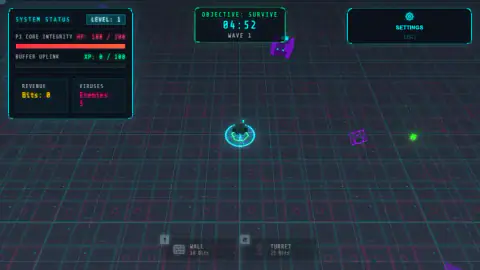
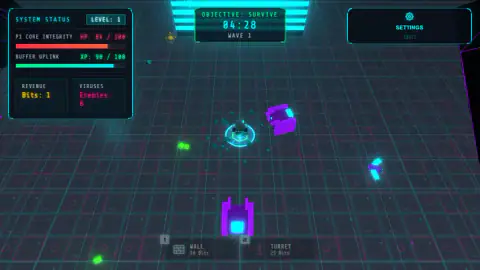
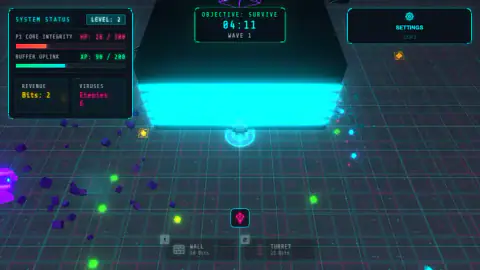
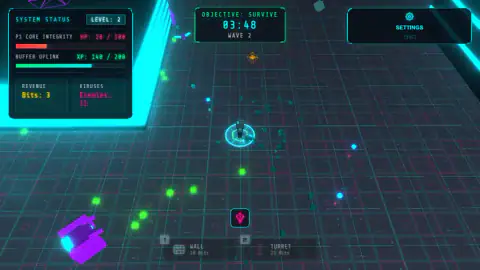
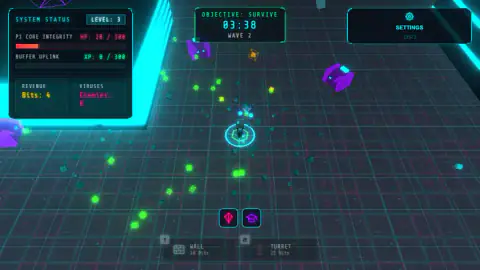
Taken by opening the game ourselves and letting it run — not supplied by the publisher, and not the same picture every other site shows.
How to play Nexus Override
- On the Mainframe Sector Map, take Sector 01: Firewall Outpost — it is the only one open — and press INITIALIZE BREACH.
- Move with WASD. The camera follows you by itself, and there is nothing to aim.
- Walk over the green orbs. They are XP, and each level you gain pauses the fight and offers three upgrade cards.
- Press 1 for a wall or 2 for a turret. Both are planted where you are standing, and both are paid for in Bits.
- Keep your core alive until the countdown runs out. The bar marked P1 CORE INTEGRITY is your health.
What the tutorial does not tell you:
- The clock does not start during the tutorial. It still reads 05:00 on the second card and on the fifth, so there is no cost to reading all eight of them.
- Health only goes down. Ours fell from full to eighty-four, then fifty-nine, forty-three, twenty-eight, twenty, four. Nothing on the floor heals you. The only repair we saw was an upgrade card.
- Bits arrive far slower than danger. We had four of them by level three, which puts the turret out of reach early. Plan for the wall first.
- The crowd grows inside a wave, not just between waves. The enemy counter read five soon after the first wave began and twenty-one by the end of the second.
- Settings is on Esc, and it is the only button on screen while a wave runs. Everything else is a key.
Controls
| WASD | Move your core around the arena; the camera follows on its own |
|---|---|
| Arrow keys | Move the second player, in the game's two-player co-op mode |
| 1 | Build a wall where you are standing, for 10 Bits |
| 2 | Deploy a turret where you are standing, for 25 Bits |
| Space | Dash, once you have unlocked it through an upgrade |
| Esc | Open Settings, which is the only button on screen while a wave runs |
Features
- Your weapon has no trigger: it fires by itself at whatever comes close, so the whole game is movement
- Each sector is one five-minute countdown, split into waves that arrive while the clock runs
- Two things to build, priced apart: a wall costs 10 Bits and a turret 25, and enemies are the only source of either
- Levelling up pauses the arena and offers three upgrade cards, one of which is the only way we found to get health back
- Each level is dearer than the last: 100 XP to reach level 2, then 200, then 300
- Six sectors on a map with only the first unlocked, each one multiplying enemy speed, health, damage and payout
- A losing run pays Credits anyway, counted from the level you reached
Game details
- Developer
- EvoLabX
- Release date
- August 2026
- Last updated
- August 18, 2026
- Added here
- July 2026
- Technology
- HTML5 (3D)
- Platforms
- Browser (desktop, keyboard)
- Classification
- 3D , Action , Multiplayer , Strategy
- Saved progress
- Saving, when available, is managed by this game. Mava cannot confirm your level.
FAQ
How do you play Nexus Override?
You pick a sector on the map, press INITIALIZE BREACH and then survive a five-minute countdown against waves of enemies. You move with WASD and nothing else: the weapon fires on its own at whatever is nearest. Enemies drop green orbs that are XP and small coins called Bits, which pay for a wall at 10 or a turret at 25, built where you stand with keys 1 and 2.
Do you have to aim in Nexus Override?
No. The tutorial calls it auto-attack and the game's own control list ends by saying shooting is automatic, so there is no fire button and no crosshair. A ring of light around your core shows how far the gun reaches. Choosing what it shoots means walking until the right thing is inside that ring.
What are Bits for in Nexus Override?
Bits are the currency enemies drop during a run, and they buy the two structures along the bottom of the screen: a wall for 10 Bits on key 1, a turret for 25 on key 2. They come in slowly. We were still on four Bits by the time we reached level three, so the wall is the realistic first purchase and the turret is something you save for.
What upgrades can you pick in Nexus Override?
Every level-up stops the arena and deals three cards. The level two draw offered Speed Boost, worth ten per cent more movement speed, Triple Shot, which fires three projectiles in a spread cone, and Cyber Vampirism, which restores forty health and raises the maximum. Level three dealt a different three, so the cards are drawn from a larger pool than the one you see.
How many sectors does Nexus Override have?
The Mainframe Sector Map shows six hexagons, of which only Sector 01, Firewall Outpost, is open; the other five are marked LOCKED. Sector 01 lists every difficulty figure at times one, so it is the yardstick the rest are measured against, and its tactical log calls it basic difficulty. The game's description says each sector ends in a boss fight, which we have not reached.
Can two people play Nexus Override on one keyboard?
The game offers a two-player co-op mode and gives the second player the arrow keys, with the first on WASD. We played alone and have not tried it, so we cannot say whether the five-minute objective or the enemy count changes with a second core on the grid.
Can you play Nexus Override on a phone?
Not as it stands. The game is listed for desktop only, and every control is a key: WASD to move, 1 and 2 to build, Space to dash. There are no on-screen buttons for a thumb, so a keyboard is not optional here.
Who made Nexus Override?
The game is credited to EvoLabX. Nexus Override was published on 17 August 2026.