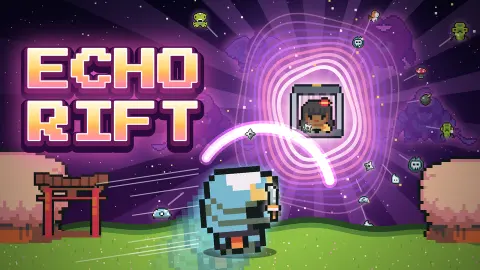







About Echo Rift
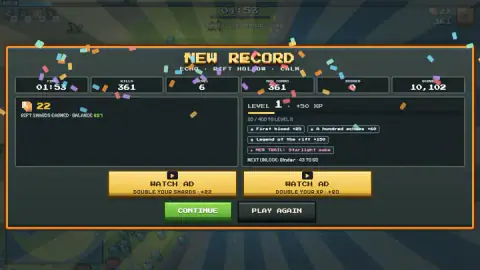
The card that ended our best run printed the same number twice. 361 kills. Maximum combo: 361. Six boxes across a run-end screen, and two of them had quietly agreed that for one minute and fifty-three seconds the chain never broke, not once.
That is the measurement Echo Rift cares about, and not the one these games usually take: the clock is there, counting up, but the figure in the bigger box is how long you kept killing without a gap.
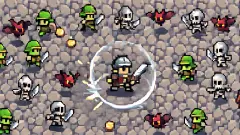
The way it gets there is to take your hands off the weapons. You move — WASD, the arrows, a drag on a phone — and that is all you do during a fight. Shuriken, scrolls, whatever you have picked up, they fire by themselves at whatever is closest. There is no attack button, which sounds like it should make the game play itself, and instead moves the whole difficulty into where you stand.
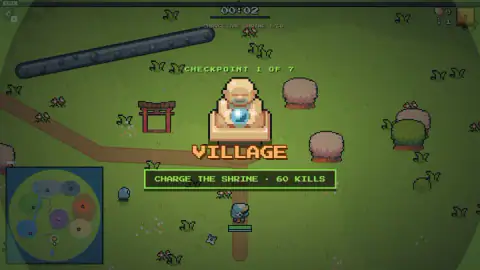
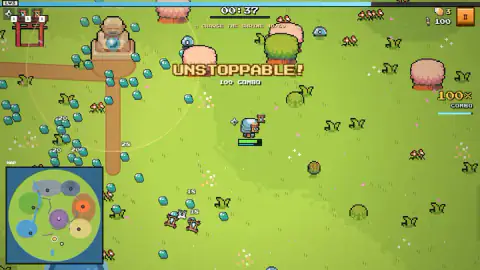
One run is not a wave counter either. It is an island, and the island is seven checkpoints, each a named place with its own job. The first is a village with a stone statue in it, and the job is written on a green banner: CHARGE THE SHRINE · 60 KILLS.
Kills and combo are the same number until you stop for a second
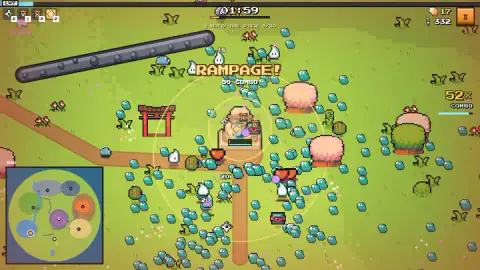
The combo counter sits on the right of the screen in gold, over a pale blue bar that drains. The bar is the time you have left to find another target. Kill something and it refills; wander, and it empties and the counter goes back to nothing.
The game marks the round numbers across the middle of the screen — "RAMPAGE!" at fifty, "UNSTOPPABLE!" at a hundred. Neither banner stops the fight, which is right: the one thing you must not do mid-chain is stand still and read.
Here is why it is the heart of the game. In the run that set our record, kills and maximum combo were the same figure. In the next run they were not: three hundred and thirty-seven kills, best chain two hundred and eighty. Same island, same difficulty, a worse score by three thousand points — and all the card reports is that somewhere in the middle there was nothing in range for a second or two.
Every level-up stops the game and sells you a recipe
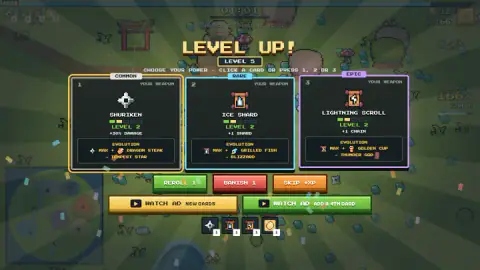
The level-up screen is the one place the action halts completely: the word in yellow, your new level in a box under it, and a line of instructions — choose your power, click a card or press 1, 2 or 3.
Three cards appear, each wearing a ribbon that says how rare it is: COMMON in grey, RARE in blue, EPIC in purple. Under the name sit five pips, the card's ceiling, and one line of what the next level does — thirty per cent more damage for a shuriken, one more chain for a lightning scroll.
Then the part worth more than any of those numbers. Each card carries a box headed EVOLUTION with a recipe in it, in the plainest form imaginable — this card at maximum, plus a named item, becomes something else. A maxed shuriken and a dragon steak become a tempest star. An ice shard and a grilled fish become a blizzard. A lightning scroll and a golden cup become a thunder god.
Because that recipe is printed the first time a card is offered, the game has handed you its whole plan at level two. You are not picking the best of three effects; you are picking which of three recipes you mean to finish. Underneath sit the ways out — a reroll, a banish, and a skip that turns the choice into experience.
Seven checkpoints, and a pair of doors between them
The green line above the first statue reads CHECKPOINT 1 OF 7, and the round minimap in the corner backs it up: seven coloured patches on one island, joined by a dotted route, your position ringed. This is not a map that fills in as you go. It is the whole trip, shown before you take a step.
Checkpoint one is the village and its sixty kills. Checkpoint two is a stone on a wooden jetty, titled LAKESIDE PIER, and the job changes shape entirely: hold the pier for thirty seconds, standing inside a ring. The counter at the top keeps the same format for both, which is why one reads as the other: in the village it counts bodies, on the pier it counts seconds.
Between them the rift makes an offer. The screen goes dark pink, a banner reads that the rift offers a deal, and two doors open with ribbons on them: one RISK, one SAFE. One pair put triple spawns for forty-five seconds, every kill paying a shard, against a golden tanuki that turns up and heals you. Another put thirty per cent more damage for the rest of the run, minus maximum health, against more health and a full heal.
Press 1 or 2. The clock does not wait, and the hero does not retreat anywhere safe while you think about it.
The statue you are charging is a roadside guardian
Look at what is standing in that first clearing. A seated stone figure, bald, eyes closed, a bib across its chest, holding a round glowing jewel in both hands. To its left, a red gateway: two uprights, a crossbeam, nothing to close.
Both are real objects, and both do a job in Japan that the game has quietly copied. The gateway is a torii, and it marks a boundary — walk under one and you have left ordinary ground for a shrine's ground. The figure is drawn the way Japan draws Jizō, a guardian whose stone statues stand at roadsides, crossroads and village edges, and who is understood to look after travellers and children. People dress them, and the bib is the thing real ones are given, usually in red, by someone who wanted a child looked after.
The jewel matters too. Jizō is described holding a wish-granting jewel that gives out its own light, which is what the pixel artist has put in the statue's hands, glowing pale blue in a green field. A Shinto gateway and a Buddhist figure sharing one clearing is no mistake either: the two traditions shared their sites for most of Japanese history, and by the road in the countryside the old mixture is still what you find.
Which leaves the design looking deliberate. The thing you have to charge, with a ring of light on the grass around it, is a guardian of people in the middle of going somewhere. You feed it kills, it lets you move on, and the next checkpoint is further along the road.
What we never reached
Honest inventory. Both of our run-end cards read BOSSES 0, and the furthest we got was the second of seven checkpoints, so everything past the pier is the game's own description talking rather than us. It promises ten islands, forty tasks, twelve bosses, ten heroes, a Boss Rush and an Endless mode, and a story about following someone named Kaede through the rift. We saw one island, Rift Hollow, at one difficulty, Calm. One tab in the menu carries a padlock we never opened, and we played on a computer, so the touch controls are the listing's claim rather than our experience.
What we can vouch for is the shape. A run is short, legible, and ends with a card that tells you in six figures which part of it you were bad at.
More runs to lose
If the appeal here is a top-down fight you steer rather than aim, Archer: Trial by Fate works through rooms of monsters with its own stack of abilities, and Undercrown runs a short trip down three floors with a different hero each time. Blade & Bedlam keeps the survive-as-long-as-you-can clock but hands the weapon back to you, and Space Survivor swaps the grass for open space. The rest are in adventure games.
Screenshots
How to play Echo Rift
- Press PLAY on the island card. The opening checkpoint names itself, states its task and waits for a tap or the space bar.
- Walk the hero with WASD or the arrow keys. Your weapons fire on their own, so your job is placement: close enough to be shooting, far enough not to be surrounded.
- Do the task the checkpoint banner names. Its counter sits at the top of the screen under the clock.
- When the screen freezes and reads "LEVEL UP!", take one of the three cards with a click or with 1, 2 or 3.
- Pick a door when the rift offers a deal, and keep going until the island runs out or you do.
What only sitting in front of it teaches:
- Kills only count inside the ring. The shrine draws a circle of light on the grass and the checkpoint card spells the rule out — defeat the creatures inside the glowing ring. Chase a straggler out of it and the kill is wasted.
- A hold pauses, it does not reset. The pier asks for thirty seconds inside a ring, and the card promises that leaving only stops the count. Stepping out to breathe costs time and nothing else.
- The clock keeps running while the doors are open. On both deal screens, the figure beside the prompt matched the run clock behind it. Reading the small print is not free.
Controls
| WASD or the arrow keys | Moves the hero. There is no attack key — every weapon you carry fires on its own while you walk |
|---|---|
| 1, 2 or 3 | Picks the matching card on the level-up screen. The screen prints the instruction itself; a fourth card appears only if you take the advert that offers one |
| A click or a tap on a card | The same choice with a mouse or a finger |
| Space | Dismisses a checkpoint card and carries on. The game's listing also gives it, and Shift, as the dash |
| R | Rerolls the three cards on offer, per the game's listing. The level-up screen also carries a REROLL button with the number of rerolls left on it |
| P or Esc, or the pause button in the top corner | Pauses the run. The panel that opens names the island, the difficulty, the clock and your level, and offers RESUME or QUIT RUN |
| Drag anywhere | Moves the hero on a touchscreen, per the game's own listing. We played with a keyboard |
Features
- Your weapons attack by themselves: the only thing your hands do is walk the hero out of trouble and pick a card every level
- One island is seven checkpoints, each a named place with its own job — charge a shrine with 60 kills, hold a pier for 30 seconds
- Kills only count inside the ring of light drawn around the objective, and stepping out of a hold pauses the count rather than resetting it
- The combo counter is simply your unbroken kill chain, and the game shouts at round numbers: RAMPAGE at 50, UNSTOPPABLE at 100
- Cards come ribboned common, rare or epic, cap at five levels, and each one prints the recipe that evolves it — a maxed shuriken plus a dragon steak becomes a tempest star
- Between checkpoints the rift offers two doors, one marked RISK and one marked SAFE, and the run clock keeps counting while you decide
- The run-end card gives six figures at once, including the longest chain you held and a score built out of both
Game details
- Developer
- Partner studio
- Release date
- October 2026
- Last updated
- October 25, 2026
- Added here
- October 2026
- Technology
- HTML5 (2D)
- Platforms
- Browser (desktop), Browser (mobile & tablet, touch)
- Classification
- Adventure
- Saved progress
- Saving, when available, is managed by this game. Mava cannot confirm your level.
FAQ
How do you play Echo Rift?
You move with WASD, the arrow keys or a drag on a touchscreen, and that is the whole of the input during a fight. Your weapons fire on their own at whatever is nearest, so surviving is a matter of walking enemies into your own fire without being surrounded. Every time you level up the game freezes and offers three cards, and you pick one with a click or with the 1, 2 and 3 keys.
How do you charge the shrine in Echo Rift?
By killing sixty creatures inside the ring of light around the statue, which is the part people miss. The card that opens the checkpoint says so in one line — defeat sixty creatures inside the glowing ring around the shrine — and kills outside that circle do not move the counter. The practical consequence is that you fight in a small circle rather than running away across the field.
What does the combo counter do in Echo Rift?
It counts your kills without a break, and a pale blue bar underneath it is the time you have left to add another one. The game marks round numbers with a banner across the screen — RAMPAGE at fifty, UNSTOPPABLE at a hundred. Our best run finished with three hundred and sixty-one kills and a maximum combo of three hundred and sixty-one, which is to say the chain never broke once in nearly two minutes.
How do card evolutions work in Echo Rift?
Every weapon card carries five level pips and a box at the bottom with its recipe in it. A shuriken taken to maximum plus a dragon steak becomes a tempest star; an ice shard plus a grilled fish becomes a blizzard; a lightning scroll plus a golden cup becomes a thunder god. The recipe is printed on the card from the first time it is offered, so the choice at level two already tells you what it is worth at level five.
What are the two doors in Echo Rift?
When a checkpoint is finished the screen fills with a panel reading that the rift offers a deal, and two doors appear, one ribboned RISK and one ribboned SAFE. One pair we were shown traded triple spawns for forty-five seconds, with every kill paying a shard, against a golden tanuki that simply heals you. Another traded thirty per cent more damage for the rest of the run, at the cost of maximum health, against extra health and a full heal.
How long does a run last in Echo Rift?
There is no fixed length — the clock counts up, and it stops when you do. Our two recorded runs ended at one minute fifty-three and at two minutes flat, both of them deaths rather than finishes, with seven checkpoints on the island and only two of them seen. When you fall the game offers one revival per run in exchange for an advert, and declining it ends the run there.
Are there ads in Echo Rift?
Yes, and they are offered rather than forced in everything we saw. The level-up screen carries two of them, one for a fresh set of cards and one for a fourth card to choose from; the death screen offers a revival with full health; the run-end card offers to double the shards and the experience you just earned. We declined every one of them and the game carried on without complaint.
Is Echo Rift free, and who made it?
It is free and runs in a browser with nothing to install. The studio behind it is not recorded anywhere we can check, so this sheet names no author rather than guessing one. It reached our catalogue on 24 October 2026, which makes it days old at the time of writing rather than something from the back catalogue.