

About Swerve Rush
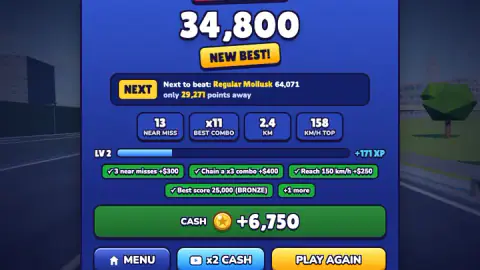
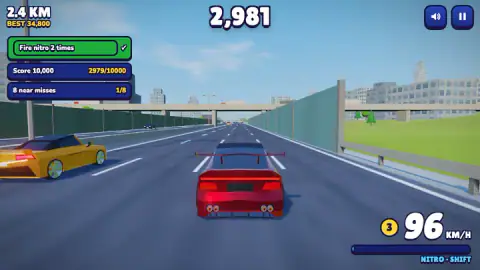
Two of our runs covered the same 2.4 kilometres of motorway. One finished on 2,981 points. The other finished on 34,800. Distance, in other words, is very nearly worthless here, and both figures sit on screenshots on this page.
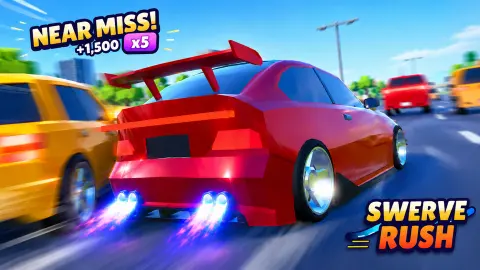
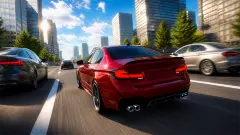
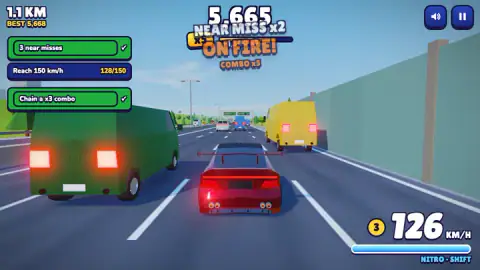
What the game pays for is the gap you leave. You sit behind a red saloon on a four-lane highway where the traffic runs your way, the car rolls forward whether you ask it to or not, and the only driving you do is sideways. Slide past a van close enough to touch it and the words NEAR MISS stamp themselves across the middle of the screen with a figure attached — one of ours read "+300". Do it again before the slim bar under your score runs out and the passes begin to stack: a yellow pill counts the chain, the word "ON FIRE!" lands over the windscreen, and the per-pass payout climbs with it.
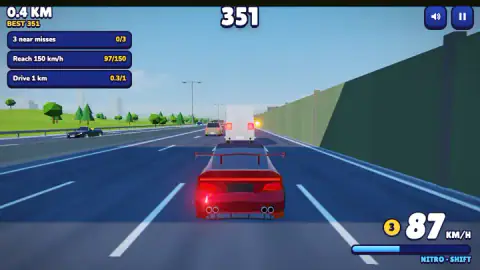
Three blue pills in the top-left corner are what you are actually chasing. They are the run's live missions, they change as you level up, and ours went from 3 near misses, Reach 150 km/h and Drive 1 km to Fire nitro 2 times, Score 10,000 and 8 near misses. Clear all three in one run and the game stops the car with MISSION COMPLETE instead of a crash.
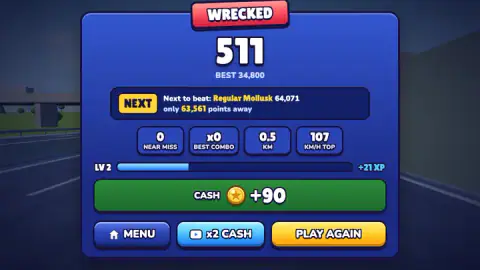
One thing before the rest. Our best attempt was that 34,800-point run, and most of the others ended inside the first kilometre — one of the cards here records a wreck at half a kilometre. We never opened the shop, the garage or the tuning screen, never bought an upgrade or a second car, and never pressed the button with a video icon on it.
Thirteen near misses beat two kilometres of clean driving
Put the two end cards side by side and the scoring system falls out of them. The run that scored 34,800 logged thirteen near misses and a best chain of eleven. The one that wrecked at half a kilometre logged neither.
The chain is the engine, not the near miss on its own. A single pass announced itself to us as "+300", which at thirteen passes would be a few thousand points and nothing like a record. The multiplier is what closes that gap, because it applies to the passes that follow it, and the card from our best run put the peak of ours at eleven.
That also explains why the same 2.4 kilometres can be worth 2,981 points on one run and twelve times that on another. The card records your distance, your top speed, your near misses and your best chain, and only the last two move the number at the top. A cautious lap of the motorway is therefore a wasted one: holding the middle of an empty lane will carry you a long way and score you almost nothing.
The three missions change every run, and they are what opens new road
The pills in the corner are not decoration. On the card at the end of a run they reappear as green chips with prices on them, and in our best run they came to nine hundred and fifty dollars between them — a tenth of what that card paid in total, for three things you were going to try anyway.
Against a bad run it is the entire game. A wreck worth a few hundred points pays double figures, so one cleared mission beats several whole runs of honest driving. Short of cash, the efficient play is not a longer run but a run shaped around whichever pill looks closest.
Clearing all three at once does something separate. Our screen went to MISSION COMPLETE, then YOU WIN, then a gold LEVEL UP panel paying three hundred in coins and two new items; the next one unlocked a stretch of road called Metro Expressway. The road we were on announced itself with a banner reading "NOW ENTERING GREENWAY HILLS", and a green gantry overhead counts down the kilometres to Harbor City and Sunvale, neither of which we reached.
A near miss is a real term, and the gap it erases has a number
Outside the game, a near miss is not a compliment. It is the word road-safety and workplace reporting use for the incident that almost happened — the one with no damage, no injury and no paperwork beyond the log. They get logged precisely because they arrive before the crashes do, which makes them the cheapest warning a road ever gives you.
The gap they erase is easy to put a number on. At a hundred and fifty kilometres an hour a car covers about forty-two metres every second. The familiar two-second rule asks you to keep twice that much clear road ahead of you, because the first of those seconds disappears into noticing the problem and the rest into stopping.
Swerve Rush takes that distance and pays you to delete it. Its mission list asked us for eight near misses in a single run, each one a pass with no measurable gap at all, and shaving the margin finer buys a bigger multiplier. That is the exact inversion of the only rule that matters at that speed — and at the top speed our best run touched, the margin between a pass that pays and a pass that ends the run is about a tenth of a second. Most of our attempts died in the first kilometre for precisely that reason.
What a run pays, and the one button with a video on it
The cash is simpler than it looks, and it does follow the score. Divide the score by six and round up, and you have what the run itself paid: our best card's 34,800 points came out as 5,800 before bounties. The wreck card proves the same rate at the other end, turning 511 points into ninety dollars.
Add the bounties back and the figure on the green button matches to the dollar. There is no hidden rate to learn, and no reason to grind the driving when the missions pay better.
Every card also names one specific player above you, with the shortfall spelled out — ours read Regular Mollusk 64,071, only 29,271 points away after the best run, and only 63,561 points away after the wreck. Whatever those names are, the arithmetic is yours to check, and it leaves even a bad run ending on a number you could chase.
The rest of what the game offers is the game's word rather than ours. Its own description promises fourteen cars from hot hatch to hypercar, upgrade lines for engine, nitro, handling and brakes, a garage for resprays and tuning, daily and weekly challenges, and a global leaderboard. The x2 CASH button on the end card carries a small video icon and offers to double a run's payout; we left it alone. We never opened a single menu screen, so take that list as the game's claim and this page as the first two kilometres.
More traffic, more motorway
If the near-miss bonus is the part that hooked you, Turbo Racer Extreme builds its entire score out of the same idea — the closer you shave the pass, the more it pays — and Traffic Racer 3D runs the endless-highway version with a garage to spend the coins in. Driver Club: Highway Racing swaps the arcade combo for straight overtaking across changing scenery, and Crash Skill Racing puts the same weaving into dense city traffic. The rest are in driving games.
Screenshots
How to play Swerve Rush
- Press PLAY on the menu. The car sets off by itself, so there is nothing to do about getting moving.
- Steer across the lanes with the left and right arrow keys, or A and D. That is the whole of the driving.
- Aim to pass traffic through the gap rather than around it. Every pass the game counts prints NEAR MISS, adds points and feeds the nitro.
- Fire a nitro charge with Shift when you want speed the accelerator will not give you. The screen tells you so itself: "NITRO · SHIFT" sits under the bar in the bottom-right corner.
- Read the three mission pills before you worry about the score. Clearing them is both the fastest money and the only thing that opens new road.
What only sitting in front of it teaches:
- The accelerator has a ceiling and nitro does not. Holding the gas parked us at about 97 km/h for stretches at a time, with the Reach 150 km/h pill frozen at the same ninety-seven. One nitro charge put us past it in seconds.
- The yellow circle beside the speed is a count, not a percentage. It held charges — three, then four — while the bar beneath filled towards the next one. Near misses are what fill it, so the scoring and the speed goals point the same way.
- Two at once count twice. Threading between a dark green van and a yellow one printed "NEAR MISS x2", which is the cheapest way to start a chain when the lanes cooperate.
- The traffic is not what kills you; the steering is. At speed a flick of the wheel meant for the next lane arrives in the one after it, and there is no recovering from that.
- Pausing is free. The panel is headed PAUSED and offers RESUME, SETTINGS and END RUN. Nothing is lost while you look at it.
Controls
| Left and right arrows | Move the car across the lanes. This is the only steering there is, and it is what we used all session |
|---|---|
| A and D | The same lane change, per the game's own listed controls |
| Up arrow or W | Accelerate. The car already rolls forward on its own, so this is for closing on traffic rather than for starting |
| Down arrow or S | Brake, per the game's listed controls |
| Shift | Fires one charge of nitro. The screen prints the binding itself, as NITRO · SHIFT under the bar in the bottom-right corner |
| The pause button, top right | Opens a panel headed PAUSED with RESUME, SETTINGS and END RUN. Nothing is lost while it is open |
| Thumb, on-screen LEFT and RIGHT buttons or tilt | The touchscreen options, per the game's own listing, where the car accelerates by itself. We played with a keyboard, so this is the listing's claim rather than ours |
Features
- Distance is worth almost nothing: two of our runs both covered 2.4 km, one scoring 2,981 points and the other 34,800
- Passing a vehicle close enough to touch prints NEAR MISS on screen with a figure attached — one of ours read plus three hundred
- Chaining those passes stacks a multiplier under the score, and the card from our best run recorded a best chain of eleven
- Three live missions sit in the top-left corner and change from run to run: ours ran from 3 near misses and Drive 1 km to Fire nitro 2 times and 8 near misses
- Each mission pays a flat bounty on the end card, and the three we cleared came to nine hundred and fifty dollars between them
- Cash from the run itself is the score divided by six, rounded up to the nearest ten, which makes the bounties the part worth chasing
- Every end card names one player ahead of you and the exact gap, so the target is never vague: ours read Regular Mollusk 64,071, only 29,271 points away
Game details
- Developer
- Partner studio
- Release date
- October 2026
- Last updated
- October 25, 2026
- Added here
- October 2026
- Technology
- HTML5 (3D)
- Platforms
- Browser (desktop), Browser (mobile & tablet, touch)
- Classification
- Driving
- Saved progress
- Saving, when available, is managed by this game. Mava cannot confirm your level.
FAQ
How do you play Swerve Rush?
You drive a red saloon down a multi-lane motorway that carries traffic in your own direction, and the car rolls forward without being told to. All you do is move left and right between the lanes with the arrow keys or A and D. Points come from passing other vehicles as closely as you dare rather than from covering ground, and a single clumsy flick of the wheel at speed ends the run on the spot.
What is a near miss in Swerve Rush and how much is it worth?
A near miss is a pass close enough that the game announces it, printing NEAR MISS over the middle of the screen with a points figure beside it. One of ours read plus three hundred. Passing two vehicles at once counts twice and prints NEAR MISS x2, and doing them back to back stacks a multiplier under the score, which is what turns a few hundred points into tens of thousands.
How do you reach 150 km/h in Swerve Rush?
With nitro, not with the accelerator. Holding the gas settled our car at about 97 km/h for stretches at a time, and the mission pill sat frozen at ninety-seven of a hundred and fifty while it did. Firing a nitro charge with Shift pushed us past a hundred and fifty within seconds, and our best run topped out at a hundred and fifty-eight.
How much cash does a run in Swerve Rush pay?
The run itself pays the score divided by six, rounded up to the nearest ten. A run of 34,800 points paid 5,800 that way, and a wreck worth 511 points paid ninety. What changes the total is the missions: each one you clear adds a flat bounty to the card, and the three we cleared in our best run added nine hundred and fifty dollars on top of the driving.
Who is Regular Mollusk in Swerve Rush?
Regular Mollusk is the name the game puts on the score immediately above yours, printed on every end card as Next to beat, with the exact number of points you are short. Ours sat on 64,071 for the whole session. The names read like generated handles rather than real players, and the game never claims otherwise, but the gap it prints is arithmetic you can check against your own score.
Does Swerve Rush have ads?
The one button we saw carrying a video icon is x2 CASH, which sits on the end card between MENU and PLAY AGAIN and offers to double the run's payout. It is an offer rather than an interruption, and you can simply press PLAY AGAIN instead. We never pressed it, so we cannot tell you what it plays or how long it runs.
Can you play Swerve Rush on a phone?
The game lists touch controls, and says that on a phone the car accelerates by itself while you steer with your left thumb, with on-screen LEFT and RIGHT buttons or tilt steering available in the settings. There is also a NITRO button in place of the Shift key. We played with a keyboard, so that is the game's own account of the phone version rather than ours.
Is Swerve Rush free, and who made it?
It is free and runs in a browser with nothing to install. The studio behind it is not recorded anywhere we can check, so this sheet names no author rather than guessing one. It reached our catalogue on 24 October 2026, which makes it days old at the time of writing rather than a back-catalogue title.