
About Fast and Wild in Sky
A racing game usually tells you how fast you are going twice. Once with a number, and once with the world: kerbs, fences, trees and tarmac grain streaming past the edges of the screen, which is the half of the message your eyes read without being asked. Fast and Wild in Sky keeps the number and throws the world away.
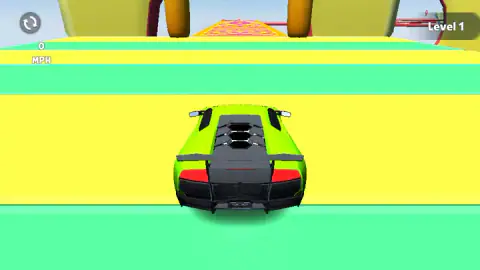
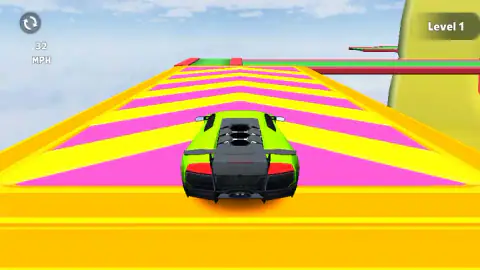
The course is a strip of track hanging in open sky. There is no roadside, because there is no side. Cloud sits at every height on both sides of you, so there is no horizon either, and the surface itself is painted in solid blocks of colour — yellow, green, magenta, red — with no texture, no markings and no kerb. Along the top of the screen there is a restart arrow, a speed readout in miles per hour, and a label telling you which level you are on. That is the whole instrument panel.
Which leaves two things in the entire frame doing the job that a roadside normally does. One is the car's own shadow, hard-edged and directly underneath it, the only thing that says you are on the surface rather than above it. The other is the chevrons painted across the ramps, magenta on yellow, pointing the way up. Once you are moving, they are the only thing streaming past you.
The game is by Ermac Alex and went up at the end of 2024.
Here is where our own account stops, because saying so is cheaper than pretending. We played level one for about four minutes, got the car moving, took it over a striped ramp, and then it stopped on a green shelf and would not start again. What follows is level one, told by someone who did not beat it.
Why a road in the sky is harder to read than a road
This is the part worth taking away, and it is a real thing about eyes rather than a thing about this game.
When you judge the speed of a car, you are mostly not looking at the car. You are using three cues, and none of them is a number. The horizon is fixed, so anything that moves against it tells you how hard you are turning. Texture on the surface packs tighter the further away it gets, and that gradient is how you judge distance down a straight. And whatever is beside the road — posts, hedges, barriers — streams through the corner of your eye, which is how you feel speed rather than read it.
Take all three away and the job gets handed to whatever is left. The sides are sky, so nothing streams. The surface is flat colour, so there is no gradient to pack. The clouds sit at every height, so there is no line where ground meets air.
What is left is the shadow and the painted stripes, which is why they matter more than they look like they should. The shadow works the way a shadow always works: tight under the wheels means you are on the ground, sliding out from under you means you are not. The chevrons are a texture gradient put down in paint, because the surface could not supply one.
The cost shows up in two places you can feel. Braking stops being something you do off the view and becomes something you do off the number, which is slower, because reading a figure is a deliberate act and feeling a hedge go past is not. And a corner has to be judged from its inside edge, because its outside edge is not an edge at all — past the paint there is simply nothing, and nothing has no shape to aim at.
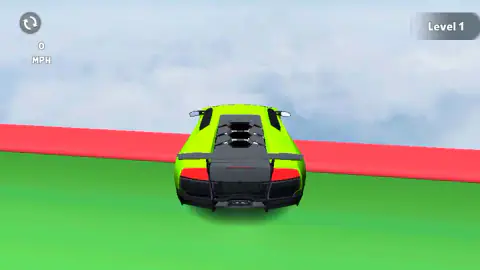
Our third screenshot is the whole argument in one picture. The car is sitting on a plain green surface that ends in a flat red band, with cloud behind it. Look at it and try to decide whether that red is a wall across the road, the deck of a bridge rising away from you, or the lip where the surface stops. We could not tell either, which is why we drove at it.
Ten levels, and a car parked in front of two of them
The level menu is a single panel headed LEVEL with ten numbered buttons in two rows, the first one outlined. The car itself is drawn in the middle of the same panel and sits in front of the bottom row, covering part of two of the buttons, so you aim at a number you can only half see.
That grid tells you more about the design than it looks like it should. A game with a level menu is a game that expects you to fail and come back, and that has decided failing should cost you a click rather than a run. These are ten discrete courses, each restartable from its own button, not a single escalating road with checkpoints in it. It also means the game is finite, and says so up front.
We cannot tell you whether the other nine open from the start or have to be earned, because we spent our whole session on the first one, and we are not going to guess on your behalf.
What level one actually gave us
A broad flat apron to start on, wide enough that the first thing you learn is the car rather than the road. Then a climb paved in magenta chevrons on yellow, steep enough to eat most of the speed you arrive with. Then a narrower green shelf edged in red, with a structure of yellow pillars and red rails standing off to one side — the only sign in the whole level that this track was put together rather than simply drawn.
And then a stop. The readout fell to zero on that shelf and stayed there through accelerating, reversing and steering both ways. Whether the car was caught on the geometry, waiting for an input we never found, or simply out of road, we cannot say, and the game did not offer an opinion. The restart arrow was there the whole time, which in hindsight is the game telling you what it expects.
So: no finish line, no second level, no crash and no reward in our account, because we did not see any of them. What we did see is a course that is easy to look at and surprisingly hard to read, and a speed readout that earns its place for reasons most racing games never need.
More cars, more ramps, more open air
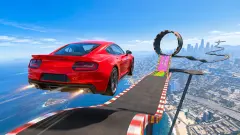
If what you want from this one is the jump rather than the road, GT Cars Mega Ramps and Hyper Cars Ramp Crash are its nearest neighbours in our catalogue: supercars and ramps again, and the second of the two puts the landing back at the centre of things. Turbo Stunt Racing and Car Stunts Driving sit on the racing side of the same shelf, for when you would rather have a course with something beside it. The rest are in driving games.
Screenshots
How to play Fast and Wild in Sky
- Pick a level from the grid. Before you drive, a panel headed LEVEL offers ten numbered buttons in two rows. The first one is outlined when it opens.
- Hold W, not the arrow keys. Our car sat on zero through several long holds of the up arrow and then moved as soon as we held W. The game names only the four letter keys.
- Watch the shadow, not the car. It is the single thing on screen that tells you whether you still have road under you, and it is the first thing to disappear when you do not.
- Read the chevrons. The painted stripes on the ramps are the only moving texture in the game, so how fast they pass you is the only speed cue you get that is not a number.
- Use the restart arrow early. It sits in the top left corner from the first frame of the level. On a track with no scenery, there is no reward for being stubborn in one spot.
What our session taught us:
- Speed arrives fast and leaves faster. From a standing start the readout reached 32 MPH in one push on the flat, and the next climb took it straight back down to nothing. This is a car that accelerates like an arcade car and loses it like a heavy one.
- The colour change is the geometry. Where the paint goes from yellow to green, or from green to red, something about the road has changed. It is the only warning the surface gives, because there is no grain, no shading and no kerb.
- Nothing tells you when you are stuck. We spent most of our session nose-first against a red band with the readout on zero. No message appeared, no failure sound played, and nothing offered to put us back. Accelerating, reversing and steering all produced the same picture.
- An ad came up over the track once, dimming the game rather than replacing it, in roughly four minutes of play.
Controls
| W A S D | Drive. Holding W is what finally got our car moving, and these four keys are the only ones the game's own instructions name |
|---|---|
| Arrow keys | We tried them first and the readout never left zero. They may do nothing, or the level may simply not have been live yet |
| Circular arrow, top left | Restart. It is on screen from the first frame of a level and it never goes away |
| The numbered grid | Picks the course. Ten buttons, with the first one outlined when the menu opens |
| On-screen buttons (touch) | The game is listed for phones and says the vehicle is driven with the buttons drawn on the screen. We played on a desktop keyboard and cannot describe that layout |
Features
- Ten numbered levels chosen from one grid, rather than a single run that keeps going
- A track suspended in open sky, with cloud on both sides, nothing underneath it and no horizon to read
- Flat blocks of colour instead of a road surface: yellow, green, magenta and red, with no texture, markings or kerbs
- A speed readout in MPH, a restart arrow and a level label, and nothing else: no timer, no lap counter, no map, no position
- Painted chevrons on the ramps, which turn out to be the only thing on the track that tells you how fast you are travelling
- A hard shadow under the car, the one cue that says whether you are on the surface or over the edge of it
- Published by Ermac Alex at the end of 2024
Game details
- Developer
- Ermac Alex
- Release date
- December 2024
- Added here
- April 2025
- Technology
- HTML5 (WebGL)
- Platforms
- Browser (desktop), Browser (mobile & tablet, touch)
- Classification
- Driving
- Saved progress
- Saving, when available, is managed by this game. Mava cannot confirm your level.
FAQ
What is Fast and Wild in Sky?
It is a browser driving game in which the course is a strip of track floating in open sky. You pick one of ten numbered levels, you get a car, a speed readout in miles per hour and a restart button, and you drive the strip. There is no scenery beside the road and nothing under it, because the sky is the setting rather than a backdrop.
How do you control the car in Fast and Wild in Sky?
With W, A, S and D on a keyboard. In our session the car stayed on zero through several attempts with the arrow keys and then moved the moment we held W, so if nothing is happening, try the letter keys before you assume the game is broken. On a phone or tablet the vehicle is driven with buttons drawn on the screen.
How many levels does Fast and Wild in Sky have?
Ten. They are laid out as a single grid of numbered buttons that appears before you drive, with the first one outlined when the menu opens. We only played level one, so we cannot tell you whether the other nine are open from the start or have to be unlocked in order.
Is there a timer or a lap counter?
No. The only things on screen while you drive are the speed in miles per hour in the top left, a circular restart arrow above it, and a label in the top right naming the level you are on. There is no clock, no lap count, no minimap and no position against other drivers.
What is underneath the track?
Nothing you can see. Both sides of the course open onto cloud, and there is no ground plane and no horizon line anywhere in the picture. We never went over an edge during our session, so we cannot tell you what the game does when you do.
Who made Fast and Wild in Sky and when?
The game went up at the end of December 2024. We have not found a studio site or any other game we can confidently attribute to the same hands.
Does Fast and Wild in Sky have ads?
Yes. One came up over the track during our session, as an overlay that dims the game rather than replacing it. It was a single interruption in roughly four minutes of play, which is modest by the standards of free browser games, but one session is too small a sample to promise you a rate.
Did you finish the game?
No, and we would rather say so. We got the car moving, took it over a striped ramp at thirty-two miles per hour, and then it came to rest on a green shelf that ends in a flat red band. From there the readout stayed on zero through everything we tried. Everything on this page is what level one showed us.