


About Traffic Craft Rider
Most games that drop you into traffic are secretly games about time. Sixty seconds, or a near-miss bonus for shaving past a bumper, and the ground you cover is a by-product of doing well at something else. This one keeps one number in the corner while you ride, and that number is a distance: miles, to two decimal places, starting at 0.00. Nothing anywhere on it counts seconds.
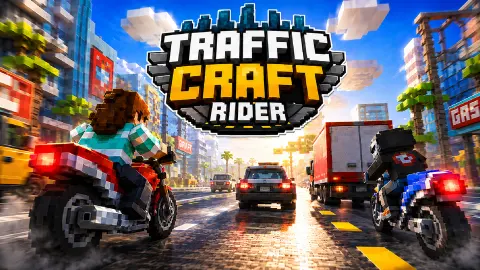
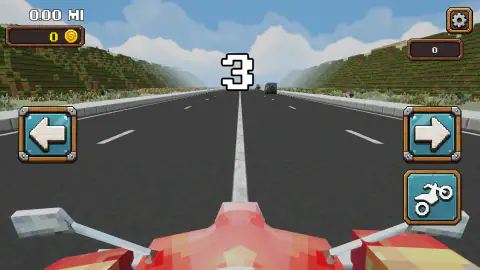
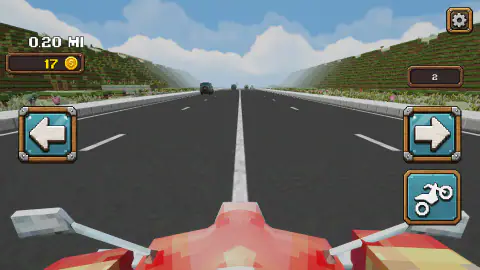
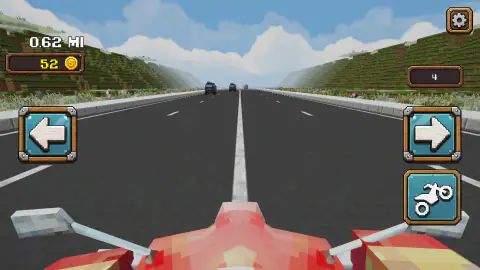
You sit on the handlebars of a red motorbike built out of cubes, two chrome mirrors in the bottom corners of your view, looking down a four-lane road: a solid white line down the middle, a dashed line either side of it, cube hillsides running past in green and in sandstone. Every vehicle ahead is going the same way you are, and you are quicker than all of them. A white 3 hangs over the empty tarmac, drops, and the bike pulls away by itself.
What the bike cannot do matters as much as what it can. There is no throttle and no brake. The settings panel lists exactly one instruction under the heading CONTROLS — PRESS LEFT/RIGHT TO MOVE — and the screen backs it up with a turquoise arrow in each lower corner. A third button, with a motorbike drawn on it, sits under the right arrow; we pressed it mid-run and could not work out what it changed.
The game is credited to ouazgames and was published in July 2026. Our best run stopped short of a mile. What follows is what we picked up on the way there, and an honest list of what we never reached.
A hundredth of a mile is about fifty feet, and that is why the counter never rests
Choosing miles sounds cosmetic. The arithmetic says otherwise. A mile is five thousand two hundred and eighty feet, so the smallest digit this game shows you — the second decimal place — is worth a shade under fifty-three feet of road. Three or four car lengths.
That is a well-judged size. Small enough that the number is always moving, so progress registers in the first second of a run. Large enough that a whole mile stays a real target: our longest ride stopped at 0.95 and never got the first digit to turn over.
The comparison is sitting right there on the tarmac, and drivers are taught it. In the United States a broken lane line is painted as ten feet of white with a thirty-foot gap behind it, and learners are told to use those gaps to judge how far back they are sitting. The dashes here are drawn the same way, short marks with long spaces, so every hundredth of a mile you bank is roughly one dash, one gap and a bit of the next.
A clock would have told you none of that. Seconds tick at the same rate whether you are threading four lanes of traffic or sitting on an empty road, which is the problem with timing a game whose throttle you do not control. Distance only moves because the bike is still upright.
Four lanes, all heading the same way
The traffic here is not coming at you. It is going where you are going, more slowly, and that one fact changes the shape of every decision you make.
A head-on dodger gives you a fraction of a second and a binary choice. Catching someone up is a different problem: the closing speed is only the difference between your speed and theirs, so a car can hold station in the middle of your view for a while, looking survivable, and then fill the screen. Nothing warns you, and the bike does not slow down because you are thinking.
Four lanes rather than two is the other half of it. One vehicle blocks a quarter of the road and leaves three ways past; two side by side make the decision for you. What we kept getting wrong early was treating the arrows as a steering wheel you can saw at. Every correction you start is a lane you have given up, and the car you were going to pass on the left becomes a car you are arriving at from behind.
One honest limitation: every stretch we rode was dead straight. The scenery changed, green cube hills on one run and sandstone on another, but the road never bent, so we cannot say whether a corner exists further out than we got.
Where the coins go, and the quickest way not to earn them
Take the GARAGE button on the end-of-run board and you reach the part of the game we never used. Three tracks of upgrades sit there — TURBO, DURABILITY and HANDLING — each a row of padlocks, the first steps marked at fifty, a hundred and a hundred and fifty coins. The same three names turn up on the main menu as bars under the heading BIKE STATS.
Put that next to the rate the road pays out at and you have a yardstick: roughly six tenths of a mile buys the cheapest padlock in the shop. The first run most people have will not reach it.
Which is where the honesty goes in. Before our first ride the game offered two hundred coins for watching an advert, and the end-of-run board carries a REWARD X2 button alongside GARAGE and RESTART. That offer is worth more than the first two padlocks together, so the fastest route into the garage is not riding at all.
We never bought an upgrade, because we never had coins in the menu to spend: the one time we opened the garage its counter read zero. So we cannot tell you what turbo does to the top speed, what durability survives, what handling changes about two arrow keys, or whether coins bank between runs at all.
How far we got
Under a mile, several times over, on a road that never turned. That is the honest shape of our session, and most of this game is still past the horizon. We never found out what the motorbike button does, nor what the bare number under the settings gear counts, nor whether it is the COMBO the end board names. We rode the whole thing from the handlebars and never saw the view from behind, and we do not know whether the green hills and the sandstone belong to one road or two.
What we can say is that the first minute is legible in a way these games often are not. One line of text stands in for a tutorial, nothing sits between you and the road, and nothing on screen needs explaining. A number, a purse, two arrows, four lanes. The only question the game asks is whether you can read the traffic a second earlier than you did last time.
More four-lane traffic
Highway Traffic is the near-opposite and worth playing back to back with this one: the same four lanes, but the money is in the near miss rather than the distance. Traffic Racer 3D puts a sixty-second timed mode beside its endurance run, which is exactly the clock this game refuses you. Moto Traffic Rider is for anyone who would rather be told what to do than told how far they got, with a career across three cities and missions written out in advance. And Motorcycle Racer: Road Mayhem keeps the handlebars view and puts the timer back. The rest are in driving games.
Screenshots
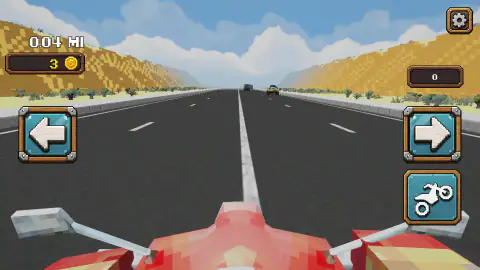
How to play Traffic Craft Rider
- Wait out the countdown. A white three hangs over an empty road, the distance counter on 0.00 MI and the purse on nothing. Nothing you press moves the bike before it clears.
- Steer with left and right, and only with left and right. Arrow keys or the two on-screen buttons. There is no third direction: forward happens whether you ask for it or not.
- Pick a lane early. A car ahead leaves you three ways past it, but every change of mind costs you the gap you had already closed.
- Take the coins in front of you, not the ones that are not. They sit in the lanes, and swinging across the road to chase one is how a run ends.
- Read the board when you crash. POINTS leads, DISTANCE sits underneath, and both keep a best. GARAGE and RESTART are the two buttons with no advert attached.
What the session taught us:
- The two numbers the game keeps do not track each other. One run ended on a quarter of a mile with four hundred points; another reached nearly half a mile and scored six hundred. Distance is what you watch while riding; points are what the game leads with afterwards, and something else is feeding them.
- Coins arrive with the miles, not with your skill. Seventeen at a fifth of a mile, fifty-two at six tenths — nearly the same rate twice, which suggests the road hands them out rather than rewarding clever lines.
- The cheapest padlock in the garage costs about six tenths of a mile.
- The gap closes slowly and then all at once. You are gaining on everything ahead of you the whole time, so the car that has looked harmless for seconds is the one that gets you.
- The bare number on the right climbs as you ride. It is neither the distance nor the coins, and we never found out what it is.
Controls
| Left arrow / Right arrow | Moves the bike across the four lanes. The game's own controls panel lists this and nothing else, in those words: PRESS LEFT/RIGHT TO MOVE |
|---|---|
| On-screen arrows, lower corners | The same two moves, drawn as turquoise arrows in wooden frames, so a mouse or a finger plays the game as well as the keyboard does |
| Hold on the vehicle, touch | The touch instruction as the game words it: HOLD YOUR FINGER ON THE CAR. It says car in a game about a motorbike. The game is listed as playing on desktop, mobile and tablet; our own session was on a desktop with a mouse and a keyboard |
| Motorbike button, bottom right | A third button under the right arrow. We pressed it during a run and could not tell what it changed, so we are not going to tell you what it does |
| Gear, top right | Opens a wooden panel with two headings, CONTROLS and CAMERA, and an APPLY button. The camera offers FIRST PERSON CAMERA and THIRD PERSON CAMERA; everything shown here is the first one |
| Throttle and brake | Neither exists. The bike pulls away by itself when the countdown clears and nothing on the screen speeds it up or slows it down |
Features
- Distance in the top-left corner in hundredths of a mile, and no clock anywhere on the screen
- Four lanes marked out by a solid white line down the middle with a dashed line either side of it, and traffic that travels the same way you do
- A coin purse under the distance counter that fills at almost exactly the same rate twice: 17 coins at a fifth of a mile, 52 at six tenths
- A garage with three things to buy — TURBO, DURABILITY and HANDLING — padlocked in steps priced at 50, 100 and 150 coins
- An end-of-run board that leads with POINTS, keeps a BEST for both points and distance, and adds a line marked COMBO
- Two cameras, one from the handlebars and one from behind, switched in the settings panel
- Made by ouazgames
Game details
- Developer
- ouazgames
- Release date
- July 2026
- Last updated
- July 15, 2026
- Added here
- May 2026
- Technology
- HTML5 (3D)
- Platforms
- Browser (desktop), Browser (mobile & tablet, touch)
- Classification
- Driving
- Saved progress
- Saving, when available, is managed by this game. Mava cannot confirm your level.
FAQ
What is Traffic Craft Rider?
It is a free browser game in which you ride a motorbike down a four-lane highway built out of cubes and get past the traffic without hitting it. The view is from the handlebars, the bike accelerates on its own, and the only number the screen keeps while you ride is how far you have gone, counted in hundredths of a mile. It is a single-player game and needs no download.
How do you play Traffic Craft Rider?
With two keys, or two buttons. The game's own controls panel says PRESS LEFT/RIGHT TO MOVE, and the screen puts a turquoise arrow in each lower corner so a finger or a mouse does the same job. There is no throttle and no brake: once the countdown drops from three the bike goes, and choosing a lane is the whole of the game.
Is there a timer in Traffic Craft Rider?
No. There is no clock anywhere on the screen, and nothing gets worse while you hesitate — though hesitating is not much use when you cannot slow down. The pressure comes from the traffic closing up in front of you, not from a countdown, and a run ends when you hit something rather than when time runs out.
How is the score worked out?
The game keeps two numbers and they are not the same number. While you ride, the corner shows distance. When you crash, the board leads with POINTS and puts distance underneath, and the two do not scale together: one of our runs ended on a quarter of a mile with four hundred points, another on nearly half a mile with six hundred. Both figures keep a separate best.
What are the coins for?
They buy upgrades in the garage. Three tracks sit there — TURBO, DURABILITY and HANDLING — each a row of padlocks, with the first steps marked at 50, 100 and 150 coins. The same three names appear as bars on the main menu under the heading BIKE STATS. We never bought one, so we cannot tell you what any of them changes.
How fast do you collect coins?
At roughly the rate you cover ground, which is the interesting part. Our purse read seventeen coins at a fifth of a mile and fifty-two at six tenths — close to the same coins-per-mile figure both times. That suggests the coins are laid along the road rather than scattered about, so riding further is the only way to earn more; you cannot farm them by weaving.
What is the number in the box on the right-hand side?
We do not know, and we will not guess. It sits in a wooden slot under the settings gear with no label and no icon, it reads zero at the start of a run, and across our published shots it showed a two at a fifth of a mile and a four at six tenths. The end-of-run board carries a line marked COMBO, which is the only label it could plausibly belong to, but we never saw the two line up.
Who made Traffic Craft Rider and when?
It is credited to ouazgames, and the game was published in July 2026 with an update the following day. Those are the platform's own dates for the page, which is the most reliable record we found; no developer site turned up to check them against.