



About Moto Traffic Rider
The first machine in the garage is a scooter. It is white, it sits on a turntable under a graffiti wall, it is badged VS 946 with a class letter C beside it, and it is the only one in the rack without a padlock on it. Then the first mission of the career asks you to reach a top speed of 100 km/h. That gap between what you have been given and what you have been asked for is the whole game in one screen.
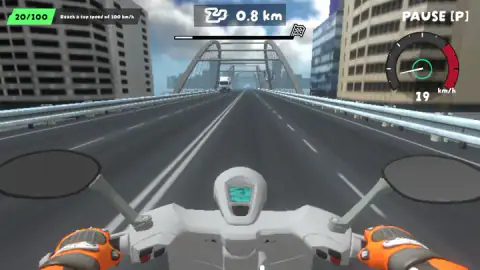
What you see while riding is the bit most browser bike games skip. You are behind the bars, not floating above the back wheel: both round mirrors are in shot, the bike's own little dashboard glows between your hands, and the rider's orange gloves sit on the grips. Traffic comes at you as shapes with mass — a lorry alongside you on the left fills a third of the screen — and the road runs through a city, over a steel arch bridge and onto a cable-stayed one with the sea underneath.
The game is credited to DarkPlay and was published on 25 February 2026.
We should be plain about our own run. It lasted about four minutes, all of it in the first level of the first city. We never found the control that opens the throttle, so the scooter crept along: 8 km/h, then 14, then 19, and it stopped climbing at 20. The mission wanted 100. We covered a few hundred metres of a one-kilometre stretch and the run ended on a LEVEL FAILED screen with three empty stars and no money. Everything below is what those four minutes showed, and we say where they stopped.
Three cities, and the star counters tell you how long each one is
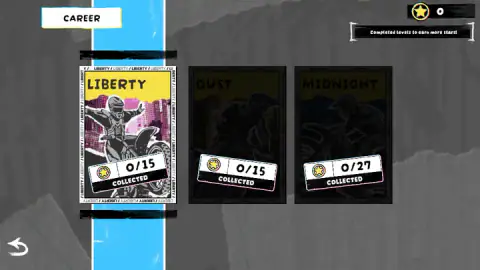
The career screen shows three cards. Liberty is the one you can enter, marked 0/15 collected. Dust sits beside it at 0/15, and Midnight at 0/27, both dark.
Those numbers are more useful than they look. The results screen hands out up to three stars for a mission, so if three stars is the going rate, 15 stars means five missions in Liberty and five in Dust, and 27 means nine in Midnight. The level picker in Liberty backs the first half of that: it shows five numbered tiles, 01 to 05.
There is one more card out there. The screen that told us we had failed draws the city cards as a scattered pile, and the pile has four in it: Liberty, Midnight, Dust and one called Aspen that never appeared in the career menu. Either it unlocks later or it is waiting on an update. We did not earn a single star, so we cannot tell you which.
What the screen is telling you while you ride
Four readouts, and three of them are doing something more interesting than they appear to.
The green chip in the top-left corner counts your progress toward the mission goal, and it banks your best reading. When the speedometer showed 14 km/h the chip read 14/100. When the speedometer dropped back to 19 from a brief 20, the chip stayed on 20/100. It only ever goes up. So a speed goal is a thing you touch once, not a thing you hold, and the right way to play it is to wait for a clear lane and spend it all in one go.
The counter above the road is a countdown, not a tally. It went 1.0 km, then 0.8, then 0.7, and the little chequered flag sits at the end of the bar. It is telling you how much road is left to do the job in.
The speedometer on the right is a proper round dial with a needle and a red zone, borrowed from the kind of bike the garage is selling you rather than from the scooter you are actually on.
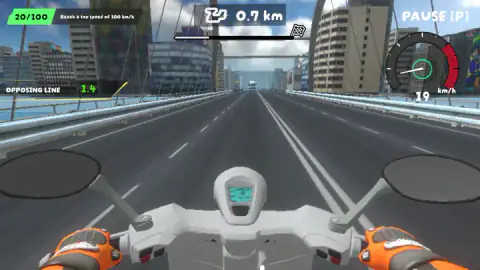
And then there is OPPOSING LINE, a meter that appeared at the left of the screen with the number 1.4 and a half-filled bar, while we were riding on the far side of the double white line with a lorry coming the other way. We know what it is watching. We never lived long enough to find out what it pays.
A motorcycle turns by leaning, and that is why leaning is the only control
Here is the real thing behind the game's one odd instruction. Above walking pace, a motorcycle does not turn by pointing the front wheel where you want to go. It turns by falling over in a controlled way.
To go right, a rider pushes the right grip forward. The front wheel points very briefly to the left, the bike drops into a lean to the right, and the lean is what carries it round the bend. The push lasts a moment; the lean does the work. It is called countersteering, every rider does it whether they have noticed or not, and rider training in the United States teaches it as a four-word rule: press right, go right.
That is why the game hands you lean left and lean right as the steering and no handlebar control at all. It has cut out the middle step and given you the part that actually turns the bike. It is also, quietly, the most accurate thing in a game that otherwise lets you ride into oncoming traffic for points.
There is one speed at which it stops being true, and we spent our whole session in it. Below a walking pace or so, a bike really is steered by turning the bars into the corner, with your weight doing the balancing. Our scooter never passed 20 km/h, which is the exact band where a real rider is still steering and not yet leaning. The mission goal is the game's way of saying: get out of that band.
Where four minutes left us
We did not see a star earned, a mission passed, a bike bought, an upgrade, the nitro, the brakes or either of the two locked cities. We did not meet an advert, though a single short session proves nothing about that. We did see enough to say what the game is: a first-person traffic game with a mission structure bolted to it, generous about what it shows you on screen and silent about which key does what.
If the throttle had opened, this would have been a different page. It is the one thing we would check first, and the one thing we would tell you to find before you worry about the traffic.
More bikes, and more traffic to thread
Highway Traffic is the closest neighbour here: same oncoming lanes and same gamble, with a car around you instead of a helmet. Superbike Hero takes the leaning seriously and puts it on real circuits. Bike Race Rush keeps the bike and drops the traffic, and Stock Car Hero trades two wheels for four and a field of rivals. The rest are in driving games.
Screenshots
How to play Moto Traffic Rider
- Pick your bike in the garage. The opening scooter is already selected in slot 01. The others have padlocks and prices. Press Play.
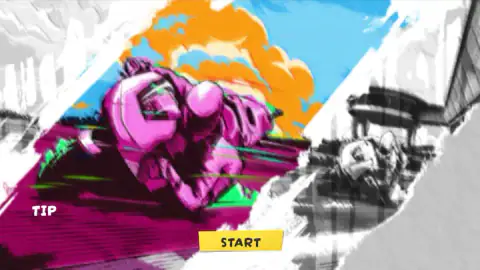
- Open Modes and choose Career. The career card is the big one in the middle, with a rider in pink on it.
- Choose a city. Liberty is lit up at the start; Dust and Midnight are greyed out behind it.
- Click the numbered level tile first, then Play. This is where we lost most of our session. Pressing Play while no tile is picked does nothing at all, with no message to say why.
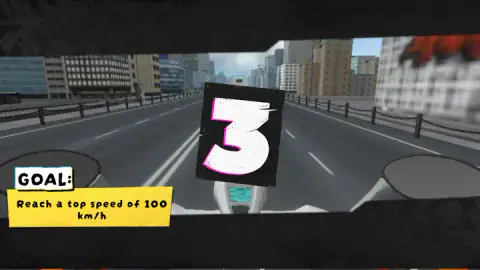
- Read the goal, then go. A card with the mission's goal sits in the bottom-left corner during the three-second countdown. That countdown is the only moment the screen holds still long enough to read it.
What we picked up on the way:
- The counter keeps your best speed, not your current one. More on that below, but it changes how you ride: you are hunting one clean stretch of empty road, not an average.
- Pause is a key, not a menu dive. The top-right corner reads PAUSE [P] while you ride, and Esc does the same job.
- The mirrors are decoration. Nothing useful ever appeared in them while we rode; the traffic that matters is in front.
Controls
| Lean left / lean right | Steers the bike. The game's instructions give leaning as the way to steer, avoid traffic and take corners |
|---|---|
| Throttle (hold) | The instructions say you hold the throttle to speed up and release it to slow down. On a keyboard we never found the key that opens it: our scooter crept to 20 km/h and stayed there |
| Brake and nitro | Listed in the game's instructions for heavy traffic and for short bursts of speed. We did not get to use either |
| P | Pauses the run. The HUD labels it PAUSE [P] in the top-right corner, and Esc works as well |
| Click the numbered level tile, then Play | Opens a mission. Clicking Play before the tile is picked does nothing, which cost us most of our session |
Features
- A view from the saddle: both round mirrors, the bike's own little dashboard and the rider's gloves stay in frame
- A career split into three cities, Liberty, Dust and Midnight, worth 15, 15 and 27 stars
- Missions with a written goal instead of a finish line; ours asked for a top speed of 100 km/h
- A speed counter that banks your best reading, so a goal speed has to be touched once rather than held
- A garage where the opening scooter is free and the locked bikes start at $4,000
- An OPPOSING LINE meter that turns up when you ride on the wrong side of the double white line
- Made by DarkPlay
Game details
- Developer
- DarkPlay
- Release date
- February 2026
- Last updated
- August 10, 2026
- Added here
- December 2025
- Technology
- HTML5 (3D)
- Platforms
- Browser (desktop, keyboard), Browser (mobile & tablet, touch)
- Classification
- Driving
- Saved progress
- Saving, when available, is managed by this game. Mava cannot confirm your level.
FAQ
How do you play Moto Traffic Rider?
You ride a motorbike along city highways from a first-person view and complete missions. Pick your bike in the garage, open Modes and choose Career, then a city, then a numbered level. Each mission comes with a written goal, such as reaching a given top speed, and the goal is shown on a yellow card during the countdown before you set off.
What is the goal of the first mission in Moto Traffic Rider?
The first level of Liberty asks you to reach a top speed of 100 km/h. The counter in the top-left corner keeps your best reading rather than your current one, so you need to touch 100 km/h once during the run, not hold it. The distance counter above the road tells you how much road you have left to do it in.
How many levels does Moto Traffic Rider have?
The career is split into three cities. Liberty and Dust are worth 15 stars each and Midnight 27. The results screen awards up to three stars per mission, which would make five missions in Liberty, five in Dust and nine in Midnight. The level picker in Liberty does show five numbered tiles.
Can you unlock new motorbikes in Moto Traffic Rider?
Yes. The garage opens with one white scooter unlocked and the rest of the rack behind padlocks and price tags, starting at $4,000. Money is earned by completing missions, and the counter starts at zero. The game's own listing says there are 13 motorcycles in all, which is more than the garage row shows at once.
What does OPPOSING LINE mean in Moto Traffic Rider?
It is a meter that appeared at the left of our screen while we were riding on the far side of the double white line, with traffic coming the other way. It showed a number and a bar that was partly filled. Games of this kind usually pay you for the risk, but our run ended before the meter paid out anything we could see.
Is Moto Traffic Rider free to play in a browser?
Yes. It runs in the browser with no download and no account, on desktop and, according to the game's listing, on Android and iOS as well in landscape. We played it on a desktop keyboard. No advert interrupted the four minutes we were in the game, though one short session is not a guarantee.
Who made Moto Traffic Rider?
It is credited to DarkPlay and was published on 25 February 2026.
Why does the bike lean instead of turning the handlebars?
Because that is how a real motorcycle turns above walking pace. A rider pushes forward on the bar on the side they want to go, the bike drops into a lean, and the lean is what carries it round the bend. Rider training in the United States teaches it as press right, go right. The game gives you the lean directly and leaves out the push.