About Superbike Hero
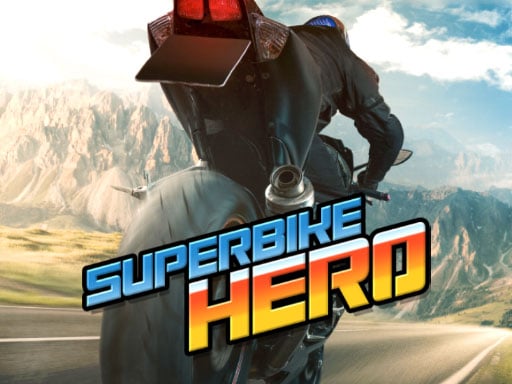
Most browser racing games give you a throttle, a brake and a steering wheel, and then hope you do not notice that none of the three matters much. Superbike Hero throws two of them away. The bike is pinned at full gas from the first metre to the flag, and you are left with the only thing a motorcycle race is actually about: where you put the bike.
It sounds like a simplification. It plays like the opposite. Every corner becomes a real decision, because the only way to be quick is to carry speed through it, and the only way to carry speed is to get the line right. Run wide onto the grass and the bike bogs down as if you had grabbed a handful of brake. Clip the kerbs and you lose the drive onto the straight. There is no throttle to hide behind.
The frame around it is a four-race championship, and it is stricter than it looks. You start each race near the back of a twenty-rider grid, you score points for where you finish, and the game keeps a running total and a personal best. Every race pays coins whatever happens — a sixteenth place still put fifty in the bank — and those coins go into four upgrades that genuinely change the bike. It was built in September 2020 by b10b, a Canadian studio with a long line of these lightweight 3D sports games, and it has collected a 4.4 out of 5 from more than 160,000 votes on Poki alone.
The four tracks are real, and they are all World Superbike venues
This is the detail no other page about this game mentions. The four circuits are not invented: they are four genuine motorcycle racing venues, and around the time the game was released all four appeared on the World Superbike calendar.
- Donington Park, England — a short, hilly, old-fashioned circuit in Leicestershire, famous for the Craner Curves, a downhill left-hand sweep that riders take almost flat out. The game spells it "Donnington", with two Ns, which is the single most common misspelling in British motorsport. The real thing has one.
- Misano World Circuit Marco Simoncelli, Italy — a seaside track near Rimini, renamed in 2012 after the Italian rider Marco Simoncelli, who was born nearby and died racing in 2011. It is the medium-difficulty round for good reason: tight, technical, unforgiving of a bad line.
- Circuit de Barcelona-Catalunya, Spain — the big, fast, modern circuit at Montmeló, best known for Formula 1 and MotoGP. Its long main straight is where the slipstream mechanic pays best.
- Losail International Circuit, Qatar — the game calls it Lusail. Opened in 2004 in the desert north of Doha and floodlit since 2008, it hosted the World Superbike season finale for years. Fittingly, it is the Expert round.
Racing them in that order is not random either. Donington is short and forgiving, Misano punishes sloppy lines, Barcelona rewards top speed, and Losail asks for all of it at once.
Where the coins go: the four upgrades
The garage has exactly four bars, and each has five levels. The first level of any upgrade costs 100 coins; the second jumps to 300, and it keeps climbing. You will not max everything in one championship, so the order matters.
| Upgrade | What it does | Buy it when |
|---|---|---|
| Grip | How hard you can lean before the bike runs wide | First. Always first. |
| Boost | How much the slipstream gives you and how long it lasts | Second — it is how you pass |
| Acceleration | How fast you recover after a mistake | Third |
| Top Speed | Your maximum on the straights | Last |
The temptation is to buy Top Speed, because a bigger number sounds faster. It is the wrong call. In a game where the throttle is already pinned, the time is lost in the corners, and Grip is the only upgrade that buys it back.
How to lean a superbike, and why real riders hang off
The game's own instruction screen tells you to "hang-on around tight corners". That phrase comes from real motorcycle racing, and it is worth understanding, because it explains why the fast line in the game feels the way it does.
A motorcycle does not turn by steering. Above roughly walking pace, it turns by leaning. To lean it, a rider does something that looks backwards: to go right, they briefly push the right handlebar forward, which stands the bike into a right-hand lean. It is called countersteering, and every rider does it whether or not they know the name.
Leaning has a limit. The further the bike is laid over, the smaller the contact patch of the tyre and the closer it is to letting go. So riders hang off: they slide their body to the inside of the turn, dropping a shoulder and a knee towards the tarmac. Because the combined centre of gravity of bike and rider moves inwards, the bike itself can stay more upright while going round the same corner at the same speed. More upright means more tyre on the road, which means more grip in reserve. That is the whole trick, and it is why racers look like they are trying to climb off the bike.
And the leg dangling under braking, the one that always gets asked about? Riders stick the inside leg out on the way into a corner. The riders themselves describe it as a mix of a weight shift, a small aerodynamic brake, and a habit carried over from dirt-track riding — where a boot out is genuinely how you catch a sliding bike. Valentino Rossi, a dirt-track obsessive, is generally credited with making it universal in MotoGP.
Superbike Hero models the visible half of all this: your rider leans and hangs off as you steer, and how much you can lean is exactly what the Grip upgrade buys.
What is a superbike, exactly?
Confusingly, "superbike" is a specific racing category, not just a fast motorcycle. A superbike is a production bike modified for racing — the machine starts life as something you can buy from a dealer, and the rules control how far the teams may change it.
That single fact is the whole difference between the two big championships:
- World Superbike (WSBK) races modified production bikes. If you have the money, you can buy a road version of the machine on the grid.
- MotoGP races prototypes. Those bikes exist only to race, are not sold to anybody, and are the fastest circuit motorcycles in the world.
- Supersport sits a class below Superbike: smaller engines, tighter restrictions on modification, and traditionally the class where riders prove themselves before moving up.
Superbike Hero is, appropriately, a superbike game and not a MotoGP one: four real WSBK venues, a production-shaped bike, and a garage where you improve the machine you already have rather than build a prototype.
Superbike Hero on Math Playground, and playing it unblocked
If you first met this game at school, you probably met it on Math Playground, which hosts a copy of it alongside its logic games — and which currently outranks even the developer's own site for the game's name. Plenty of people search for "math playground superbike hero" for exactly that reason: it is where they found it, so it is where they look for it again.
It is the same game, by the same studio. The version on this page is the standard b10b build, so your line, your coins and your championship behave identically. And because the whole thing is one HTML5 page with no plugin, no installer and no login, it runs on a locked-down school Chromebook the same way it runs on a gaming PC. Press play at the top and the first race begins in this page.
More games by b10b
b10b built a whole series of these: same lightweight 3D, same "one clear mechanic" philosophy, same instant loading. All of them are here — Grand Prix Hero for open-wheel racing, Stock Car Hero for door-to-door oval and street racing, Tennis Hero and Athletics Hero.
If it is the bikes you came for, try Superbikes Racing 2022 for a straighter simulation, City Bike Stunt 2 for something far sillier on two wheels, or browse the whole driving category.
How to play Superbike Hero
- Pick your race. The championship opens at Donington and unlocks Misano, Barcelona and Losail as you go. Difficulty climbs with each one: Easy, Medium, Hard, Expert.
- Steer, and only steer. Left and right arrows, or A and D, or the left and right halves of a touchscreen. The bike accelerates on its own.
- Hold the racing line. The tarmac is wide but only one part of it is fast. Aim to enter wide, brush the apex, and let the bike drift out on the exit.
- Tuck in behind rivals. Sitting in another rider's slipstream gives you a boost. That is where the game's own tagline — "boost between opponents" — comes from, and it is the fastest way through the field.
- Spend the coins. After every race the garage opens. Four bars, five levels each.
Five things worth knowing before your first race:
- The grass is not a shortcut. Cutting a corner across the green costs you far more time than the metres you save. The bike does not crash, it just stops pulling — which is worse.
- The kerbs bite. The red-and-white strips look like they are there to be used. In this game they unsettle the bike and kill your drive. Stay just inside them.
- Overtake on the straight, not in the corner. Riders defend the inside line. Follow them through the turn, take the slipstream, and go past where the track is wide.
- Buy Grip first. It is the upgrade that makes every other one work.
- Losail is a different game. By the time you reach Qatar the AI stops making mistakes. Expect to replay the earlier rounds for coins before you can win it.
Controls
| ← / → or A / D | Steer and lean into the corner — the only input that really matters |
|---|---|
| ↑ / W | Tuck in behind the rider ahead to pick up the slipstream boost |
| ↓ / S | Sit up and scrub speed before a corner you have arrived at too fast |
| Touch | On a phone or tablet, hold the left or right side of the screen to steer |
| Throttle | Automatic — the bike is always at full gas, so the game is about lines, not acceleration |
Features
- A four-race championship across Donington, Misano, Barcelona and Losail, rising from Easy to Expert
- Points scored by finishing position, a running total and a personal best to beat
- Coins earned in every race, whatever your result, and spent on four separate upgrades
- Top Speed, Grip, Acceleration and Boost, five levels each, with the price climbing after every purchase
- Around twenty riders on the grid and a live track map showing exactly who you are hunting
- Loads in seconds, plays with two keys, and runs on a school Chromebook without an install
Game details
- Developer
- b10b
- Release date
- September 2020
- Last updated
- November 1, 2020
- Added here
- March 2023
- Technology
- HTML5 (3D, 720×405 landscape)
- Platforms
- Browser (desktop), Browser (mobile & tablet, touch), Chromebook
FAQ
How do you play Superbike Hero?
The throttle is automatic. You only steer, with the arrow keys, A and D, or by holding one side of a touchscreen. Stay on the tarmac, cut the corners as tightly as you can without touching the kerbs, and tuck in behind the rider ahead to pick up the slipstream.
How many tracks does Superbike Hero have?
Four, raced in order as a championship — Donington in England (Easy), Misano in Italy (Medium), Barcelona in Spain (Hard) and Losail in Qatar (Expert). All four are real motorcycle circuits.
What should I upgrade first in Superbike Hero?
Grip. Top Speed is useless if you cannot hold the racing line, and every metre you run wide costs more than a slightly higher top end. Grip first, then Boost, then Acceleration, and Top Speed last.
Is Superbike Hero free?
Yes. It runs in the browser with nothing to download and no account. It is funded by short ads shown before the game and between screens.
Is this the same Superbike Hero as on Math Playground?
It is the same game by the same studio, b10b. Math Playground hosts a copy for schools; this page runs the same build, so your championship works exactly the same way.
Who made Superbike Hero?
b10b, a Canadian studio that specialises in lightweight 3D sports games for the browser. They also made Grand Prix Hero, Stock Car Hero, Tennis Hero and Athletics Hero.
What is a superbike?
In racing, a superbike is a production motorcycle — a bike you can buy from a dealer — modified for competition. That is what separates the World Superbike championship from MotoGP, where the bikes are prototypes built only to race and never sold.
Why do riders hang off the bike in corners?
Moving their body to the inside shifts the combined centre of gravity, so the bike can take the same corner at the same speed while leaning less. Less lean angle means more rubber on the road and more margin before the tyre lets go.