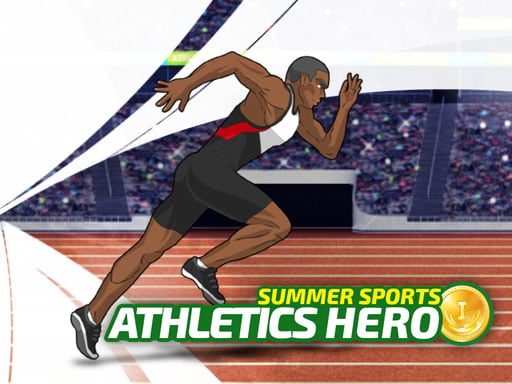
About Athletics Hero
The gold medal in the 100 metres is set at 9.58 seconds. That is not a number somebody picked because it sounded fast: it is the exact time Usain Bolt ran in Berlin on 16 August 2009, and it is still the world record. Athletics Hero puts it on the board next to a silver at 11.00 and a bronze at 16.00, hands you two arrow keys, and asks you to go and get it.
What you actually do is time taps. A green arrow flashes on the left or the right of the screen and you hit that side. Get it right and your athlete accelerates and you bank a coin. Get it wrong and a penalty meter climbs — faster than it falls, because a miss adds twenty per cent while a hit only takes a fifth off what is already there. Miss five in a row and you are running through treacle. For the javelin and the triple jump a second layer arrives: hold the spacebar, watch a power bar fill, let go.
It was built by b10b, a Canadian indie studio on Vancouver Island, on awe6, their own open-source Haxe framework. Athletics Hero arrived in January 2021 and holds 4.3 out of 5 from more than 174,000 votes on Poki alone. The build on this page is version 45, compiled on 22 June 2021; every figure below was read out of it.
Two of the three gold medals are world records
Most sports games invent their targets. Athletics Hero borrowed two of its three from the record books, which is why the medal screen looks like an arcade scoreboard and behaves like a wall.
- 100 m, gold at 9.58 s. Bolt's Berlin run. He took 0.11 off his own Beijing record and became the first man under 9.6. Nobody has been within a tenth of it since.
- Triple jump, gold at 18.00 m. Jonathan Edwards jumped 18.29 m in Gothenburg on 7 August 1995 and the record still stands thirty years later. He is one of only seven men ever to pass 18 metres. The game asks you to join them.
- Javelin, gold at 85.00 m. The outlier. The world record is Jan Železný's 98.48 m from Jena in 1996, and Paris 2024 was won with 92.97 m. Eighty-five metres is an excellent throw; it is not a record.
Plan around that asymmetry: the javelin is the cheapest gold in the game, and gold pays 8,000 coins against 5,000 for silver and 3,000 for bronze. Those coins are what eventually make 9.58 possible.
The bottom tier is a nice touch too. Finish under the bronze mark and the game does not say you failed — it gives you Respect, a medal worth no coins and carrying no shame.
Why an athletics game is a game about buttons at all
There is a reason "track and field video game" means "press things quickly" to anybody over about thirty, and it starts with one cabinet. Konami's Track & Field — Hyper Olympic in Japan and Europe — reached Japanese arcades in September 1983 and North America that October. Six events, and three buttons: two marked RUN and one marked ACTION. You alternated the run buttons as fast as human fingers allow and hit ACTION to set an angle: 42 degrees for the long jump, 43 for the javelin, 45 for the hammer. It sold 38,000 cabinets in Japan before the end of 1983 and finished 1984 as the third highest-grossing arcade game in the United States.
And players destroyed it. Because the machine rewarded raw button frequency and nothing else, an arms race broke out over pressing a button faster than a finger can. People swiped coins and ping-pong balls across the button tops. They laid a metal ruler across both buttons and struck it so it vibrated. They wedged a comb between their fingers so pushing one end returned the other to the second button in firing order. Operators reported button failures at rates they had never seen; later cabinets shipped with a "C"-shaped guard forcing a straight downward press, and some swapped the buttons for a trackball outright.
Athletics Hero is the descendant that learned the lesson. It keeps the two-sided input and the alternating rhythm and removes the reward for speed. Prompts arrive when the game says so, and mashing only accumulates misses. You cannot out-frequency it; you can only match it. Nobody has ever needed a ruler to play this one.
Hop, skip and jump: the technique the game is animating
The triple jump's old English name — the hop, skip and jump — describes the rules, not a nickname. World Athletics puts it plainly: the hop must land on the same foot you took off from, the step must land on the other foot, and the jump is taken from that second foot into the pit. Three phases, one continuous sequence, and an order of feet a judge will disqualify you for breaking. An athlete hitting the board at nearly sprint speed has to survive two more landings before they are allowed to jump.
Unpack the game's sprite sheet and you find exactly that: a run cycle, then HOP, then SKIP, then JUMP, each a separately labelled sequence. This is not a long jump with extra frames.
The javelin gets a quieter version of the same respect. Schoolroom physics says 45 degrees gives maximum range, and Track & Field dutifully asked for 43; real throwers release far flatter, nearer the mid-30s, because the spear flies like a wing rather than a stone. That lift is why the implement was redesigned in 1986, after Uwe Hohn threw 104.80 m in 1984 and started landing javelins near the far end of stadiums: the centre of gravity moved forward four centimetres and distances fell by around 12 per cent overnight. Athletics Hero asks for no angle at all — power and timing, and the flight takes care of itself.
Where the coins go: four bars, eight levels, exactly 50,000 coins
The shop is called Train your hero. Four bars, eight levels each, and a fixed price ladder anybody who has met a Fibonacci sequence will recognise — from the third step on, each price is the sum of the two before it:
100 · 300 · 500 · 800 · 1,300 · 2,100 · 3,400 · 5,500
Here is what you are buying:
| Upgrade | What it really changes | Range over eight levels |
|---|---|---|
| Timing | Width of the power-bar release window, in frames | 18 → 25 |
| Stamina | How much your boost fades with every prompt you hit | 0.95 → 1.00 |
| Power | Multiplier applied to a throw or a take-off | 0.825 → 1.00 |
| Speed | Base running speed | 15 → 20 |
Stamina is the sneaky one. It is not an energy bar: each time you hit a prompt your boost is multiplied by the stamina value, so at level zero every tap contributes five per cent less than the last and a long approach dies on its feet. Maxed, the multiplier is 1.00 and the boost never decays — which in the triple jump, the event with the longest run-up, is most of the gap between silver and gold.
The two teams are not cosmetic either. Different starting stats, and separate coin purses and separate upgrade trees, so switching hero begins a second career:
| Team | Speed | Timing | Power | Stamina |
|---|---|---|---|---|
| Men | 5 | 2 | 4 | 3 |
| Women | 3 | 4 | 2 | 5 |
The men's team is quicker and stronger out of the box; the women's team times better and lasts longer. Either way, maxing all four bars costs exactly 50,000 coins — the totals balance. That is six or seven gold medals' worth of prize money, which is the polite way of saying you will be replaying the javelin.
Playing Athletics Hero unblocked
There is nothing to install. Athletics Hero is a single HTML5 page — roughly 400 KB of code and a handful of sprite sheets — so it starts in seconds with no plugin, no download and no account. That is why it turns up on school "unblocked games" lists: a managed Chromebook plays it exactly like a gaming PC, because there is nothing to block except the address. It is drawn for a 720×405 landscape frame, so on a phone use landscape and the fullscreen button. And although the GameMonetize feed flags this title as desktop-only, the build handles touch fine: tapping the left or right half of the screen below the HUD replaces the arrow keys.
More games by b10b
b10b have made nineteen of these, and the sports ones split into two families. The medal games share Athletics Hero's structure — pick a hero, chase gold, train between events — and the closest relative here is Tennis Hero, which wraps the same frame around a serve-and-volley match. The racing games swap medals for a championship and vehicle upgrades: Superbike Hero across four real World Superbike circuits, Grand Prix Hero for open-wheel, and Stock Car Hero for oval racing. Same engine, same instant load, same coin-and-upgrade shop.
If it was the timing you enjoyed rather than the athletics, Basket Random plays the same trick with physics doing the comedy. The rest lives in our sports category.
How to play Athletics Hero
- Pick a hero, pick an event. Men's team or women's team, then the 100m Sprint. The Javelin unlocks once you have run it, the Triple Jump once you have thrown.
- Hit the prompts. Green arrows appear left or right. Press the matching arrow key — or A and D, or the matching half of a touchscreen. That is running.
- Fill the bar, then release. In the javelin and the triple jump, hold the spacebar or the mouse button to charge, and let go near the top.
- Spend the coins. Between events, "Train your hero" opens: four bars, eight levels each.
Five things the game does not tell you:
- Your first attempt at each event is a rigged tutorial. On a brand-new event the power-bar window is 40 frames wide and the hints ("Tap To Run", "Hold For Power") are visible. From the second attempt the texts vanish and the window shrinks to 18-25 frames, depending on your Timing stat. If the game suddenly got harder, that is why.
- Overpowering costs you exactly half. Hold past the maximum and the throw fires at 0.50 power — the same as releasing far too early, because 0.50 is the floor. Only the top half of the bar is worth anything.
- The prompt pattern differs by event. In the 100 m it is always the same side, so it is pure rhythm. In the javelin it strictly alternates. In the triple jump the runs get longer as the approach goes on — singles, then pairs, then threes, then fours. That is the hardest thing in the game to read, and it is designed that way.
- Only one rival matters. The sprint is a four-lane race with you in lane three; of the three computer athletes, one runs at 0.98 skill and the other two at 0.70 and 0.15.
- Buy Timing first, and grind the javelin. A losing run still pays: every correctly timed prompt drops a coin, and coins on the track are worth ten.
Controls
| ← / A and → / D | Hit the green prompt on the matching side — this is the whole running game |
|---|---|
| Spacebar (hold) | Charge the power bar for the javelin throw and the triple jump take-off |
| Spacebar (release) | Throw or jump. Release in the top half of the bar or the effort is wasted |
| Mouse or touch | Tap the left or right half of the screen below the HUD instead of the arrow keys |
| Hold click or touch | Same as holding the spacebar — charges and releases the power bar |
Features
- Three events unlocked in order — 100m Sprint, Javelin Throw, Triple Jump — each with its own bronze, silver and gold target
- Gold in the 100m is 9.58 seconds, the exact time of the current world record; gold in the triple jump is 18.00 m
- Four medal tiers, and the lowest is not failure but "Respect" — you always finish the event
- A men's team and a women's team with different starting stats, separate coin purses and separate upgrade trees
- Four upgrades — Speed, Timing, Power, Stamina — with eight levels each and prices that climb 100, 300, 500, 800, 1300, 2100, 3400, 5500
- Every correctly timed prompt pays one coin, so even a losing run funds the next upgrade
- Loads in a few seconds, plays with two keys and a spacebar, and runs on a school Chromebook with nothing installed
Game details
FAQ
What events are in Athletics Hero?
Three, played in order — the 100m Sprint, the Javelin Throw and the Triple Jump. You have to finish an event before the next one unlocks, so everybody starts on the track and nobody sees the sand pit until the javelin is done.
How do you play Athletics Hero?
Two things. You hit the left or right arrow key each time a green prompt appears on that side, which is how your athlete runs, and for the javelin and the triple jump you hold the spacebar to fill a power bar and release it near the top. On a touchscreen you tap the left or right half of the screen instead.
What time do you need for a gold medal in the 100m?
9.58 seconds — the exact time Usain Bolt ran in Berlin in 2009, which is still the world record. Silver is 11.00 seconds and bronze is a far gentler 16.00, so bronze and silver are realistic goals long before gold is.
What should I upgrade first in Athletics Hero?
Timing. It widens the window on the power bar from 18 frames to 25, and a wider window is what turns a half-power throw into a full one. Stamina is the useful second buy because it stops your per-tap boost fading during a long run-up.
Why did my javelin go nowhere when the bar was full?
You held it too long. If the bar goes past maximum the throw fires at exactly half power — the same as releasing far too early. The game's own instructions warn you to "avoid over powering", and it means it literally.
Is Athletics Hero free to play unblocked at school?
Yes. It is a single HTML5 page with no plugin, no installer and no account, so it runs in Chrome, Edge, Firefox and Safari and on a locked-down school Chromebook, as long as the site itself is reachable.
Who made Athletics Hero?
b10b, a Canadian indie studio based on Vancouver Island, British Columbia. It is one of their "Hero" series of lightweight browser sports games, alongside Superbike Hero, Grand Prix Hero, Stock Car Hero and Tennis Hero.
What are the three phases of the triple jump?
The hop, the step and the jump. You take off from one foot and land on that same foot for the hop, land on the other foot for the step, and take off from that foot for the jump into the sand. Athletics Hero animates all three as separate sequences rather than treating the event as a long jump with extra frames.