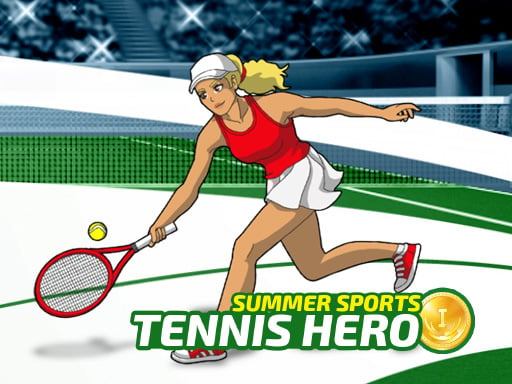
About Tennis Hero
Real tennis counts in a private language. Fifteen, thirty, forty, deuce, advantage — a system nobody can fully explain and everybody has to memorise. Tennis Hero throws all of it out and counts to six, and tells you why on the first screen of every match, in one word printed across the court: Tie-Break.
The controls are just as stripped. There is one button, and your player runs to the ball without you, so you are never steering — only choosing the instant to swing. Press as the ball arrives and the HUD grades you: Very Early, Early, Good, Perfect, Great, Late, Very Late. Perfect sits dead centre, with Good and Great one step out on either side — which means they are exactly as accurate as each other, the first thing here that catches people out.
The serve works the other way round: hold the button, let the power bar fill over about two thirds of a second, release as it tops out. Keep holding and the swing fires anyway with the worst grade the game has. Serves are struck at twice the power of a rally shot, which makes the first ball of every point the most dangerous.
It was built by b10b, a Canadian indie studio on Vancouver Island behind a long line of one-mechanic browser sports games — Superbike Hero, Grand Prix Hero, Athletics Hero, Stock Car Hero. Tennis Hero was live on their own site by April 2020 and carries a 4.1 out of 5 from 29,044 votes on Poki.
The match is a tie-break, and the tie-break is the newest thing in tennis
Most tennis games either simulate the full 15-30-40 apparatus badly or invent a score of their own. Tennis Hero takes the one part of real tennis already counted in plain numbers — and takes it properly.
The match ends at six points with two clear. That two-point margin is the actual spine of deuce and advantage: you must beat someone, not merely reach a number first. The service pattern is the tie-break's own — the opponent serves the opening point, and from there service changes every two points, exactly as a real tie-break rotates. Two honest differences: a real tie-break runs to seven, and real players change ends every six points, which this game skips.
The scoring it discards is the part nobody can account for. The 15-30-40 progression is genuinely disputed. The popular story is a clock face, a quarter turn per point — 15, 30, 45, shortened in speech to 40 — but the objection is hard to get around: minute hands did not become common until the late 1500s, long after jeu de paume was already scored this way. "Love" for zero is no clearer. The familiar explanation is the French l'œuf, an egg for the shape of a nought; the linguist Heiner Gillmeister rejects it phonetically and traces the word to the Flemish lof, honour.
The tie-break has a paper trail. James "Jimmy" Van Alen of the Newport Casino in Rhode Island designed it for his Van Alen Streamlined Scoring System and in 1965 paid $10,000 to get Rod Laver, Ken Rosewall and Pancho Gonzales to test it — nine points, sudden death at 4-4. It reached a Grand Slam at the 1970 US Open, where the umpire raised a small red flag so the crowd knew one was under way. Tennis has been played for centuries; the scoring this game copies is barely older than the home computer.
The court is drawn to real ITF dimensions
Pull the numbers out of the build and the court is not a cartoon. The singles court is 0.749 of the doubles width; the International Tennis Federation says 8.23 m of 10.97 m, or 0.7502. The service line sits at 0.538 of the half-length; the real one is 6.40 m from a net 11.885 m from the baseline, or 0.5385. Line those up and the game's world units are almost exactly centimetres of a real court — 1190 to the baseline, 550 to the doubles sideline, tramlines drawn in even though nobody plays doubles. The one simplification is the net, a flat 1.00 m barrier where a real one sags from 1.07 m at the posts to 0.914 m in the middle.
What the game does not model is surface. Real tennis is defined by the same shot behaving differently on each: clay slows the ball and kicks it up, grass is the fastest in common use and keeps the bounce low, hard courts sit between them. Tennis Hero has one venue — a green court in a blue surround under floodlights — and all three events are played on it. Nothing about the bounce changes between Beginner and Expert. Only the opponent does.
Where the coins go: Speed, Timing, Power and Spin
Four bars, eight levels each, and the price depends on the level you are buying rather than the bar you buy it on: 100, 300, 500, 800, 1,300, 2,100, 3,400, 5,500. From the third rung on, every price is the sum of the two before it. Maxing a hero across all four bars costs exactly 50,000 coins, about seven gold medals' worth, so the order matters more than the total.
| Upgrade | What it changes | Buy it |
|---|---|---|
| Timing | The width of the band that turns your tap into a grade — a slightly early press still resolves as Perfect | First |
| Power | How hard the ball leaves the racket, doubled on serves | Second |
| Speed | How fast your player accelerates towards the ball; still not enough to match the Expert | Third |
| Spin | Sideways curve, but only on balls struck without moving across court | Last |
Timing first is not a preference. Every shot's power is multiplied by its grade, so a mistimed swing at maximum Power lands softer than a Perfect one at the untrained minimum.
Two heroes, two mirror-image stat lines
The choice of hero looks cosmetic and is not. The male hero starts on Speed 4, Timing 2, Power 5, Spin 3; the female hero on Speed 3, Timing 5, Power 2, Spin 4. Both total 14 points, and because the shop charges by the level you are climbing to, both cost the same 50,000 coins to finish.
The consequence is that your cheap upgrades are your weak stats: the male hero's first point of Timing costs 500, his first point of Power 2,100. They are not fast and slow versions of each other — they are two different opening moves, with progress stored separately for each.
Playing Tennis Hero unblocked
The whole game is one HTML5 page: a canvas, the CreateJS runtime and about 400 KB of compiled script, with no plugin, no installer, no login and no download. That is why it turns up on school "unblocked games" lists — there is nothing for a filter to object to except the domain. At 720×405 and 30 frames per second it plays smoothly on a low-end Chromebook. One note for new players: the on-screen prompts disappear for good once you win your first medal on Beginner.
More games by b10b
b10b builds these to a formula: one mechanic, one button, instant loading, a shop between rounds. Tennis Hero belongs to their Summer Sports set alongside Athletics Hero, which runs the same medal structure across the 100 m, javelin and triple jump. On the motorsport side there is Superbike Hero, Grand Prix Hero, Stock Car Hero and Rally Car Hero — all steering-only, all with a shop between races. For the sport rather than the studio, Mini Tennis is the lighter alternative; everything else is in our sports category.
How to play Tennis Hero
- Pick a hero and an event. Two heroes, three events — Beginner, Normal and Expert. Each stays locked until you take any medal, even a Bronze, on the one before.
- Serve. Hold the button, watch the bar, release the moment it fills. The opponent serves the first point; after that service changes every two points.
- Swing on time. A beacon lights under your player when the ball is in range. Press then, not before — the grade you get multiplies everything else your hero can do.
- Reach six. First to 6 points with two clear takes it. The HUD flashes Match-Point when either of you is one away.
- Spend the coins in "Train your hero". Four bars — Speed, Timing, Power, Spin — eight levels each.
Five things worth knowing before your first match:
- Spin only works on shots you take standing still. The game scales spin by how fast you are moving sideways, and above a certain speed cancels it entirely. A ball struck flat-footed curls; the same ball struck on the run does not.
- Winning a point on the first shot pays the maximum. An unreturnable serve is worth 100 coins, the same as a forty-shot rally. Points you lose pay nothing.
- A close defeat is worth 2,000 coins more than a heavy one. Silver, at 5,000, needs the opponent to go past six points. Lose 6-2 and you get a 3,000-coin Bronze.
- Rallies physically speed up. The ball's flight time shrinks about one frame every five shots. A long rally ends because it gets faster than you, not because you got bored.
- You cannot out-run the Expert. Its movement rating is 2.25; a maxed hero tops out at 2.0. Against the third opponent the answer is placement, never chasing.
Controls
| Click / tap | Swing. Press the moment the ball reaches you — that single instant is the whole game |
|---|---|
| Space (also Q, Z or E) | The same swing on a keyboard, for the serve and for every shot in the rally |
| Hold, then release | Serve. The power bar fills in about two thirds of a second; let go the instant it tops out |
| Movement | Automatic. Your player chases the ball without you, so the Speed upgrade is what decides whether they get there |
Features
- Every match is a tie-break — first to 6 points with two clear, with service changing every two points exactly as it does in a real one
- Three events (Beginner, Normal, Expert) against opponents rated 0.5, 0.75 and 1.0, each locked until you medal on the one before
- Four outcomes per event — Gold for a win, Silver for losing 7-5 or closer, Bronze for scoring at least a point, "Respect" for a 6-0
- Gold pays 8,000 coins, Silver 5,000 and Bronze 3,000; winning a point on the first shot pays 100 coins, the same as a 40-shot rally
- Four upgrades of eight levels each — Speed, Timing, Power and Spin — priced 100, 300, 500, 800, 1,300, 2,100, 3,400 and 5,500
- Two heroes with mirror-image starting stats, so the same 50,000 coins buys a maxed player by two different routes
- Seven timing grades from Very Early to Very Late, with Perfect in the middle and a squeak of shoe rubber on every change of direction
Game details
FAQ
How do you play Tennis Hero?
One button does everything. Your player runs to the ball automatically, so all you do is click, tap or press Space at the instant the ball arrives. To serve, hold the button and release it the moment the power bar fills. The game grades every swing from Very Early to Very Late, and Perfect sits in the middle.
How do you serve an ace in Tennis Hero?
The serve power bar takes about two thirds of a second to fill. Release exactly as it tops out and the serve is graded Perfect; keep holding and the swing goes anyway with the worst grade available, which is what the game means by "avoid over powering". Serves are also hit at twice the power of a rally shot, so a Perfect serve is the hardest ball in the game.
What should I upgrade first in Tennis Hero?
Timing, then Power. Timing narrows the band that turns your tap into a grade, so a slightly early press still comes out as Perfect, and every other stat is multiplied by how well you struck the ball. Speed matters third and Spin last, because spin only applies to shots you take standing still.
How do you win a gold medal in Tennis Hero?
Win the match. Gold goes to whoever takes the tie-break, and it pays 8,000 coins. Losing still pays — 5,000 for a Silver if the opponent needed more than six points to beat you, and 3,000 for a Bronze if you scored at least one point.
Is Tennis Hero a 2 player game?
No. It is single player only, against three computer opponents of rising skill. There is no shared-keyboard mode and no online play, and the game saves your medals and coins in the browser so you can come back to the same hero.
Which hero is better in Tennis Hero, the man or the woman?
Neither, and that is deliberate. The male hero starts on Speed 4, Timing 2, Power 5, Spin 3; the female hero starts on Speed 3, Timing 5, Power 2, Spin 4. Both add up to 14 points and both cost exactly 50,000 coins to max out — they just get there in a different order.
Can I play Tennis Hero unblocked at school?
It is a single HTML5 page of roughly 400 KB of script with no plugin, no installer and no account, so it runs on a school Chromebook the same way it runs anywhere else, as long as the site itself is reachable.
Why is tennis scored 15, 30, 40?
Nobody knows for certain. The most repeated explanation is a clock face — a quarter turn per point, 15, 30, 45 shortened to 40 — but critics point out that minute hands only became common in the late 1500s, after the game already existed. The tie-break, by contrast, is documented — James Van Alen invented it, tested it in 1965, and it reached a Grand Slam at the 1970 US Open.