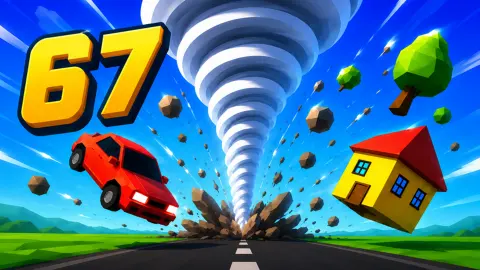









About Tornado-67
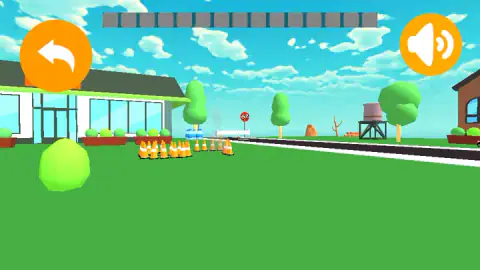
The first thing we did in Tornado-67 was lose track of our own tornado. It was on the lawn somewhere, in among a heap of orange traffic cones outside a glass-fronted shop: a grey wisp about as tall as one of the cones, and no taller. The row of boxes along the top of the screen was empty. That is the whole proposition. You are a weak draught, and everything in front of you is bigger than you are.
You grow by eating. Push the funnel into something small enough and it goes up inside it, and once enough of those are gone the next size up stops being out of reach. The boxes fill in white as you go, and they are the only readout the game gives you: no score, no clock, and no name for the thing you just swallowed.
The game is credited to Marusya.Games. The game was published in June 2026.
We should say where our own sitting stopped. It was four minutes on a desktop: two of the three locations, three of fifteen boxes in one and two of fifteen in the other, and neither of them finished. About a minute of those four was spent stranded over open water, which turns out to be the most useful thing we can pass on.
You start shorter than a traffic cone
The clearest thing we can show you is two moments in the same level, from the same camera.
At the start of the suburban street there is a heap of traffic cones on the grass in front of a shop, five blue water bottles of the sort that go on an office cooler, and a water tower behind the house across the road. All fifteen boxes are grey. The tornado is a smudge between the cones, and it is the shortest thing in the picture.
A short while later the cones are gone except for two still standing by the kerb, two boxes have whitened, and the funnel is a solid column taller than the shop. It is at the water bottles now, which it could not have touched before.
That is the loop, and it is why the game bothers to start you so small. Clearing a dozen cones feels like nothing. It is the only reason you can later clear something that is not nothing.
The map has an edge, and nothing tells you
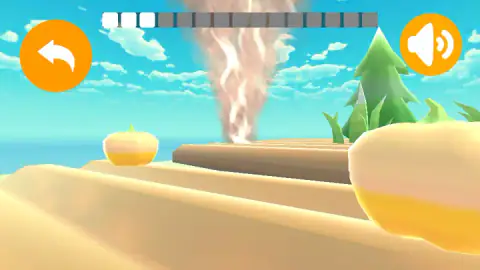
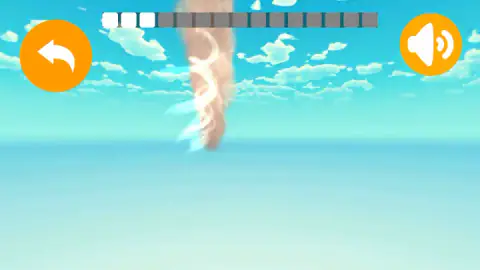
In the pumpkin field we held W for a while with nothing in front of us, and sailed off the end of the world. The field was gone. What was left was a flat expanse of pale blue-green water out to the horizon, an empty sky, and our tornado in the middle of it, by then a bright column with blue streamers winding up it and nothing whatsoever to swallow.
We stayed out there for over a minute. There is no fence, no warning and no nudge back, and the row of boxes simply stops filling, which is easy to miss because it does not look like anything. We never worked out how to turn round at speed, and we never tried the camera drag the provider lists; with hindsight that is almost certainly the answer, and we cannot tell you so from experience.
So when the ground runs out, go back the way you came at once. The game will not stop you wasting your session, and it will not tell you that you are.
Three places, and none of them is a city
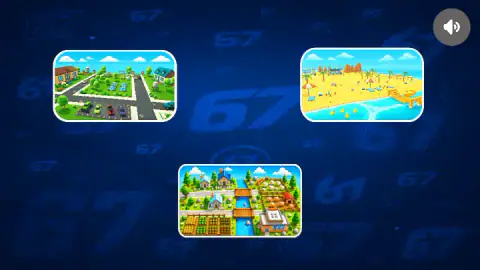
Press the arrow and you get the menu: a dark blue wall with the number 67 scrawled across it in a dozen typefaces, and three picture cards.
One is a suburban street seen from above, with bungalows, lawns, stop signs and a car park with cars in a row. One is a beach: golden sand, parasols, red rock stacks, a wooden jetty and rubber ducks bobbing in the shallows. The third is a village on a river, two wooden bridges across it, vegetable plots in neat lines and a farm with a brick-red roof.
None of the three carried a padlock, so there seems to be nothing to unlock. And none of the three is a city. The nearest thing to one is a quiet residential strip where the tallest building is a two-storey house, so if you came hoping to take a skyline apart, this is not that game. The field of pumpkins is a fairer picture of its scale than the word tornado suggests.
The 67 is never explained. Besides the menu wallpaper, the number turns up once in play, painted on a speed-limit roundel by the suburban road, which is the game grinning at you and saying nothing.
Real tornadoes are graded by what they carry off
The idea that a tornado has a tier, and that the tier decides what it can pick up, is not a game invention. It is roughly how the real ones are described.
Wind inside a tornado is almost never measured as it happens, because instruments rarely survive standing in the right place. So the Enhanced Fujita scale, in use in the United States since 2007 in place of the scale Tetsuya Fujita drew up in 1971, works from the wreckage instead. Surveyors walk the path afterwards against a published list of 28 damage indicators - house, barn, motel, warehouse, softwood tree, hardwood tree - and read the rating off what each one did or did not survive.
In order, that list is a ladder, and it is close to the one this game makes you climb. At the bottom, broken branches and loose gutters. A step up, roofs stripped and mobile homes shoved off their blocks. Another, large trees snapped and cars shifted. Near the top, whole storeys gone and heavy vehicles thrown. Things do not get randomly bigger; they get bigger in an order, and each step belongs to a different storm.
The game runs that ladder backwards. A surveyor reads the debris to work out the strength; here you build the strength so you can make the debris. It is the better bargain, and it is why the cones have to go first.
What we did not see
We never filled the row of boxes, never finished a location, never opened the beach and never got a car off the ground. Nor can we tell you what the fifteen boxes actually count: the funnel kept growing while the bar sat on three, so the two are not measuring the same thing.
It is a quiet, slow, undemanding game with a clean idea underneath and very little telling you what is going on. If that sounds restful, it is. If you want to be told whether you are doing well, you will not be.
More things that grow, and other storms
Giant Snowball Rush is the nearest relative: the same bargain of getting bigger by running into things, on a lane with two rivals and a bit more urgency. Diner in the Storm keeps the weather and swaps the destruction for six strangers and a long night. John is a lifeguard gives you the beach this game kept us off. Dig out of Prison is the other direction entirely, a first-person job of work with a spoon. There is more to wander into under adventure games.
Screenshots
How to play Tornado-67
- You start in a level, not in a menu. The game dropped us straight into a ploughed field full of pumpkins, with no choosing and no tutorial.
- Hold W. That is what moved us. The provider also lists A, S and D for the other directions, a held right mouse button for swinging the camera and the wheel for zoom, and on a phone an on-screen stick.
- Go for the smallest thing you can see. Cones, pumpkins, roadside bottles. Anything bigger stays put: every house, tree and water tower we passed was still standing when we left.
- Watch the boxes. Each one that whitens is a step up, and the funnel thickens and brightens as they fill.
- Use the orange arrow, top left. It goes back to the three-card menu, the only way we found to change location.
What we picked up on the way:
- The camera sits low when you are small, so a pumpkin fills a quarter of the screen and a cone looks like a bollard. It is not that the objects are huge; it is that you are tiny. As you grow the view pulls back and the field starts to look like a field.
- Stay among clutter. Our best stretch was the cone heap, cleared in one pass.
- Twice in four minutes the picture dimmed and a line reading AD IN counted down across the top. Expect a break for an advert every couple of minutes.
- There is no save and no checkpoint that we saw. Leaving by the arrow puts you back at the menu with the funnel small again.
Controls
| W | Moves the funnel forward. The key we held most, and the one that got us across both levels |
|---|---|
| A, S, D | Listed by the provider as the other three directions. We held A a few times without seeing a change |
| Right mouse button, held and dragged | Listed by the provider as the camera. We never used it, and we think it is how you turn around |
| Mouse wheel | Listed by the provider as zoom. Not used by us |
| Orange arrow, top left | Goes back to the menu of three locations |
| Orange speaker, top right | Sound |
Features
- Three locations on the menu, none of them locked: a suburban street with parked cars, a beach with a jetty, and a river village of ploughed plots
- A funnel that starts shorter than a traffic cone and ends taller than a shop front
- One readout only - a row of fifteen boxes across the top - with no score, no clock and no name for what you swallow
- Objects in sizes, smallest first: cones, pumpkins and five-gallon water bottles went for us, while the cars in the menu picture sit further up the ladder
- A 67 speed-limit roundel standing by the suburban road, and the same number papering the wall behind the level menu
- Nothing that chases, shoots or times you - in four minutes we found no way to lose
- Made by Marusya.Games, listed in June 2026
Game details
- Developer
- Marusya.Games
- Release date
- June 2026
- Last updated
- June 5, 2026
- Added here
- April 2026
- Technology
- HTML5 (3D)
- Platforms
- Browser (desktop, keyboard), Browser (mobile & tablet)
- Classification
- .io , Multiplayer
- Saved progress
- Saving, when available, is managed by this game. Mava cannot confirm your level.
FAQ
How do you play Tornado-67?
You steer a tornado over the ground and run it into things small enough to be lifted. Hold W to move forward; the provider also lists A, S and D for the other directions and a held right mouse button to swing the camera. Every object you take fills part of the row of fifteen boxes at the top of the screen, and as the funnel grows it can take bigger things.
How do you make the tornado bigger in Tornado-67?
By swallowing the smallest things first. At the start of the suburban level our funnel was no taller than one of the traffic cones heaped on the lawn, and it could only take them. Once the heap was gone it stood higher than the shop behind it and could reach the water bottles. Nothing else makes it grow, and there is no shop or upgrade screen.
What is the bar at the top of the screen in Tornado-67?
It is a row of fifteen small boxes that fill in white as you absorb things, and it is the only progress readout in the game. There is no score, no timer and no count of objects. We reached three of fifteen in the pumpkin field and two of fifteen in the suburban street, and never saw a full row.
How many levels does Tornado-67 have?
The menu shows three picture cards, with no padlocks on any of them. One is a suburban street with houses and parked cars, one is a beach with parasols and a wooden jetty, and one is a river village with ploughed plots and a farm. We played the field and the street and never opened the beach.
Can you destroy buildings in Tornado-67?
Not at the size we reached. In four minutes our funnel took traffic cones, pumpkins and large water bottles, and every house, shop and water tower it passed stayed where it was. The menu picture of the suburban level shows rows of parked cars, so those are presumably within reach of a bigger tornado than ours became.
Can you lose in Tornado-67?
We found no way to. Nothing attacked the funnel, there is no clock running down and no health of any kind on screen. The only thing that can go wrong is wasting time, which is easy to do, because the levels have an edge and the game lets you drift straight over it onto open water where there is nothing to absorb.
What does the 67 in Tornado-67 mean?
The game never explains it. The number is the wallpaper behind the level menu, repeated in several typefaces, and it turns up again in play as the number on a speed-limit sign beside the suburban road. Beyond that it is a joke the game does not let you in on.
Who made Tornado-67?
The developer is named as Marusya.Games. The game was published in June 2026. It is listed for PC, Android and iOS, in landscape, with text in 22 languages.