






About Sweet Supermarket Simulator
The name promises a shop. The first thing on screen is a field.
Sweet Supermarket Simulator opens with your character standing on bare earth outside the building, under an isometric camera, on a stretch of ground divided into tilled squares. A line of text sits across the middle of the screen: UNLOCK FIRST CACAO TREE. Off to one side, a small wooden sign planted in front of another empty plot reads HAZELNUT. There is a road, there is grass, there is a wooden fence. There is no shelf, no till and no customer anywhere in sight.
Above all that runs a bar with the real ambition written on it. It says For a new Supermarket, and underneath it a dark pill holds a counter. Ours read 12 out of 10,000. In the opposite corner, a stack of green banknotes with the number 12 beside it, which is every penny you own. A large green arrow floats over your character's head, and a second one points down at a wad of cash lying on the ground a short walk away.
That is the whole opening statement, and it is a more interesting one than most games in this genre manage. You are not being handed a shop to run. You are being handed a patch of dirt and told that the chocolate has to come from somewhere.
Our run was short, and this page is better for saying so plainly. It lasted a little under four and a half minutes. We walked from the dirt outside onto the checkered floor inside, past signs reading UPGRADE and HR hung over two openings, past a brown sofa and a wall clock, and back again. The objective line never changed. The money counter never moved off 12. We did not unlock the tree. The game is credited to Ermac Alex and has been available from March 2025.
The first thing it asks for is a tree, not a shelf
A cacao tree before a cash register looks like an odd design choice until you look at where chocolate actually comes from. Then it looks like the only honest order to put things in.
Theobroma cacao does something unusual for a fruit tree: its pods grow straight out of the trunk and the thick old branches, not out at the ends of the twigs. Botanists call that cauliflory, and it is why photographs of cacao farms look faintly wrong, like someone glued rugby balls to a tree. Each of those pods holds something between twenty and fifty beans, packed in a white pulp. They do not fall when ripe. Somebody has to walk up to the trunk and cut each one down by hand, with a machete low down and a blade on a pole for the ones out of reach, taking care not to damage the stub the next pod will grow from.
What comes out of the pod does not taste of chocolate. Not even slightly. The beans have to be heaped up and left to ferment for roughly a week, which is the step that creates the flavour compounds everything later depends on, and then dried in the sun for days more before they can be shipped at all. Chocolate as you know it is the far end of a process that starts with a fruit nobody would recognise.
And it is slow at the front. A young cacao tree takes something like three or four years before it gives you a first pod, which is a long time to own a field and sell nothing. Most of the world's supply comes from a narrow band near the equator, and Côte d'Ivoire and Ghana between them account for somewhere close to sixty per cent of it, a concentration that is the reason a bad season in two West African countries moves the price of a chocolate bar everywhere else.
Which brings us back to that second sign. The plot labelled HAZELNUT is not decoration either. Hazelnuts and cacao are the two halves of the most-eaten sweet spread on the planet, and the large majority of the world's hazelnuts come from one country, Turkey, grown along the Black Sea coast and shipped mostly to European chocolate makers. A game that puts a cacao plot next to a hazelnut plot and calls the result a sweet supermarket has, whether it meant to or not, drawn the real supply chain in the right order: field, then factory, then shelf.
Twelve out of ten thousand
That counter deserves a paragraph of its own, because it is the clearest thing the game tells you about itself.
Ten thousand is not a difficulty setting. It is a declaration of length. Starting a player on twelve of it is the genre's oldest move: make the first number visibly, almost comically small against the target, so that every small gain afterwards feels like movement. Tycoon games live or die on that ratio: the gap is the motivation, which is why they show you the whole of it from the first second.
The flip side is the one we ran into. If the early earning is slow and you have not worked out what triggers it, the counter is a wall rather than a horizon. Our twelve stayed twelve, and twelve out of ten thousand is a number that tells you very plainly that you have not started yet.
So the useful advice is the boring one. Ignore the big counter early. Watch the small one in the corner, the one with the banknotes beside it, and do whatever makes it move. The big one takes care of itself after that.
What we did not see
Our session was short, so here is the honest ledger.
We never unlocked the cacao tree, so we do not know what it costs, how long it takes or what comes out of it. We never stocked a shelf, never served a customer, never hired anybody, never upgraded the character and never saw a second supermarket. We never found out what is behind the UPGRADE and HR signs. We did not see a single advert, but four minutes is far too short to claim a game has none.
What the game itself says is waiting past all that: you collect ingredients, you fill shelves, you earn money, and the money unlocks new shelves with new products, hires staff, improves your character and eventually opens entirely new supermarkets. That is its description of itself rather than our report, and we have marked it as such. It is listed for phones and tablets as well as desktops, in portrait as well as landscape, though we played it on a desktop with a keyboard and have not tried it with a thumb.
More shops, farms and counters
If the shop floor is the part you want, Raccoon Retail puts you behind one straight away with none of the groundwork. Cooking City is the version where the customers are already queueing and the pressure is the point. For the same unlock-to-unlock rhythm on a bigger site, Idle Zoo Tycoon grows an attraction one enclosure at a time, and Airport Manager hands you something considerably larger than a supermarket to keep moving. The rest are filed under strategy games.
Screenshots
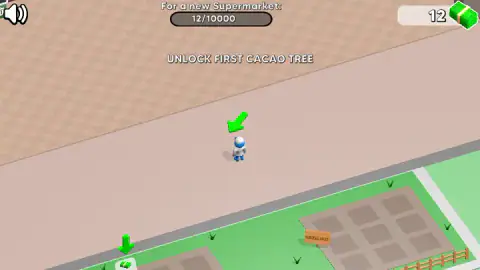
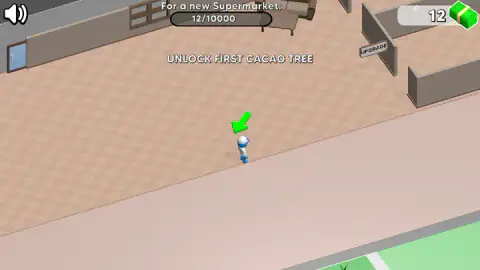
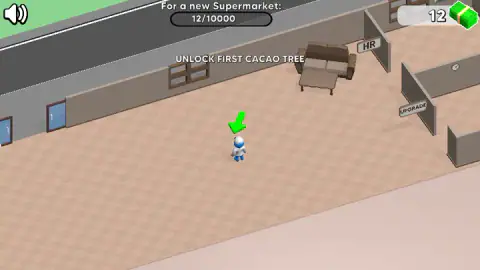
Taken by opening the game ourselves and letting it run — not supplied by the publisher, and not the same picture every other site shows.
How to play Sweet Supermarket Simulator
- Click into the game and let the opening screens pass. The character you land with is a small figure in a white helmet with a blue visor, standing outside the building.
- Move with W, A, S and D. The game also lists the mouse and touch as controls, and all of them do the same job: they steer the character. None of them selects anything.
- Follow the green arrows. One sits over your head so you can find yourself on a wide floor; the others point at the spot the game wants you standing on.
- Walk onto the wad of banknotes on the ground. Money is the bottleneck for everything else, and the game puts the first of it within a few steps of where you start.
- Read the line in the middle of the screen before doing anything else. It is the current objective, and at the start it is the cacao tree rather than anything to do with a shop.
Things worth knowing before you sit down with it:
- It is a standing game, not a clicking game. We spent a long time clicking at the scenery, at the signs and at the character, and none of it did a thing. The character walks, and the walking is what triggers things. If a prompt is not clearing, you are probably beside the spot rather than on it.
- Watch the money counter, not the objective. The objective tells you what to want. The counter tells you whether you are actually doing anything. Ours sat on the same number for four minutes, which was the game telling us, politely, that we had achieved nothing.
- The signs are a map of the game's economy. UPGRADE and HR are hung over openings before you have money for either. The game says the money you earn goes into hiring staff and improving your character, and the signs tell you where that will happen when it does.
- There is no rush anywhere in it. Nothing attacked us, nothing timed us, and nothing ended. It is a game you can leave running while you work out what it wants.
Controls
| W, A, S, D | Walks your character around the shop floor and the land outside it |
|---|---|
| Mouse, or a finger on a phone | The game lists these as the same control, a way to steer the character rather than to select things |
| Walking onto a marked spot | How the game moves you on; big green arrows point at the spot it wants you on next |
| Speaker icon, top left | The only button we found outside the counters along the top of the screen |
Features
- The first objective is agricultural, not retail: a line across the middle of the screen reads UNLOCK FIRST CACAO TREE
- A counter at the top tracks progress toward a new supermarket, and it opens at 12 out of 10,000
- The ground outside the shop is divided into tilled plots drawn as grids of squares, one of them signposted HAZELNUT
- Two openings inside the building carry signs reading UPGRADE and HR
- Green arrows do the teaching: one hangs over your character, another points at a wad of banknotes lying on the floor
- An isometric camera looks down on a checkered floor, so you can see most of a room without moving the view
Game details
- Developer
- Ermac Alex
- Release date
- March 2025
- Last updated
- August 1, 2026
- Added here
- May 2025
- Technology
- HTML5 (Unity WebGL)
- Platforms
- Browser (desktop), Browser (mobile & tablet, touch)
- Classification
- Simulation , Strategy
- Saved progress
- Saving, when available, is managed by this game. Mava cannot confirm your level.
FAQ
How do you play Sweet Supermarket Simulator?
You walk a character around a supermarket and the land around it using W, A, S and D, the mouse, or a finger on a phone. Everything happens where you stand rather than where you click, and green arrows point at wherever the game wants you next. The game describes the loop as collecting ingredients, stocking shelves and earning money, which then unlocks new shelves, staff and eventually new supermarkets.
What is the cacao tree in Sweet Supermarket Simulator?
The game's opening objective is a line reading UNLOCK FIRST CACAO TREE, and it is the first thing on screen before any shelf or any customer. The plots of bare earth outside the shop are where it goes, and the plot beside it is already signposted HAZELNUT. We did not manage to unlock it in our session, so we cannot tell you what it costs or what it produces once it is standing.
What does the number at the top of the screen mean?
The bar along the top reads For a new Supermarket and holds a counter that starts at 12 out of 10,000. It is the long goal of the game: a second shop, a very long way off. A separate counter in the top-right corner shows the money you are carrying, next to a stack of green banknotes.
Is Sweet Supermarket Simulator the same as Supermarket Simulator on Steam?
No, and they are not related. Supermarket Simulator is a first-person PC game by the studio Nokta Games, which went into Early Access in February 2024 and released fully in June 2025. Sweet Supermarket Simulator is a separate browser game by Ermac Alex, seen from above, free, and playable without installing anything.
What are the UPGRADE and HR signs for?
They hang over two openings inside the building, and we could read the signs but never got far enough to find out what is behind them. The game says the money you make goes on hiring staff and on upgrading your character, which matches what the two signs suggest. Treat that as the game's description rather than something we confirmed ourselves.
Can you play Sweet Supermarket Simulator on a phone?
It is listed for PC, Android and iOS, in both landscape and portrait, and the control list includes touch alongside the keyboard. That suggests it works with a finger on a phone held either way. We played it on a desktop with a keyboard and mouse, so we have not tested the touch controls ourselves.
Who made Sweet Supermarket Simulator and when?
The game is credited to Ermac Alex. It was published in March 2025 and last updated in August 2026. We could not find the title on any other site, so the game's listing is the only source we have for the author.
Is Sweet Supermarket Simulator hard to get started in?
Getting in is easy and getting moving is slower than it looks. The arrows tell you where to stand but not what the standing achieves, and our money counter sat on 12 for the whole of a four-minute session without ever ticking up. If nothing is happening, walk onto the marked spot and wait there rather than clicking at it.