




About Pier & Lighthouse: Merge Story
A banner came down over the board telling us it was full and we should merge, deliver or sell something. Forty-eight squares in front of us were visibly empty. Both things were true at once, and working out why is the first thing Pier & Lighthouse: Merge Story actually teaches.
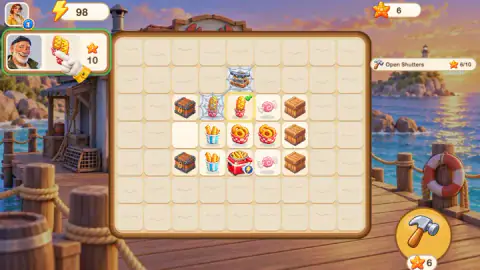
The frame is nine squares across and seven deep. Only a block of fifteen in the middle belongs to you. Every other square carries a faint wave mark and refuses to hold anything — coastline you have not won back yet. So "full" is a statement about fifteen squares, and it arrives long before the size of the grid leads you to expect it. You are always short of room, and room is bought with progress.
Inside those fifteen the work is ordinary merging. Drag a cup of crinkle-cut chips onto an identical cup and the two become something better; the red fryer in the middle is a generator you tap for more, priced on its own card at one point of energy a tap. Then the people on the pier start asking. Walt, the grey-bearded neighbour in the navy beanie, wanted one corn dog, and handing it over paid ten starfish — the only thing the hammer button in the corner will take.
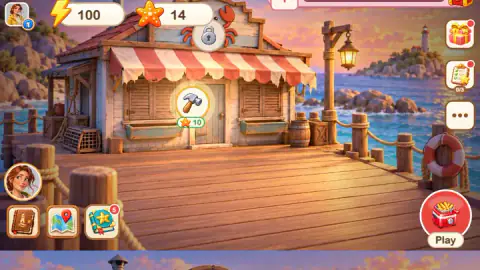
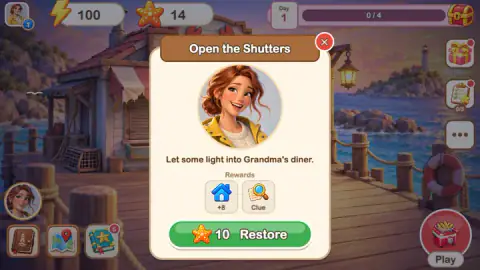
That hammer is the point of the game. Hazel has come home to a diner boarded shut under a padlock and a carved wooden crab, and the first job on the pier costs exactly ten starfish: open the shutters. Pay it and the scene changes in front of you — shutters folding back, lamps coming on behind the glass, flower boxes appearing under the windows — and two rewards come back. One is eight points toward the house. The other is labelled Clue. Behind the shutter sits an envelope in the grandmother's handwriting, saying that the lighthouse keeps the truth.
That is roughly where we stopped: shutters open, a style chosen, the letter read, the next job started. We never finished a day, never freed an item from a cobweb, never opened a padlocked chest.
The grid is sixty-three squares, and the game gives them to you slowly
The opening board feels generous and plays cramped because you are looking at the finished board through a window. Fifteen live squares hold three or four merge chains and nothing more, so every item you generate is a decision about what you will lose space for.
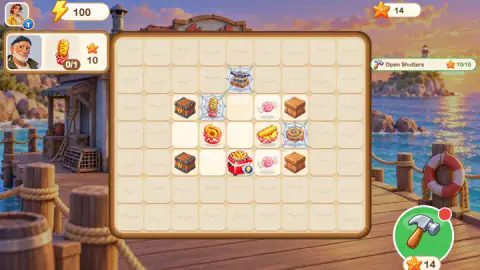
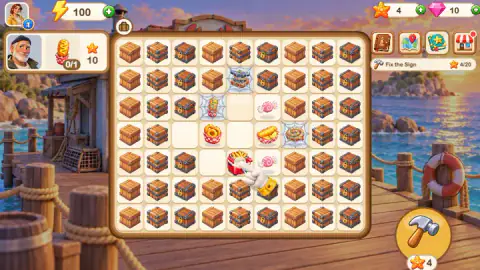
Then you finish the job, and the game shows you what the rest of the grid held. The second board — headed Fix the Sign — opens the full nine by seven, and fifty-one of those squares arrive carrying something you cannot merge. Plain wooden crates. Crates bound in grey iron. Chests with a gold padlock. Barely a dozen squares are free, in a ragged island around the fryer.
It is a neat inversion. The first board asks what you can build in a small clean space; the second asks what you can clear, with that same small space in the middle of a yard full of boxes. The three kinds of crate read as a difficulty ladder rather than decoration, and the padlocked chests are plainly the top of it.
Ten starfish is one corn dog, and the next repair costs twenty
Most cosy merge games hide their exchange rate behind a coin counter and a shop. This one puts the sum on screen at once. An order has its price beside it: Walt's corn dog was worth ten. The badge over the diner's door was also ten. So on the opening board, work and progress run one to one — deliver what the man in the beanie asked for and you have paid for the repair.
That does not last, and the game says so the moment the shutters come open. In the conversation that follows, a new badge is already sitting over them reading twenty. When the next board loads, the task pill confirms it: Fix the Sign, 4/20. The price has doubled while the board has got harder — the standard shape of this genre, delivered without a word of explanation.
A third counter sits beside energy and starfish, each of the three with a small green plus. Ours held ten gems from first screen to last and never asked to be spent.
Lighthouse keepers really did write the truth down
The letter behind the shutter sounds like a line of fiction. The idea under it is not. A lighthouse was never only a lamp on a rock; it was a staffed station, and much of the keeper's job was paperwork.
Under the instructions issued to American light-keepers in 1902, every station kept a journal: the weather, the inspector's visits, anything of note nearby. One duty was oddly specific, and it is the one that matters here — each night the keeper recorded whether the neighbouring lighthouses and lighted buoys could be seen from his own station. Surviving journals also log the hour the lamp was lit and the hour it was put out.
Put those habits together and you have this game's premise. A light going dark was not a private event. It was written down that same night by the keeper along the coast, in a book the service collected, and those books still exist as a series of their own in the United States National Archives, filed under the name of each light.
Which makes "the lighthouse keeps the truth" less of a riddle than it first reads, and explains the shape of the reward. You are not repairing the diner for the scenery, satisfying as that is — the change on that one building, from padlock and grey boards to lit windows and flower boxes, is the best few seconds in the first half hour. You repair it because the record of this coast is stuck inside its buildings, and the only way to read a page is to pay for one. Which is presumably why the journal in the town view has a lighthouse stamped on its cover.
What we never reached
An honest inventory, because the pier is longer than our session was. The game's description sets out five places to restore — the diner, the arcades, a beach cove, a boathouse and the lighthouse itself — each with a style to pick and a clue to find. We restored one. It names other generators too, a tool crate and a taffy puller; we only used the fryer. A day has a structure we never completed either: a pink bar reads Day 1 and counts to four with a locked chest at the end, a clipboard on the right counts to three, and neither moved for us. Our run ended with an advert and a black screen that never came back, and we played with a mouse, so the touch version is the game's claim rather than ours.
What we can vouch for is the tone, unusually restrained for the genre. Nobody shouts. The sun is always about twenty minutes from setting. Walt says the shutters are open and that Marnie would have had the fryer going by now, and that line does more work than most of these games manage in an hour.
More things to merge and mysteries to open
If the merge-and-serve loop is what you came for, Coffe Merge House runs the closest version, with generators and customer orders behind a counter, and The Flowers Merge and Sell Bouquets turns the same idea into a garden you keep clearing. Crazy Merge Room strips out the restoration and leaves the board. If it was the boarded-up building and the letter that pulled you in, Mystery of the Old House: Hidden Objects works that half, and Sea Legends - Match 3 keeps the coast and the shipwrecks. The rest are in puzzle games.
Screenshots
How to play Pier & Lighthouse: Merge Story
- Drag one item onto an identical item. The pair becomes a single better one, and that is the whole core verb.
- Tap the fryer when you need raw material. Its card reads Old Fryer, Level 1/4 and says each tap uses one energy.
- Drag a finished item to the character on the left. The panel shows what they want and what it pays in starfish.
- Press the round hammer button to leave the board for the pier, then press Restore on the building you are fixing.
- Read the scene that follows. Each repair brings a short conversation and a clue, then a new job at a new price.
What only playing it teaches:
- "The board is full" means fifteen squares, not sixty-three. Count the pale ones, not the whole frame.
- Watch the hammer button's colour, not the number. Amber while you are short, green with a red dot the moment you can pay. At six starfish it was amber; at fourteen, green.
- The price goes up fast. The shutters cost ten, the sign behind them twenty. The rhythm of the first board will not carry the second.
- One good order is worth a whole repair. Walt's corn dog paid ten starfish, the entire price of opening the diner. Chasing orders beat merging for its own sake.
- Cobwebs do not clear by wishing. The same webbed machine sat in the same square from our first board to our last. Treat a webbed tile as a wall.
- Energy is not the brake. It only drains when you tap a generator; ours climbed back to a hundred and stayed.
Controls
| Drag with the mouse | Pulls one item onto another. Two identical items become a single better one |
|---|---|
| Click a generator | Taps the fryer in the middle of the board to produce a new item. Its own card says each tap costs one energy |
| Click the order panel | Hands a finished item to the character waiting on the left and collects the starfish the order is worth |
| Click the hammer button | Leaves the board for the town view. The button is amber when you cannot afford the next repair and green with a red dot when you can |
| Click Restore | Pays the repair in the town view. The first one on the pier costs ten starfish |
| Tap or Skip | Advances the conversation scenes. Each one offers Tap to continue in the middle and Skip on the right |
| Touch and drag | The touchscreen equivalent of all of the above, per the game's own listing. We played with a mouse |
Features
- The grid is sixty-three squares but only fifteen of them are in play at the start, and the game still tells you the board is full when those fifteen fill up
- Orders are paid in starfish, not coins, and starfish are the only thing the repair button accepts
- One corn dog handed to the man in the navy beanie was worth ten starfish — the exact price of the first repair on the pier
- Repairs pay back a clue as well as scenery: the reward panel lists eight points for the house and one Clue
- The repair button changes colour rather than greying out — amber while you are short, green with a red dot the moment you can pay
- Finishing one job opens the rest of the grid, and the new squares arrive loaded: fifty-one of the sixty-three carried a crate or a padlocked chest
- Three counters run along the top with a green plus on each, and a pink Day bar ends in a locked chest
Game details
- Developer
- Partner studio
- Release date
- October 2026
- Last updated
- October 25, 2026
- Added here
- October 2026
- Technology
- HTML5 (2D)
- Platforms
- Browser (desktop), Browser (mobile & tablet, touch)
- Saved progress
- Saving, when available, is managed by this game. Mava cannot confirm your level.
FAQ
How do you play Pier & Lighthouse: Merge Story?
You drag one item onto an identical item to turn the pair into a single better one, and you tap the fryer on the board to make more raw items, at a cost of one energy per tap. Characters standing to the left of the board ask for finished food, and filling an order pays you in starfish. Starfish are then spent through the hammer button on repairs in the town view, which is how the pier gets rebuilt.
Why does Pier & Lighthouse: Merge Story say the board is full when it looks empty?
Because the part you can use is much smaller than the part you can see. The grid is nine squares across and seven deep, but at the start only a block of five by three in the middle is live; the rest are marked with a faint wave and will not hold anything. When those fifteen squares are occupied the game puts up a banner asking you to merge, deliver or sell, even though dozens of squares look free.
What are starfish for in Pier & Lighthouse: Merge Story?
They are the game's repair currency. You earn them by handing finished items to the characters' orders, and you spend them in the town view on the building you are restoring. The first job on the pier, opening the diner's shutters, costs ten starfish; the next one we were shown, fixing the sign, costs twenty.
What is the story in Pier & Lighthouse: Merge Story?
Hazel comes back to the pier where her late grandmother ran a diner and finds the place boarded up. An old neighbour called Walt helps her open the shutters, and an envelope in the grandmother's handwriting turns up behind them, reading that the lighthouse keeps the truth. Each repair you pay for returns another clue, so the mystery is unlocked by the merging rather than told alongside it.
Does Pier & Lighthouse: Merge Story run out of energy?
Energy is only spent when you tap a generator to make a new item, so merging and delivering cost nothing. Ours sat at ninety-eight at the start, climbed back to a hundred during the session and stayed there, and we were never short. The game's own listing says energy refills over time, which matches what the counter did.
Is Pier & Lighthouse: Merge Story free, and does it have ads?
It is free and runs in a browser with nothing to install. One the advert appeared over the game during our session; after it the screen went black and the game did not come back for us, which is worth knowing before you settle in. There are also gem and energy counters with a plus button beside each, which we never pressed.
How many places can you restore in Pier & Lighthouse: Merge Story?
The game's own description promises five along the pier — the diner, the arcades, a beach cove, a boathouse and the lighthouse itself — with a new style to choose and a new clue at each one. We only reached the first, so the rest is the listing's claim rather than ours. What we can confirm is that finishing the diner's shutters immediately opened a second, much more crowded board.
Can you play Pier & Lighthouse: Merge Story on a phone?
The game lists mouse and touch, and dragging one tile onto another is a gesture that suits a touchscreen better than most puzzle controls. We played it with a mouse on a computer, so the phone version is the listing's claim and not something this page has tested. The board is wide, so a tablet is likely the kinder of the two.