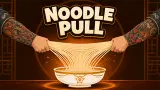





About Noodle Pull
Most cooking games hand you a dozen jobs at once: chop this, fry that, mind the queue. Noodle Pull has one job, and it took us four minutes to fail at it in every way the game allows.
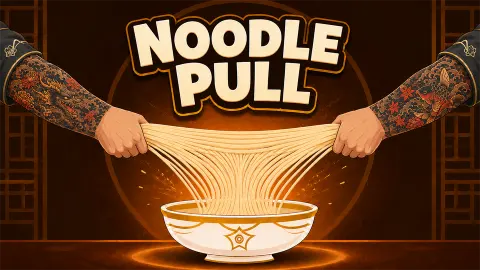
You are a pair of hands over a bowl. You hold the mouse button and the hands draw a piece of dough apart. You let go, and the dough either holds or tears. That is the whole game, and everything else on screen is a way of raising the price of that one decision.
We have to be straight about our session. We cleared the practice pull, met four of the five customers on level 1, and did not serve a single one of them a proper bowl. So this page is strong on how the game is laid out and how it punishes a mistake, and it says where our knowledge stops.
The game's listing credits the game to Elvian Studio. It has been available since September 2026.
One torn dough ends the order
The game is not gentle about a bad release. A red "SNAP!" lands across the screen, the dough hangs in two halves over the bowl, and the order is over.
The card that follows is hard to misread. It shows the finished bowl with "1 STRANDS · STANDARD QUALITY" under it, the words ORDER FAILED, three grey stars and a red label: "0 STARS · $0". Below that, the customer's name and "NEEDS ANOTHER BOWL".
We saw that card six times and no other. The money counter in the header read $0.00 at the start and $0.00 at the end.
What a failed order does not do is stop the level. Press CONTINUE and the next customer walks in. The queue moved on from Maya to Kenji, from Kenji to Mei and from Mei to Theo, and we had failed each of the first three. A row of five small bars sits at the foot of the ticket, and the first was already lit when Kenji arrived, although Maya had gone without her bowl.
The ticket does the arithmetic: every pull doubles the bowl
The left side of the screen is an order ticket, and it is worth more attention than the hands.
Maya, the first customer, wants 16 strands for one star. Her ticket says "4 PULLS TO SERVE" and shows the count at 1 of 16. One strand becoming sixteen in four pulls can only mean each good pull doubles what you hold: two, four, eight, sixteen.
| Customer | One star | Two stars | Three stars |
|---|---|---|---|
| Maya, first in the queue | 16 strands | 32 | 64 |
| Kenji, an office regular | 32 strands | 64 | 128 |
| Mei, a neighborhood regular | 32 strands | 64 | 128 |
| Theo, a track athlete | 32 strands | 64 | 128 |
So each extra star costs exactly one more pull. Maya's best bowl is six clean releases in a row, and Kenji's is seven. And since one torn dough ended every order we played, the question the game keeps asking is how much you trust your next release.
All four asked for the same dish, the house hand-pulled noodles. We never reached the fifth customer.
Ten stars out of fifteen, and what two failures cost
The ticket also carries the target for the level: 10 stars to open the next one, 15 for mastery. Five customers at three stars each is 15, so mastery means a perfect level.
Ten is less forgiving than it sounds. A failed order is worth nothing, so one failure leaves 12 stars on the table and a second leaves 9. Two failed orders put the next level out of reach, unless stars carry over from one attempt to the next. We could not check that, because we never banked one.
That is why a modest bowl can be the right call. Two stars from each of the five customers is exactly ten.
The green zone shrinks when a customer is waiting
The practice pull is kinder than the real thing. On the practice bar the green zone covered about a sixth of the length. With a customer's ticket on screen it was nearer a ninth.
It also moves. In practice it sat well to the right of the middle. On the orders it was closer to the centre, and not in the same spot twice. You cannot learn one hold by heart and repeat it.
There is an amber band on each side of the green. We never released inside it, so we do not know whether it gives a weaker pull or a torn dough.
Real hand-pulled noodles double too
The game did not invent its arithmetic. Hand-pulled noodles are a real Chinese technique called lamian: la means to pull or stretch, and mian means noodle. The cook stretches a rope of dough to about an arm's span, brings the two ends together and pulls again. Each time, the dough is twice as long in total and much thinner.
Fold a rope in half and you have two strands. Do it seven times and you have 128, which is Kenji's three-star bowl to the strand. The oldest known description of the method is in a Chinese dietary manual from 1504.
A real cook faces the same wager as you do. The thinner the strands, the easier they break, and a break cannot be mended.
The kitchen break
Twice in four minutes the game stopped behind a card that read "A quick kitchen break", with a note that progress is saved and service resumes after the ad. No advert played for us either time, and the game came back after a few seconds.
Who it is for
Someone who likes a single skill tested hard: one button, one bar and a growing reason to be nervous. A level is five short bowls.
It is not a restaurant management game. We saw no stove, no menu to plan and no second dish. The header has a MENU button and a counter called Craft that stayed at 0, and we opened neither door, so what the money buys is something this page cannot tell you.
More games about timing, and about soup
Chubby Duck Jump is built on the same hold and release, with a jump in place of a pull. Pick a Lock asks for one well-timed tap per pin and also sends you back for one mistake. If you came for the food, Cook Soups: 3 in a Bowl is a matching puzzle played in a pot, and Paws And Pals Diner is the restaurant with tables to run that this game is not. The rest are under cooking games.
Screenshots
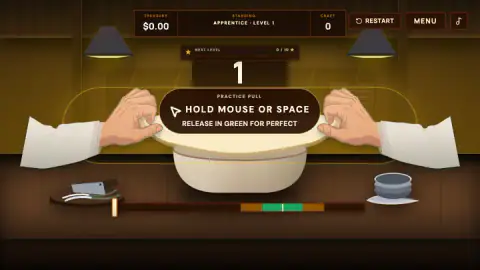
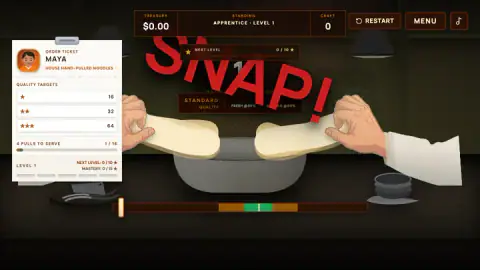
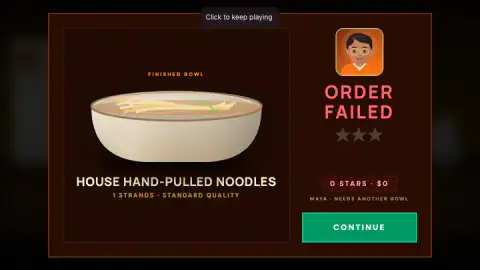
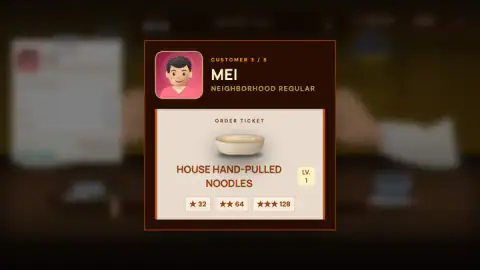
Taken by opening the game ourselves and letting it run — not supplied by the publisher, and not the same picture every other site shows.
How to play Noodle Pull
- The game opens on a practice pull. Hold the left mouse button, or the Space bar, and a marker starts moving along the bar at the bottom of the screen.
- Let go while the marker is inside the green zone. The sign on screen puts it in six words: "RELEASE IN GREEN FOR PERFECT".
- Take the first order. A card introduces the customer, and a ticket on the left lists how many strands earn one, two and three stars.
- Pull again, and again. The ticket tells you how many pulls stand between you and the first star.
- When the bowl is done, a result card shows the stars and the money. Press CONTINUE for the next customer.
What four minutes taught us:
- A click is not a pull. We tapped the mouse the way you would press any button. The marker stayed at the start of the bar, and six orders in a row ended with a torn dough.
- Hold for longer than feels natural. Our one success was the practice pull, with Space held for about a second and a half.
- Read the ticket before you pull. It tells you how many pulls the cheapest star costs, and that number changes from one customer to the next.
- RESTART is not a retry of the bowl. Twice it sent us back to the first customer of the level.
Controls
| Hold the left mouse button | Stretches the dough and moves the marker along the tension bar |
|---|---|
| Hold Space | Does the same as holding the mouse button |
| Release | Ends the pull; inside the green zone it counts, far outside it the dough snaps |
| CONTINUE | Leaves the result card and calls the next customer |
| RESTART | Sent us back to the first customer of the level |
Features
- One move for the whole game, hold and release, with the mouse or the Space bar
- A tension bar whose green zone is narrower with a customer waiting than in the practice pull
- Five customers a level, each with a name, a short description and an order ticket
- Three star targets on every ticket, counted in noodle strands, from 16 up to 128 on level 1
- Ten stars out of a possible fifteen to open the next level
- A result card for every bowl, with its strands, its stars and the money it earned
Game details
- Developer
- Elvian Studio
- Release date
- September 2026
- Added here
- August 2026
- Technology
- HTML5
- Platforms
- Browser (desktop)
- Saved progress
- Saving, when available, is managed by this game. Mava cannot confirm your level.
FAQ
What is Noodle Pull?
Noodle Pull is a free browser game credited to Elvian Studio. You play a noodle cook who stretches a piece of dough by holding the mouse button or the Space bar and letting go at the right moment. Each customer wants a bowl with a set number of strands, and the bowl is paid in stars and money.
How do you pull the dough in Noodle Pull?
Hold the left mouse button or the Space bar and watch the marker travel along the bar at the bottom of the screen. Let go while it is inside the green zone. A quick click does not work, because the marker has barely left the start and the dough snaps.
Why does it say SNAP in Noodle Pull?
The red SNAP! means you released at the wrong point of the tension bar and the dough tore. In our session that ended the order at once, with a bowl of one strand, no stars and no money. It happened to us every time we clicked instead of holding.
How many stars do you need to pass a level in Noodle Pull?
The order ticket on level 1 asks for 10 stars to open the next level and 15 for mastery. There are five customers and each bowl is worth up to three stars, so 15 is a perfect level. We did not earn a star in our session, so we cannot say how level 2 differs.
How many pulls does a three-star bowl take in Noodle Pull?
The ticket counts the pulls for you. The first customer's one-star target of 16 strands is marked as four pulls, and the next customer's 32 as five, so each good pull doubles the strands. By that count her three-star bowl of 64 takes six clean pulls and a bowl of 128 takes seven.
What happens when you fail an order in Noodle Pull?
You get a card that reads ORDER FAILED with three empty stars, and the game notes that the customer needs another bowl. Pressing CONTINUE brings the next customer in the queue, so the level goes on. The lost stars still count against the ten you need.
Can you play Noodle Pull on a phone?
The game's listing gives PC as its platform, in landscape. We played on a desktop computer only, with the mouse and the Space bar, so we cannot tell you how it behaves on a touch screen.
Who made Noodle Pull?
The game's listing credits Elvian Studio. The game was published in September 2026.