




About Line Control
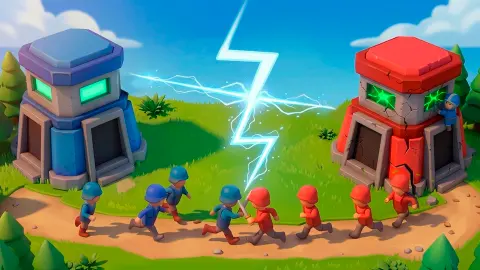
Most strategy games ask you to pick a unit, click where it should go, and then do it again. Line Control asks for one drag and lets it run. You pull a line from your building to another, and small soldiers walk along it on their own, in single file, until you cut it.
That changes what a decision is. You are not sending one squad, you are opening a supply route, and it stays open. The question in each level is less "where do I attack" than "which of my lines is still feeding a building that no longer needs it".
You are not the only one drawing them. From level 2 an orange line comes the other way, out of the red building into one of yours, and the number over your roof starts falling while you look elsewhere.
Line Control is by DudaGames, the studio behind the castle-defence game Merge Elementals, and was published in June 2026.
Capture all buildings to win: what a level looks like
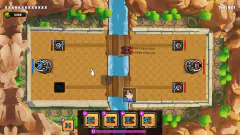
Every level we have seen is the same small valley from straight above: a strip of green grass across the middle, bare orange ground above and below it, brown rocks piled outside that. Rows of blue spiked posts stand on the grass like fences, far out on the left and right in level 1, and between the buildings themselves in level 2.
The buildings are not towers in the castle sense. Each is a squat machine on tracks with a coloured head, a number floating above it, and three slots down its body. The colour says who owns it: blue is you, grey is nobody, red is the enemy. The number says how many soldiers are inside.
Level 1 is a lesson with nobody shooting back: one blue building of yours, one grey in front of it, then two more once that is done. When the last turned blue the field dimmed, a cartoon soldier threw his arms up under a green banner reading "YOU WON!", and a CONTINUE button appeared.
Level 2 lines four up instead: a red one, one of yours and a grey one in a row across the grass, with a second blue one of yours below them. The bar at the top is no longer solid blue. It is part blue and part red, a running tally of who holds how much of the valley.
The numbers are a clock, and it only runs for owned buildings
The figure over each building is not a label. It counts up by itself, and only for buildings that belong to somebody.
We played level 2 from its opening three separate times, and the neutral grey building on the right sat at 5 from the first second to the last on every attempt.
The red building beside it did not. Over the same stretch it climbed from 3 to 12, and ours more than tripled, with nobody touching either one.
So neutral ground waits for you and enemy ground does not. The grey building costs the same late as early; the red one you ignore becomes several times the problem it was a minute ago. That asymmetry is most of the strategy here, and it is why the game's own page tells you to grab the free positions first.
The lines run both ways, and their colour says whose they are. Ours are pale blue with white dots; the enemy's are orange with red ones. The first orange line we saw was already pouring into a building of ours, which fell from 6 to 1 in the time it took to look twice. Moments later it was doing both jobs at once: taking the orange line on one side and pushing a blue one out of the other into the grey building, which shed debris as it dropped.
Swipe to cut the path
Cutting is the second thing the game teaches, and the fussiest gesture in it. Once your first building is captured, a pale white circle closes around the pair and the caption "Swipe to cut the path" appears beside the line still running between them.
Why bother? Because a line is a commitment. For as long as it is open, soldiers keep leaving your building for that one destination, and a building you have already taken no longer needs them. The game's page puts the same idea as a warning not to spend all your squads at once. The cut is how you take that back.
A straight drag from above the line down through it has removed one for us: by the next look the path was gone and the building at its end was still ours. Other times we crossed the same line a dozen ways and it stayed exactly where it was. If it does not take, keep drawing new lines and try again later.
Upgrade the Tower, and what "max" actually means
It is tempting to read the word max, which replaces a building's number, as "fully upgraded". It is not. One of ours read max while its three slots were still empty: a bare shell we had captured a moment earlier. The word means the soldiers inside have hit that building's ceiling, so the count stops.
Upgrading is the other thing, and the game shows it down the body rather than on the roof. Our starting building in level 1 has all three slots glowing green; one you have just taken has the same three, dark. Level 2 opens with a white cartoon glove tapping one of your blue buildings under the words "Upgrade the Tower". That building had a single slot lit at the start of the level and two lit by the time it read 17.
What we cannot tell you is the price. We never caught the moment a slot lit, so we do not know whether an upgrade spends soldiers, or what the third slot does to a building that already reads max.
Where the idea comes from
Drawing routes between buildings that fill up on their own is an old, much-copied design. The best known ancestor is Galcon, a space game by Phil Hassey that reached the iPhone in 2008. There the buildings were planets and the soldiers were ships, and every planet you held kept making more while you decided where to send them.
Line Control keeps that core and changes two things. It swaps space for a sunny valley, and one-off fleets for standing lines, so you think in routes rather than single attacks. The numbers do the same job as Galcon's planet counts: they show you at a glance which fight you can win.
Who it is for
One drag, one swipe and one tap are the whole control scheme, so a child can pick it up and a phone handles it as well as a desktop. It suits anyone who wants strategy without menus or resources to juggle.
It is not a big war game. There is no army to build, no map to explore and no story. We never finished level 2, so we cannot say how hard the red side gets or how many levels there are. If you want long battles with many unit types, this is the wrong game; if you want short rounds of "which line do I open next", it is the right one.
More strategy games
Merge Elementals: Castle Defense comes from the same studio and trades routes for merging fighters along a castle wall. Pixel Conquest is another map-colouring fight, where you draw trails to claim ground instead of lines to claim buildings. Kingdom Tower Defense turns the idea around: you hold towers against waves rather than taking them. More games that reward a plan are in our strategy category.
Screenshots
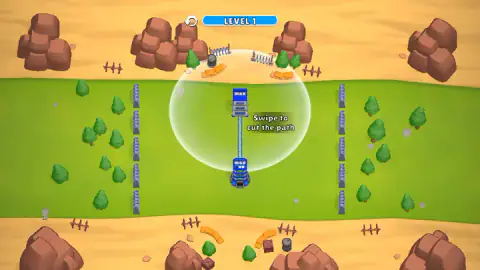
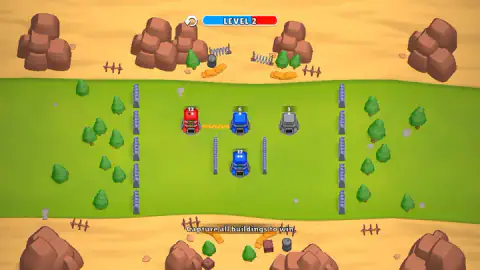
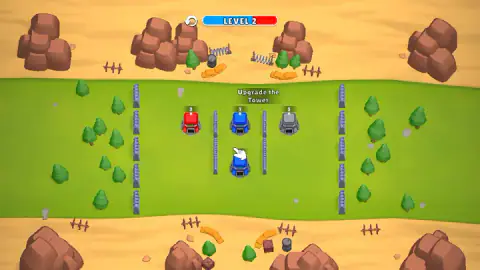
Taken by opening the game ourselves and letting it run — not supplied by the publisher, and not the same picture every other site shows.
How to play Line Control
- Find your building. It is blue, it sits at the bottom of the grass, and in level 1 it is the only one fully built, with three slots glowing green down its body.
- Press on it and drag to the grey building in front. The game lights that one with a pale white circle labelled "Capture Tower".
- Watch the line fill. Soldiers leave your roof one at a time, and when enough arrive the grey building turns blue and its number starts climbing.
- Swipe across a line to cut it when the far end no longer needs feeding. The game spells this out as its second lesson: "Swipe to cut the path".
- Keep taking buildings until nothing grey or red is left. The rule sits along the bottom of the screen throughout: "Capture all buildings to win."
Tips from our run:
- Start the drag on top of the building, not near it. Our first minutes produced nothing; the line only appeared once we began the drag squarely on the blue roof.
- A zero is a free building. When level 1 opened out it put two grey ones side by side, showing 5 and 0. The one on zero costs a single soldier.
- One building can feed two lines. We ran a route to the 5 and a second to the 0 from the same base, with the first still moving.
- Hurry for the red ones, not the grey ones. Grey buildings do not grow and red ones do, so every second you spend elsewhere makes the enemy dearer and the neutral building no dearer at all.
Controls
| Drag from one of your buildings to another building | Draws a line between them; soldiers leave your roof one at a time and walk along it |
|---|---|
| Swipe across a line | Cuts the path, as the level 1 lesson asks. It is the fussiest gesture in the game |
| Tap one of your buildings | Upgrades it. Level 2 opens with a white glove tapping one of yours and the words "Upgrade the Tower" |
| Circular arrow beside the level bar | Sits to the left of the level name at the top of the screen; we never pressed it |
Features
- Orders are standing lines, not clicks, and a route you draw keeps carrying soldiers until you cut it
- The number over a building is a clock, and it only ticks for buildings somebody owns
- Neutral grey buildings never grow, so a free one costs the same late as it does early
- The enemy draws lines too, in orange, and can drain one of your buildings while you are looking elsewhere
- A clear win rule printed on screen, capture all buildings to win, with no timer and nothing to destroy
- Three slots down each building's body that light up green as it is upgraded
- A bar at the top that names the level and, once there is an enemy, splits into a blue share and a red one
Game details
- Developer
- DudaGames
- Release date
- June 2026
- Last updated
- June 4, 2026
- Added here
- April 2026
- Technology
- HTML5 (3D)
- Platforms
- Browser (desktop, mouse), Browser (mobile & tablet, touch)
- Classification
- Strategy
- Saved progress
- Saving, when available, is managed by this game. Mava cannot confirm your level.
FAQ
What is Line Control?
Line Control is a free browser strategy game by DudaGames, published in June 2026. You own blue buildings, drag lines from them to grey and red ones, and small soldiers walk along those lines to take them over. A level is won when every building on the map is yours.
How do you play Line Control?
Press on one of your blue buildings and drag to another building. A pale blue line appears and soldiers start walking along it in single file. Swipe across a line to cut it, and tap one of your own buildings to upgrade it. Each building shows a number, and you want yours to be bigger than the one you are attacking.
How do you win a level in Line Control?
The game prints the rule along the bottom of the screen, Capture all buildings to win. There is no timer and nothing to destroy. In level 1 that meant three grey buildings and no opponent; when the last one turned blue the screen dimmed and a green banner reading YOU WON came up with a CONTINUE button.
What do the numbers on the buildings mean?
They are how many soldiers are inside, and the number only climbs for buildings that belong to somebody. We watched the same level three times and the neutral grey building sat at 5 throughout, while the red one went from 3 to 12 and ours from 5 to 20 with nobody touching them.
What does max mean on a building in Line Control?
It means that building is full, not that it is fully upgraded. When the count reaches the ceiling the number is replaced by the word max. One of ours read max while its three upgrade slots were still empty, so the word is about soldiers inside, not about how built up the building is.
What does Swipe to cut the path mean?
A line you draw is a standing route, not a one-off order, so it keeps sending soldiers to the same place until you remove it. Swiping across it cuts the path. It is the fussiest gesture in the game. A straight drag down through the line worked for us once, and other attempts left the line exactly where it was.
Does the enemy attack you in Line Control?
Not in level 1, which is a lesson with only neutral grey buildings. From level 2 the red side draws lines of its own, in orange with red dots. One ran into a building of ours and dropped it from 6 to 1 in about ten seconds while we were busy elsewhere.
Is Line Control free and does it work on phones?
It is free in the browser with no download. The game's page lists PC, Android and iOS, and everything is a drag, a swipe or a tap, so it plays the same with a finger as with a mouse.