
About Strategy of War: Tanks and Helicopters
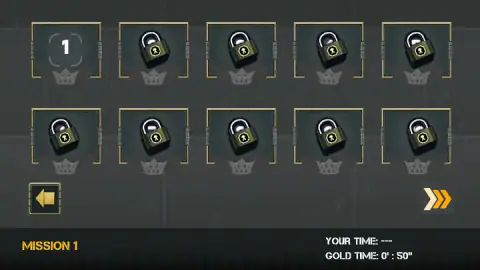
Before the first mission begins, the game tells you what it actually wants from you. Under the grid of locked missions it prints YOUR TIME, with three dashes where your record would be, and then GOLD TIME, set at fifty seconds. Not win. Win inside fifty seconds.
We took almost four minutes on that first mission and still had red bases on the board when we stopped.
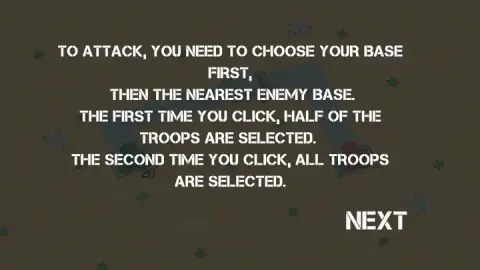
Everything in between runs on one rule, and the game puts it on a card before it lets you touch anything. Each base is a domed tent on a pad with a number beside it, and that number is the troops standing inside. Click one of your bases, then click another, and a column rolls out along the road that joins them. One click sends half of what you have. Two clicks send everything. There is no build menu, no unit types to choose between, no resources to gather. You decide where troops go and when, and that is all you decide.
The game is credited to 3S Games. It went up in December 2024. That page is also the only source we could find on any of it, so treat the credit as one source rather than three.
What follows is an account of one mission, played for four minutes on a desktop with a mouse. We never captured every base, so we never saw a win screen, a second mission or a crown turn from grey, and we never saw a helicopter either. What we did get is the rule the whole thing runs on, watched twice on the counter.
The clock counts up, so fifty seconds is a target and not a deadline
The timer at the top of the battle screen counts upwards. We watched it pass fifty seconds, pass a minute, and keep going while the mission carried on exactly as before. Nothing failed. There is no clock running out.
The gold time is a par score instead. The mission grid shows YOUR TIME against GOLD TIME, and under every tile on that first page sits a crown, grey and empty. Ours was still grey when we left.
Which makes the slow, safe, accumulate-everything approach the wrong one. You can win by sitting on a full base, letting it refill and grinding the enemy down over several minutes. We essentially tried. The game allows it, and then quietly leaves the crown grey.
One click sends half, two clicks send all, and why half is usually the wrong half
The card says it. The counter proves it. Our green base was holding twenty-three troops when we clicked once on a target, and when we looked back it was holding twelve.
It happened again later. The base was on thirty, one click sent a floating yellow 15 off down the road, and thirty became fifteen. Half both times, rounded in the home base's favour.
So why not always send half and keep a cushion at home? Because of a piece of arithmetic that is more than a century old.
In 1916 an English engineer named Frederick Lanchester published a book on the then-new business of flying, and in it he set down what he called the N-square law. When every unit on each side can engage any unit on the other, he argued, a force's strength does not scale with how many you have. It scales with the square of how many you have. Doubling the quality of your units gives you twice the force. Doubling their number gives you four times it.
Translate that into clicks. A full base emptied into one target is not merely twice the force of half of it sent twice over; by that arithmetic it is four times the force.
Send half now and half a little later, and the defender fights two small battles it can win, one after the other, instead of the big one it cannot. The two halves of your army never meet. The game hands you that trap as its default, because one click is easier than two.
So: half is for reinforcing something of yours, all is for taking something of theirs. A column sent to a base you own only adds to the garrison and risks nothing. A column sent at a defended base has to arrive bigger than what is waiting there, and both numbers are printed on the screen before you commit.
Lanchester's law is a simplification written for a world of straight lines and even odds, and the game is simpler still. But it is why a map you were losing turns around the moment you empty your best base into one target.
Reading the map in a glance
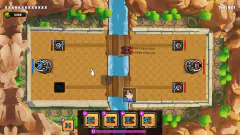
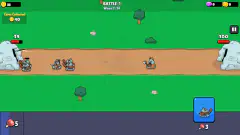
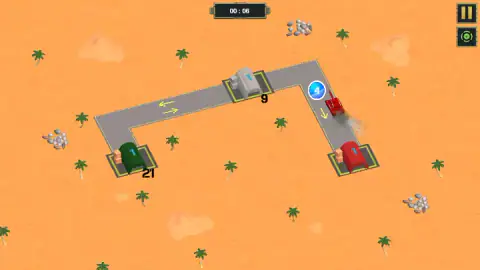
The desert board is deliberately plain: three bases, a grey road bending between them, and palm trees that are there to be looked at and nothing else.
Every dome, yours and theirs, carries a small blue 1 stamped on it. That number never moved for us all game, while the black number beside it changed constantly. One of the two is the garrison; the other is something we never found a way to raise.
The road between two bases carries a pair of yellow arrows, one pointing each way: traffic runs in both directions, and so does trouble. When fighting starts, a red cross flashes over a base or over a column on the move, and we could not pin down whether it means the same thing in both places.
Top right there are two buttons, a pause and a green crosshair. We never worked out what the crosshair does.
Desert Storm, Forest Fight, and the helicopters we never flew
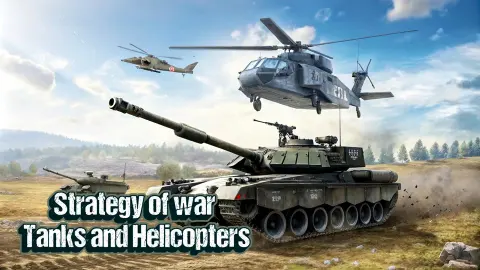
The campaign screen offers two theatres. Desert Storm is illustrated with a tank. Forest Fight is illustrated with a tank and a helicopter. We played the desert, mission one, and every unit that moved on our screen was a tank on a road. Not one aircraft.
The game's own instructions mention something we never got to test: that moving troops between a ground base and an air base costs double. If that holds, the helicopters are not a reskin but a different economy, in which the fast route across a map is also the expensive one.
The same goes for the rest. The tutorial says enemy bases come in red and yellow; mission one had only red, so we never saw a three-way fight. Somewhere between picking the mission and reaching the map there is a screen offering items to buy, with five hundred coins already in the account; we clicked straight past it and cannot tell you what any of it does. And the corner of the mission grid has a double arrow that suggests more pages behind the ten we could see.
Clear more of it than we did and you will know more than this page does.
More maps worth taking
Clash of Armour keeps the tanks and swaps the map for a straight fight. Age of Tanks: Warriors TD War puts you on the other side of the same arithmetic, holding a line instead of spending troops to cross one. Kingdom Tower Defense is the patient version, where the question is where to spend rather than when. Warfare Area is the one for when you do not want a tutorial card at all. The rest live in strategy games.
Screenshots
How to play Strategy of War: Tanks and Helicopters
- Pick a campaign. The menu has one button, CAMPAIGN, and behind it sit Desert Storm and Forest Fight. Then pick a mission from the grid: only the first one is open.
- Learn the colours before the clock starts. The game's own card puts it plainly: your base is green, enemy bases are red and yellow, neutral bases are grey. The number beside a base is its garrison.
- Click your base, then click your target. The column takes the road, and roads are the only way across the map. There is no clicking an empty patch of sand.
- Decide half or all, every time. One click, half. Two clicks, all. It is the only decision the game gives you, which is why it is worth thinking about.
- Take the grey bases first. A neutral base does not grow. We watched one sit on nine troops while ours climbed on its own, so its price never goes up. The red bases we left alone were in single figures early and far bigger later.
What the run taught us:
- Standing still is a move. Your bases refill by themselves. Ours started on twenty and was already climbing by the time we had read the tutorial, a few troops every ten seconds, with nothing asked of us.
- It stops at thirty. Our base reached thirty and stayed there for over a minute, never going higher. Troops sitting in a full base are troops doing nothing.
- A moving column has a number on it. It travels as a tank with a blue circle beside it, and that circle is how many are riding in it. The dust trail tells you which way it is going.
- The numbers are the only feedback. The game made one sound for us all session, the one it plays on opening. Nothing dings when you take a base.
- Nothing on the keyboard does anything. Arrow keys, letters, all ignored. Mouse only.
Controls
| Click your own base | Picks it as the source. The black number beside a base is the garrison it has to spend |
|---|---|
| Click a second base | Sends a column down the road towards it. One click sends half the garrison, a second click sends all of it |
| Pause button, top right | Two yellow bars in a metal frame, next to a green crosshair button whose job we never worked out |
| Music and sound icons, main menu | Turn the music and the effects off before you start. They are not on the battle screen |
| Keyboard | Nothing we could find. Arrow keys and letters were ignored; this is a pointer game |
Features
- Ten numbered missions on the first page of the campaign, nine of them padlocked until you clear the one before
- A gold time printed under every mission, fifty seconds on the first one, with a crown that stays grey until you beat it
- One click sends half your garrison and two clicks send all of it: that is the whole control scheme
- Bases that refill themselves while you think, so standing still is a move too
- Neutral grey bases that never gain a soldier, which makes their price the only fixed price on the map
- Two campaigns on the menu, Desert Storm and Forest Fight, the second one drawn with a helicopter over the trees
- Made by 3S Games
Game details
- Developer
- 3S Games
- Release date
- December 2024
- Last updated
- August 10, 2026
- Added here
- March 2025
- Technology
- HTML5 (Unity)
- Platforms
- Browser (desktop, mouse), Browser (mobile & tablet, touch)
- Classification
- Strategy
- Saved progress
- Saving, when available, is managed by this game. Mava cannot confirm your level.
FAQ
How do you play Strategy of War: Tanks and Helicopters?
Every base on the map carries a number, and that number is the troops standing in it. You click one of your own bases and then click another base, and a column drives down the road between the two to reinforce it or attack it. The mission ends when every base on the map is yours.
What is the difference between clicking once and clicking twice?
One click sends half the garrison, a second click sends all of it. The game states this on a tutorial card before the first mission, and the counter backs it up: a base of ours holding twenty-three troops was left with twelve after a single click. Two clicks empty the base and leave it open to a counter-attack.
What does GOLD TIME mean in Strategy of War: Tanks and Helicopters?
It is the target time for the mission, shown on the selection screen next to YOUR TIME. The first mission asks for fifty seconds. The clock on the battle screen counts upwards rather than down, so running past the gold time does not end anything; it just means the crown under that mission stays grey.
Are there really helicopters in the game?
Not in the campaign we played. The menu offers two campaigns, Desert Storm and Forest Fight, and only the second one is drawn with a helicopter. We played the desert campaign, where every unit on the road was a tank, so we cannot tell you how the helicopters handle.
Can you play Strategy of War: Tanks and Helicopters against another person?
We found no way to. It is listed as a multiplayer game on some pages, but the menu we met had a single button on it, CAMPAIGN, and everything behind that button was a numbered mission against the machine. No lobby, no second player, no online opponent appeared at any point.
How many missions does the campaign have?
The first page of the mission grid holds ten, arranged in two rows of five, with only the first one open and the rest behind padlocks. There is a double arrow in the corner of that page, which suggests more pages behind it, but you have to clear missions to find out and we did not get that far.
What do the colours of the bases mean?
The game explains this on its own tutorial card: your base is green, enemy bases are red and yellow, and neutral bases are grey. Neutral bases are worth taking early because they sit still, while an enemy base you leave alone keeps adding troops to the garrison you will eventually have to beat.
Who made Strategy of War: Tanks and Helicopters, and does it work on a phone?
The game is credited to 3S Games. It went up in December 2024. It is listed for PC, Android and iOS in landscape; we played it on a desktop with a mouse, so we cannot vouch for it under a thumb.