










About Temple Quest
Every temple runner since 2011 has taught you the same reflex: the path turns, so you swipe. Temple Quest does not have that move. Its arrows step you one lane sideways and nothing else, and when the causeway swings right the game simply checks which lane you are standing in. Wrong one, and you carry straight on into the water.
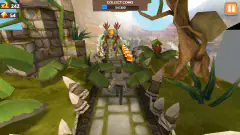
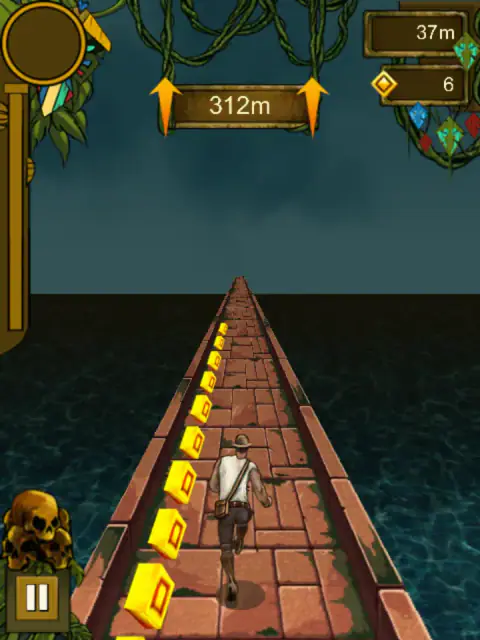
That check is the whole game. The track is a raised brick causeway over black water, three lanes wide, and three things on it can end your run: a gap you have to jump, a beam or a rock you have to get past, and a bend you have to be leaning into before it arrives. Coins run along the lanes in long strings, so you are always being tempted one step off the safe one. There is one life, no checkpoint, and a distance counter in the corner that is your score.
It was made by Inlogic Software, a studio in Košice, Slovakia, which still keeps its own copy of the game on its website. It was published in November 2019. The studio's bigger mobile game, sold on Android as Tomb Runner - Temple Raider, has passed ten million downloads and shares the same three-lane, run-and-slide design. What you play here is the stripped-down browser version of that idea.
We have played it twice. The first time we went through the tutorial, on the arrows and again on the number pad, and let a dozen runs end where they wanted. The second time, on 30 September 2026, we played eight more runs back to back to see what an ordinary session looks like.
Left and right are not steering. They are where you stand
Three lanes, and one rule: you are either left, centre or right. That is the entire movement system. What makes it feel unlike other runners is what the track does with it. A left-hand bend drops anyone not in the left lane, a right-hand bend is the mirror image, and a gap drops anyone who is not in the air.
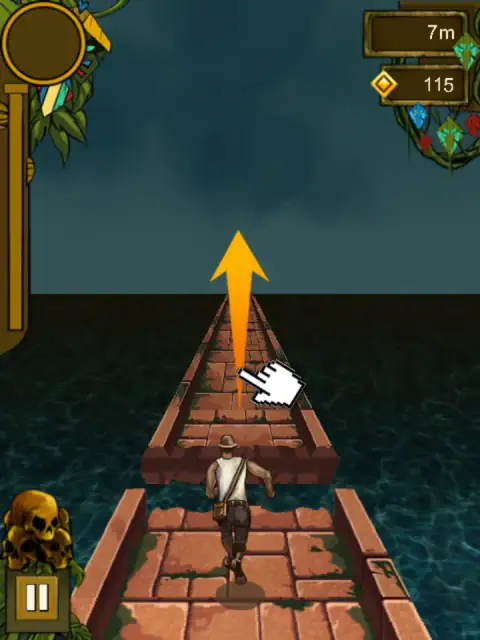
The game never draws a warning for any of it after the tutorial. The first run shows you a pointing hand and an arrow at the first bend, and then stops explaining. The result is a runner where reading the road matters more than reflexes. A bend is visible a long way off, and the player who moves early survives it; the player who waits for it to look dangerous does not.
The pressure comes from speed. The causeway runs quicker the longer you last, so a long run does not feel crowded, it feels rushed, until your hands stop arriving on time. That is the honest shape of the game, and it is why a run that reaches a hundred metres feels different from the first thirty.
What eight runs actually earn
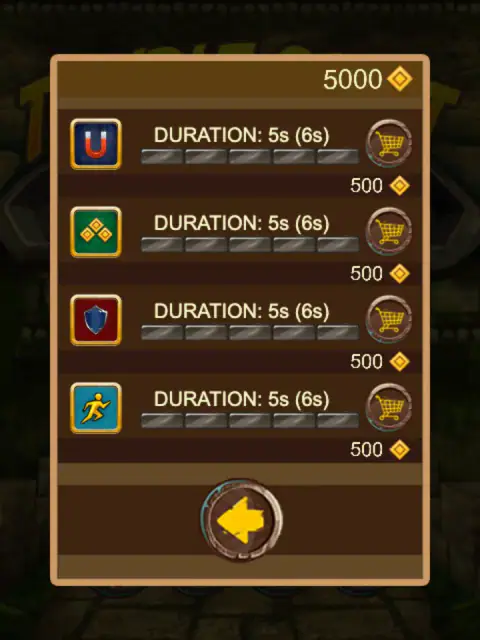
The shop sells four power-ups, shown as a magnet, a pile of coins for a coin doubler, a shield and a running figure for a sprint. Each one reads "DURATION: 5s (6s)": what it lasts now, and what it will last after the next upgrade. Under it sits a row of empty bars, one per level, and every level adds a single second.
The first level of any of them costs 500 coins. Then the prices climb: we bought three levels and paid 500, 650 and 700, and the next one was marked 850. One tap on the cart buys it, with no confirmation.
Now the other side of the ledger. In the second session, eight runs and about four minutes of play banked fewer than 200 coins.
Most runs brought back between 12 and 18. The first was the exception, at 48 coins, because it lasted longest and a longer run passes more coin strings. So the first purchase is a goal for an evening of play, not a reward after a couple of runs, and the shop is really a reason to keep going rather than a quick boost.
The other honest note: in roughly twenty runs across both sessions, we never saw a power-up appear on the track. They are in the shop from the start, but in short runs you should not expect to meet one on the causeway. They belong to the long runs.
The numeric keypad works, and that is a fossil
Press 8 on the number pad and the runner jumps. Press 2 and he slides, 4 and 6 step him left and right. We played the entire tutorial that way, one hand on the keypad, and it works exactly as well as the arrows.
Nothing on screen mentions it. The instructions panel only describes swipes. Inlogic's history goes back to 2002, when it made games for Java phones with a number pad and two soft keys under the screen, before moving to Android, Unity and the browser. A working keypad layout in a 2019 browser game is not an accident. It reads like a studio carrying a control scheme forward through platforms it was never designed for, because it never stopped working.
What this version does not have
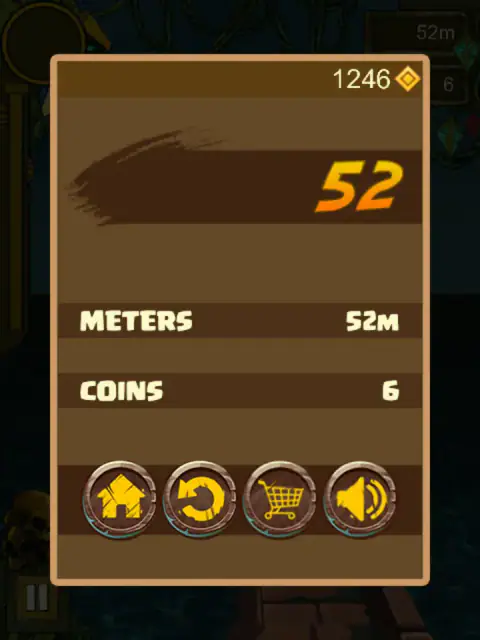
Read the description that travels with this game around other portals and you will be promised golden idols, unlockable outfits with special abilities, objectives and a growing score multiplier. None of that is here. In two sessions we never saw an outfit, an objective screen or a multiplier. The menu leads to the run and the shop, and the game over panel shows metres, coins and your bank.
Those extras belong to the phone version. What you get here instead is smaller and cleaner: run, fall, look at your metres, go again. There is no revive, which also means there is no video waiting to sell you one.
It works on a phone, in both orientations. We tested taps and all four swipes on a phone-sized touch screen, and turning it sideways gives the game a genuinely wider track rather than a stretched portrait one.
More games by Inlogic Software
The studio has three other sheets here, and they are nothing like each other: Drifting Mania, where you hold to swing a car around a post and let go to straighten; Pick a Lock, a one-tap timing game about stopping a needle on a dot; and Wild Hunting Clash, a 3D hunting game. If it is the running you came for, Relic Runway is the closest neighbour in the catalogue, and Skate Hooligans is the same idea on a board. There are more of them in arcade.
Screenshots
How to play Temple Quest
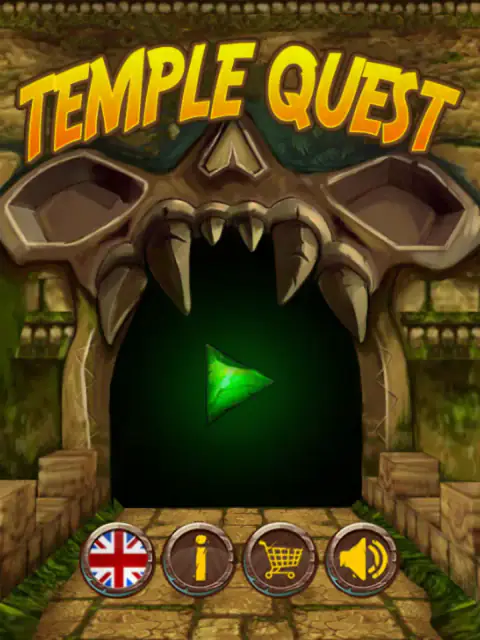
- Pick a flag. There are seven, with no names under them, one per language. Choose carefully: we clicked the middle of the screen and got the whole game in Italian, with the score panel reading METRI and MONETE. The flag screen comes back on every visit, so you can fix it next time.
- Press the green arrow in the stone skull's mouth. Your first run is a tutorial.
- Arrow up or space to jump, arrow down to slide, left and right to change lane. The tutorial shows one arrow at a time and holds the track still until you make that move, so you cannot fail it.
- Run, then spend. Coins are the only reason to leave the safe lane. They go into a bank shown at the top of the game over panel, and you spend them in the shop.
Tips from our runs
- Take the bend early. The moment the causeway starts to curve, step to the inside. If it already looks urgent, you are too late.
- Two things end most early runs. Across both sessions, runs mostly finished at a break in the causeway that wanted a jump, or at a bend we were on the wrong side of.
- Ignore the coin counter at the start. It reads 115 before you have picked anything up, in both of our sessions and on a phone. It is a leftover number, and it only starts telling the truth once you collect your first coin.
- Chase the sign. Your best distance hangs over the track on a wooden board flanked by two orange arrows. Our first run of the second session reached 139 metres, and from then on that board sat above the causeway at the start of every run.
- Nothing interrupts a run. When you fall, the score panel is already there, with restart in the second slot.
Controls
| Left / Right arrow | Step one lane left or right. There are three lanes, and this is also how you take a bend |
|---|---|
| Up arrow or Space | Jump a gap in the causeway or a low beam |
| Down arrow | Slide under a bar |
| Numeric keypad 4 6 8 2 | The same four moves, left over from the studio's keypad-phone games |
| Swipe | On a touchscreen, flick left, right, up or down |
Features
- Three lanes on a stone causeway over black water, with one life and no checkpoints
- Bends are lethal: a left-hand bend drops you unless you are already in the left lane
- Distance is the score, and your best distance hangs over the track as a wooden sign on every later run
- Four timed power-ups in the shop - magnet, coin doubler, shield and a sprint - each starting at five seconds
- Every upgrade adds one second, with five levels per power-up, and the first costs 500 coins
- Seven languages on a flag grid with no labels, which comes back on every visit
- No revive: the game over panel offers home, restart, shop and sound, and nothing else
Game details
- Developer
- Inlogic Software
- Release date
- November 2019
- Added here
- March 2023
- Technology
- HTML5 (Phaser, portrait and landscape layouts)
- Platforms
- Browser (desktop, keyboard), Browser (mobile & tablet, touch)
- Download size
- 6.4 MB
- Ad requests
- 3 (few)
- Has a save
- Yes
- Saved progress
- Saving, when available, is managed by this game. Mava cannot confirm your level.
Measured by opening the game ourselves on 2026-09-10, not taken from the feed. Twelve seconds on a phone-sized screen, with ad requests counted and blocked rather than loaded.
FAQ
What is Temple Quest?
Temple Quest is a free browser endless runner by the Slovak studio Inlogic Software. You run along a ruined stone causeway over dark water, stepping between three lanes, jumping gaps and sliding under beams, and collecting coins that buy longer power-ups. Your score is how many metres you covered before you fell.
Who made Temple Quest?
Inlogic Software s.r.o., a games studio in Košice, Slovakia. The game is credited to the company, and the studio hosts its own copy of the same game on its website. Its bigger mobile cousin, Tomb Runner - Temple Raider, has passed ten million downloads on Android.
How do you control Temple Quest?
On a keyboard, the left and right arrows step between the three lanes, the up arrow or space jumps, and the down arrow slides. The numeric keypad keys 4, 6, 8 and 2 do the same four things. On a phone you swipe in those four directions.
Why do I keep falling off the edge in Temple Quest?
Because the arrows are not steering. When the causeway bends left, you fall unless you are already standing in the left lane, and the same in reverse for a right-hand bend. Step across as soon as you see the curve coming, not once you are on it. In our runs, bends and gaps ended far more attempts than obstacles did.
How far can a beginner get in Temple Quest?
Not far at first. Across two sessions, most of our runs ended somewhere between 50 and 90 metres, and our best reached about 150. Once you learn to take bends early the runs get longer, but the track also gets quicker the longer you survive.
What do the power-ups in Temple Quest do?
The shop sells four, shown as a magnet, a pile of coins, a shield and a running figure. Each starts at five seconds, and each of its five upgrade levels adds one more second. In roughly twenty runs over two sessions we never met one on the track, so treat them as a reward for long runs rather than something you will see early.
How much do upgrades cost in Temple Quest?
The first level of any power-up costs 500 coins, the second 650 and the third 700, and the price keeps rising after that. A typical early run brings back 10 to 20 coins, so the first purchase takes a good number of runs. One tap on the cart buys straight away, with no confirmation.
Does Temple Quest have a revive or video ads during a run?
There is no revive. When you fall, the game over panel shows your metres and coins with four buttons - home, restart, shop and sound - and nothing asks you to watch a video to carry on.
Can I play Temple Quest unblocked?
It is an HTML5 game that runs in an ordinary browser tab with nothing to install, and it works on a phone as well as a desktop. Whether a school or office network allows this site is that network's decision; we do not offer ways around filters.