




About Tall Grass
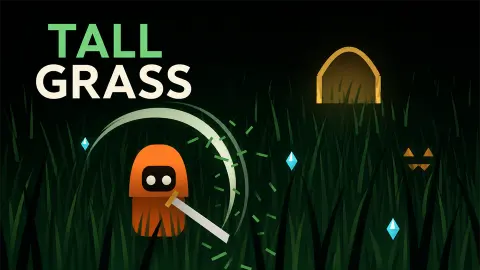
Most grid puzzles keep you outside the grid. You hover, you click, and the worst that can happen is a box telling you the game is over. Tall Grass puts you on the board. You are a small figure in an orange hood carrying a curved blade, standing at the bottom of a field seven tiles wide and nine deep, and every clump of grass between you and the gate at the top hides a shard, a heart or a monster.
Step into a clump and you cut it. If there was nothing underneath, the bare ground shows a number, and that number counts the monsters hidden in the eight tiles touching it. The game puts it on screen in its first few seconds: Tap a tile to walk there · numbers count nearby foes. A moment later the hint changes to the one you live with: Step into a foe to strike · reach the gate up top.
What stops you tiptoeing round the edges is the gate. A counter at the top reads 0 / 7 SHARDS when a field opens, and the gate stays a plain wooden arch until the bar beneath that counter is full. Shards are buried in the grass, so the only way out is to cut, and cutting is how you find monsters.
Tall Grass is by Dragon Pixel Studio. It has been available since August 2026. We played ten minutes of it on 22 October 2026 and got through two fields, the Meadow and the Hollow: two hearts lost, one found again in the grass, two upgrades taken, one gate opened, no deaths.
Minesweeper's rule, walked instead of clicked
Minesweeper shipped with Windows 3.1 in 1992 and taught a whole generation one idea: uncover a square, and if it is empty you get a number telling you how many mines sit in the eight squares that touch it, diagonals included. Nothing else on that screen helps you. The whole game lives in those digits.
Tall Grass keeps the rule unchanged, and even keeps the habit of colouring the digits: ones come up pale blue, twos a soft cream. Across both our runs we never uncovered anything higher than a two, which keeps the early fields readable.
Three things change because your feet are on the board.
The first is reach. In Minesweeper every square is one click away, so the only limit is what you can prove. Here you can only open a tile you can walk to, and the safe square you worked out may be four steps away across ground you have not read. You end up solving a path, not a square.
The second is the price of being wrong. One mine ends a game of Minesweeper. In Tall Grass the monster simply wakes up: a round green slime that sits on the cleared tile, grinning, until you walk into it to strike. You have three hearts, and they come back. We reached the second field with one heart left and picked a pink one out of the grass a few turns later.
The third is that you are never asked to finish. Minesweeper is won by clearing the whole board. Tall Grass is left by filling a shard bar, which means the last few monsters can stay buried for good if you decide the walk is not worth it.
Shards, the gate and knowing when to leave
The shard quota belongs to the field, not to you. The Meadow asked for seven; the Hollow, one field deeper, asked for eight. The progress bar is the thin blue line along the top edge of the board, which is easy to miss until you know it is there.
Above the field name, in yellow, sits the line that puzzled us the first time we played: HEART IN 12. It is not a timer and it does not count your moves. It read twelve for our whole stay in the Meadow, however much grass we cut, and it read eleven in the first frame of the Hollow. It counts fields. Twelve of them lie between the first meadow and whatever the Heart turns out to be, and you give one up each time you walk through a gate.
That makes each gate a decision rather than an exit. Leaving the Meadow with the bar full took our score from 170 to 330 by the time the next field drew itself, but it also spent one of the twelve. Staying means more shards and more upgrades, and more chances to meet something in the grass with one heart left. The run is patient about it: the title screen opens on a gold CONTINUE RUN button above PLAY, so a run you walk away from is still waiting.
Attack, cut flow and the hearts you get back
Three small things sit around the edge of the screen, and all three matter more than they look.
Top left, next to the hearts, a blade icon with a short green bar. That is your attack, and it starts at half. It filled to the top in the exact moment we took a Whetstone, the card that reads +1 Attack, and it stayed full for the rest of that run. A fresh run began at half again.
On the right, a panel marked CUT FLOW with three marks. Each clump you cut lights one. Light all three and the panel turns gold and renames itself WIDE CUT, which is the game rewarding a run of cuts rather than a cautious shuffle across cleared ground.
Then the boons. Ours arrived as the fourth shard landed: Whetstone against Seer, which promises to reveal four hidden foes. Earlier we had taken Iron Armor, whose line reads Armor blocks the next 2 hits and which puts silver plate over the orange hood; it was still on him in the next field. Under the two cards sits a gold button offering TAKE BOTH – WATCH AD: one card is free, two cost you an advert. The title screen also carries a Remove Ads button priced at one dollar.
The patch that is a different shade
Our first time out we noticed one clump drawn slightly darker than every other, and had no idea why. The game answers it itself, in a panel at the side of the field:
One grass patch in every field is a slightly different shade. Trample it — today's visitor is underneath.
It fits the rest of the furniture. The title screen shows a sun and a butterfly side by side, with the line One patch is a different shade. Find it. underneath, and a small notebook button reading 0 / 3. The day we played, the sun was the one lit. We never did find the odd patch, so we cannot tell you what the visitor does.
What we did not see
We never landed a strike, never ran out of hearts and never saw what happens when you do. We did not meet the Pumpking the game warns about, saw none of the weather it promises — rain, mist, frost, dusk — and never took the Seer card, so we cannot say how it marks the foes it reveals. Everything above is what the screen showed us in ten minutes across two runs.
Who it is for
Tall Grass suits anyone who likes Minesweeper but resented that one wrong click threw the whole board away. It gives you three mistakes, a weapon and a way out, and there is only one rule to learn. It is not an action game: no timer, no dodging, and the field will wait all afternoon while you count.
More puzzle games with something hidden in them
Pop It! is the closest relative, classic Minesweeper with surprises added to the cells. Capybas mixes Minesweeper-style deduction with Sudoku rules to find hidden capybaras, and Petdoku: Cozy Puzzle Games does the same trick with pets. More of them are in our puzzle category.
Screenshots
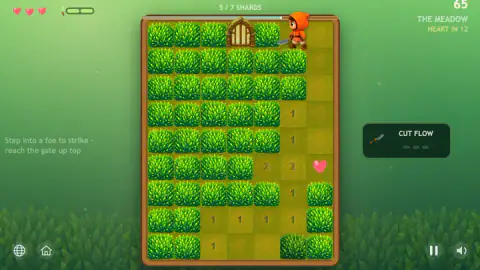
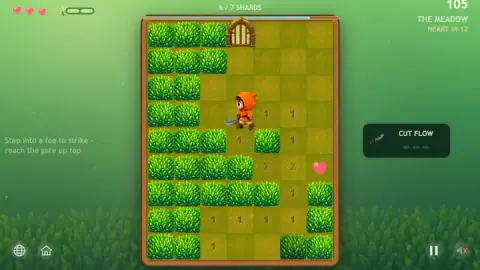
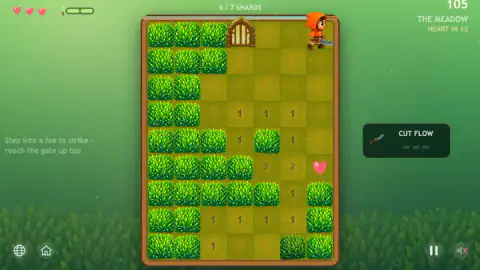
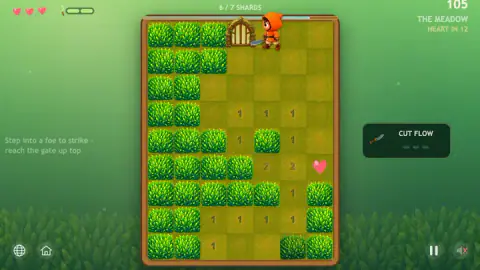
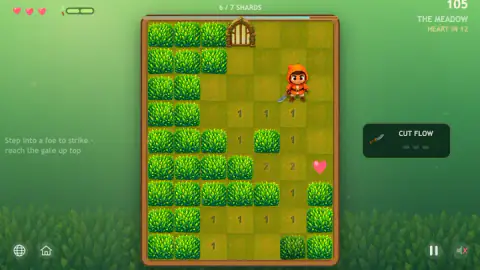
Taken by opening the game ourselves and letting it run — not supplied by the publisher, and not the same picture every other site shows.
How to play Tall Grass
- Move one tile per turn with the arrow keys or WASD. On a phone, tap the tile you want. Nothing moves until you do.
- Walk into a clump of grass to cut it. Out comes a shard, a heart, a monster, or bare ground with a number on it.
- Read the numbers. A 1 means one monster is hidden in the eight tiles around that square, corners included.
- Fill the shard bar along the top edge of the board. When it is full the counter changes to GATE OPEN and the arch glows gold.
- Walk into the gate to leave, or stay and keep cutting. If a monster is awake, walk into it to strike.
Tips from our game:
- Watch the tally, not just the tiles. Next to the shard counter, a tuft of grass carries a number: how many monsters are still hidden. The Meadow started with six. When it dropped from five to four, a green slime was sitting on the board.
- A 1 with one uncut neighbour is a monster. Leave that clump alone until you want the fight.
- Cut in streaks. Three cuts in a row light all three marks on the right-hand panel, which then turns gold.
- Leaving early is allowed. We walked out of the Meadow with three monsters still buried and most of the grass standing.
Controls
| Arrow keys or WASD | Step one tile; stepping into tall grass cuts it |
|---|---|
| Tap or click a tile | Walk there, one tile per turn |
| Walk into a woken monster | Strike it |
| 1 or 2, or Left and Right | Pick one of the two boons on the Choose a Boon screen |
| P | Pause |
| M | Mute |
| Enter or Space | Start or restart |
Features
- A field of 7 by 9 tiles where every clump of grass hides a shard, a heart or a monster
- Numbers on cut ground that count the monsters in the eight tiles around them, exactly as in Minesweeper
- A running tally of how many monsters are still hidden, six in the Meadow and four in the Hollow
- A shard quota that changes with the field, seven in the Meadow and eight in the Hollow, and a gate that reads Gate Open once the bar is full
- Boons offered two at a time, among them Whetstone for an extra point of attack, Seer to reveal four hidden foes and Iron Armor to block the next two hits
- Hearts hidden in the grass that give back the health a monster took
- A run that waits for you, since the title screen opens on Continue Run, and a one-dollar option to remove the ads
Game details
- Developer
- Dragon Pixel Studio
- Release date
- August 2026
- Last updated
- September 16, 2026
- Added here
- July 2026
- Technology
- HTML5 (2D)
- Platforms
- Browser (desktop, keyboard or mouse), Browser (mobile & tablet, touch)
- Saved progress
- Saving, when available, is managed by this game. Mava cannot confirm your level.
FAQ
What is Tall Grass?
Tall Grass is a free turn-based puzzle game by Dragon Pixel Studio that runs in the browser. You walk a field of grass one tile at a time, and every clump hides a shard, a heart or a monster. The numbers left on cut ground tell you how many monsters are hiding next to them, so it plays like Minesweeper with a blade.
How do you play Tall Grass?
Move one tile at a time with the arrow keys, WASD, a click or a tap. Stepping into grass cuts it and shows what was underneath, and a number on cut ground counts the hidden monsters in the eight tiles touching it. Collect shards until the bar along the top of the board is full, then walk through the gate in the top row.
Is Tall Grass like Minesweeper?
The number rule is the same, down to the colour coding of the digits. What changes is that you are standing on the board instead of clicking it from outside. A wrong read does not end the game, it wakes a monster you then have to walk into, and you only have three hearts to pay for those mistakes.
How do you open the gate in Tall Grass?
Fill the shard bar that runs along the top edge of the board. The quota changes with the field, seven shards in the Meadow and eight in the Hollow in our runs. When it fills, the counter is replaced by the words Gate Open and the wooden arch lights up gold, and you can leave with half the field still uncut.
What does Heart in 12 mean in Tall Grass?
It is the yellow line under the field name, and it counts fields rather than moves. It read Heart in 12 for our whole stay in the Meadow, and Heart in 11 from the first frame of the next field, the Hollow. So twelve fields separate the first meadow from whatever the Heart is.
What are boons in Tall Grass?
Boons are upgrades the game offers as a pair of cards, which came up for us as the fourth shard landed. We were shown Whetstone, worth one point of attack, against Seer, which reveals four hidden foes, and we picked up Iron Armor earlier, which blocks the next two hits and visibly puts plate on the character. A gold button offers both cards in exchange for watching an ad.
Does Tall Grass have ads?
Yes, and the game is open about where they sit. The boon screen offers to give you both cards instead of one if you watch an ad, and the title screen carries a Remove Ads button priced at one dollar, with a Restore Purchase line under it. Nothing forced an ad on us in ten minutes of play.
Can you play Tall Grass on a phone?
Yes. The game's own first hint is to tap a tile to walk there, and it is listed for both landscape and portrait screens. Because nothing on the field moves until you do, there is no rush to your taps and no gesture to time.