



About Palkovil The Way Home
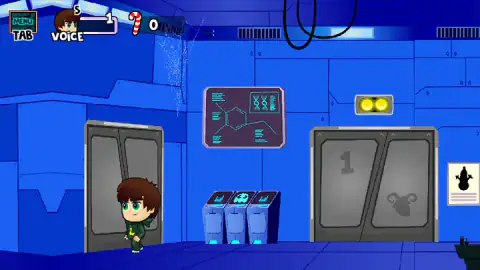
Most browser games about Christmas put you in a snowy village with a sack and a list. Palkovil The Way Home puts you in a corridor lit the cold blue of a hospital at night, with ribbed metal walls, a chemical diagram glowing green on a wall screen, and a row of two-leaf doors that open like lifts. The only thing in the building that looks like December is the string of fairy lights somebody has taped along the ceiling.
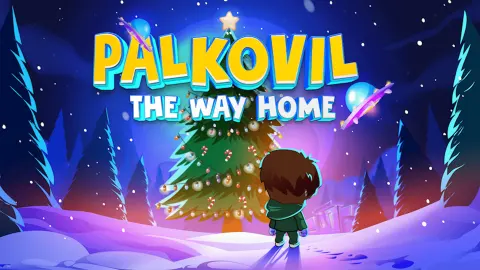
The opening screen explains the joke in one picture, before a single word of story. On the left, a decorated Christmas tree stands lit inside a glass display case, presents at its foot, a child with magenta hair looking in from outside the glass — and bolted to the case, a yellow radiation trefoil sign. On the right, in a tall glass tube with a readout on top reading -80 C, a white yeti in a lab coat and tie stands with its arms out. Two children in lab coats are busy at a machine underneath it. The holiday is in this building. It is behind glass, under a hazard sign, and the game is called The Way Home.
Three options sit stacked in the middle in yellow capitals: PLAY, SETTINGS and COMIC. The third one is unusual enough to mention and we will be honest that we never pressed it.
Press PLAY and you are a boy in a dark green tracksuit, seen from the side, standing in an open doorway. There is no tutorial screen, no pointing hand and no line of text. The only instruction the game prints anywhere is in the top-left corner, where a small green panel reads MENU with TAB under it. Everything else you work out by walking.
Our session ran about four minutes and never left that corridor. We are going to tell you exactly what we found in it, because for a game with no tutorial, the first four minutes are the whole of the argument.
Every door is labelled twice, and neither label is a word
This is the thing the game does well, and it does it without printing a single sentence.
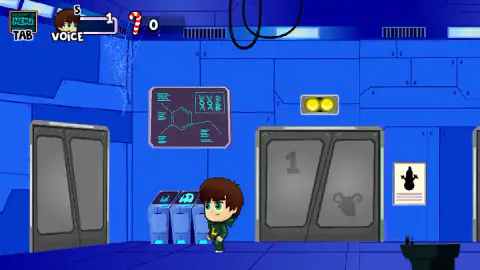
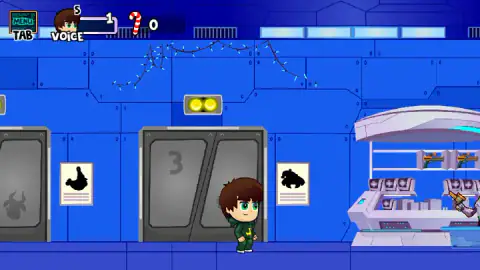
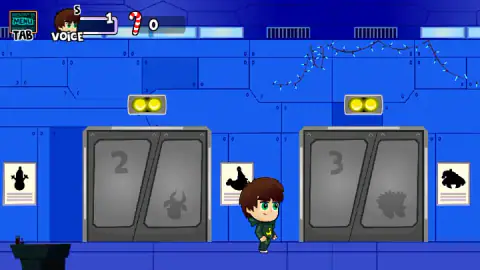
Each door in the corridor is a tall grey two-leaf unit, the kind that parts in the middle. Pressed faintly into the left leaf is a number. Pressed into the right leaf, at about the height of your head, is the outline of an animal. We walked past doors one, two and three. One and two both carry horned heads, the horns curling on the first and sweeping up on the second. Three carries something shaggy and spiked, closer to a hedgehog than to anything with antlers.
So the number tells you where you are in the order, and the picture tells you who is inside. That is a complete signpost with no language in it, which matters for a game aimed at children and translated into nothing.
The walls repeat the trick in a second register. Between the doors hang small cream cards, each printed with one solid black creature above three ruled lines where text would sit on a real notice. The silhouette on a card is never the same shape as the one on the door beside it. Stand between doors two and three and you can count three of these cards in view at once, each with a different animal on it.
Put the two together and the corridor stops being a corridor. It reads like a filing cabinet with the drawers labelled, or a zoo with the signs up and the animals still in their boxes. You learn the cast of the game by walking past it.
A Christmas tree behind glass, and a yeti at minus eighty
The number on the yeti's tube is the kind of detail that is easy to skip and worth a second.
-80 C is not a figure somebody invented to look scientific. Minus eighty degrees Celsius is the standard setting of the ultra-low temperature freezers that sit in real laboratories, the upright cabinets where biological samples are kept for years without spoiling. It is a specific, boring, real number, and the game has put it on a tube with a yeti in it.
That is the register the whole place works in. The consoles in the first room have angled screens with cyan light under them, and the middle one shows a glowing pale ghost face where the other two show a graph. The wall screen carries a hexagonal chemical ring in green lines with a double helix in an inset beside it. Further along the corridor there is a white counter with padded seats, a canopy, and a rack of orange-and-green toy blasters on the shelf above, with somebody behind it holding one.
And over all of it, the fairy lights. Someone in this building has strung a garland of small lights across a ceiling with cable looms running through it, and left a tree in a case under a radiation sign. The candy cane sitting in the top bar of the screen with a zero next to it belongs to the same joke: the holiday is here, it is inventory, and somebody has to go and get it.
Four minutes in the corridor, and we did not open a door
Here is the part another page would leave out.
We spent the session walking the boy back and forth past three numbered doors, and not one of them opened. We clicked on them directly, more than once each. We clicked the consoles in the first room and the machinery at the end of the corridor. We pressed Enter at two different spots. The counters at the top never moved: the bar stayed on one and the candy cane stayed on zero, start to finish. We never saw a second room.
What that means for you is simple enough. Something in this game has to be unlocked before a door will answer, and it is not written down anywhere on the screen we were looking at. The one hint the game does print is TAB, in the top-left corner, under the word MENU — and that is where we would start if we were sitting down with it again, because a game that prints exactly one key is probably not printing it for decoration.
We would rather tell you that than pretend we finished it. What we can promise is what the first four minutes look like: a quiet, well-drawn, slightly strange laboratory where the Christmas decorations have been put up by people who also keep a yeti in a freezer, and where every door is politely labelled with what is behind it.
More games for younger players
If the corridor of creature doors is what caught you, Funny Rescue Zookeeper is the straightforward version of that idea, with animals to get out of trouble rather than silhouettes to read, and Dino funny digging puts a creature on screen instead of on a door. For something gentler after the cold blue walls, Squishy Sheep and About a Frog both ask one small thing of you and ask it clearly. We have not played those four as far as a finish, so take them as signposts and nothing firmer. The rest of the shelf is in games for kids.
Screenshots
How to play Palkovil The Way Home
- Press PLAY on the opening screen. SETTINGS and COMIC are stacked underneath it in the same list.
- You arrive side-on in a blue corridor. Walk the boy left and right to bring more of it into view; the corridor runs further than one screen.
- Read the doors as you pass them. Each one carries a number on its left leaf and the outline of a creature on its right leaf.
- Read the walls too. Between the doors hang cream cards, each with one creature printed in solid black.
- Keep half an eye on the two counters along the top: a dark bar with a number in it, and a candy cane with a number beside it.
What four minutes in the corridor actually taught us:
- Clicking is not the verb here. We clicked the doors, the three consoles, the floor, the wall screen and the counter at the far end. Nothing answered, not once. If you arrive expecting a point-and-click adventure you will spend your first minute the way we spent ours.
- He does walk, and that is worth knowing. In one of our pictures he is standing inside the open left-hand door; in the next, that door has closed and he is across the room at the consoles. The corridor is not a backdrop, it is a place with a left and a right.
- The candy cane stayed on zero. So did everything else in the top bar. Whatever those counters are for, we did not earn one of anything.
- Both lamps over every door were lit the whole time. We never saw a dark one, so we cannot tell you what a lamp is trying to say.
Controls
| PLAY, on the opening screen | Starts the game and drops you into the blue corridor. SETTINGS and COMIC sit under it in the same list, and we opened neither |
|---|---|
| Left and right arrow keys | Walking. The boy is standing somewhere different in each of our pictures, so he does move along the corridor, but we were clicking at the same time and will not swear which input carried him |
| Mouse click on scenery | Nothing, in our hands. We clicked the doors, the three consoles, the floor, the wall screen and the counter over four minutes, and not one of them answered |
| Enter | Nothing that we could see, tried twice at two different spots in the corridor |
| TAB | The game prints it in the top-left corner, under the word MENU, which is as clear a hint as a game gives. We never pressed it, so we cannot tell you what it opens |
| Touch | The game is listed for phones and tablets as well as desktop. Our session was played with a pointer and a keyboard, so we are not going to describe a touch layout we did not use |
Features
- A Christmas story set in a cold blue laboratory rather than a snowy village: ribbed metal walls, chemical diagrams on the screens and fairy lights strung along the corridor ceiling
- The corridor is a row of two-leaf lift doors, each one numbered on the left leaf and badged on the right leaf with the outline of the creature behind it
- Cream cards pinned between the doors repeat the same idea in solid black, one creature to a card, so the wall reads like a filing cabinet with the drawers labelled
- A panel of two round yellow lamps sits over every door and was lit in everything we saw
- Two counters run across the top of the screen all game, one in a bar and one beside a candy cane, and neither of them moved while we played
- The opening screen offers a third option, COMIC, alongside PLAY and SETTINGS, and shows a decorated Christmas tree locked in a glass case under a radiation sign with a yeti frozen in a tube across the room
- Credited to farenlait, who has nine games on the same platform
Game details
- Developer
- farenlait
- Release date
- December 2024
- Last updated
- October 24, 2026
- Added here
- March 2025
- Technology
- HTML5
- Platforms
- Browser (desktop), Browser (mobile & tablet, touch)
- Saved progress
- Saving, when available, is managed by this game. Mava cannot confirm your level.
FAQ
What is Palkovil The Way Home?
It is a free browser Christmas adventure, played from the side, set inside a laboratory painted in cold blue. You control a boy in a green tracksuit who walks a corridor lined with numbered lift doors, each one carrying the embossed outline of a creature. The opening screen shows what the holiday has to do with it: a decorated Christmas tree sealed in a glass case, with a radiation sign next to it.
How do you start playing Palkovil The Way Home?
The first screen gives you three options stacked in yellow capitals: PLAY, SETTINGS and COMIC. PLAY puts you straight into the corridor with no tutorial screen, no hand pointing at a key and no text telling you what to do. The only instruction the game prints anywhere is in the top-left corner, where the word MENU sits above the word TAB.
How do you move in Palkovil The Way Home?
The boy walks left and right along the corridor, and the arrow keys are what we used. We will be straight about the limit of that answer: we were also clicking around the screen, so we cannot promise the keys alone were doing the walking. What we can say is that he is standing somewhere different in every picture we took, and that nothing we clicked on ever answered.
What do the numbers on the doors mean in Palkovil The Way Home?
Each door is a tall two-leaf unit like a lift, with a faded number pressed into the left leaf and the outline of a creature pressed into the right one. We saw doors one, two and three. Door one and door two both carry horned heads, and door three carries something shaggy and spiked, so the numbers are an order and the pictures are the subject.
What are the cream cards on the walls in Palkovil The Way Home?
They are small notices pinned between the doors, each one showing a single creature in solid black above three ruled lines where text would normally go. The creature on a card is a different shape from the one on the door beside it, so between the doors and the cards the corridor keeps a running list of what lives in this place. None of the lines on the cards is readable as words.
Is there a Christmas tree in Palkovil The Way Home?
Yes, and the way the game shows it is the point. On the opening screen the tree stands lit and decorated inside a glass display case, with presents at its foot, a child staring at it from outside the glass and a yellow radiation trefoil sign mounted on the case. A red alarm lamp sits above. The holiday is in the building, behind glass, and getting it home is the premise.
Who made Palkovil The Way Home and when did it come out?
It is credited to farenlait, a developer with nine games listed on the same platform. The listing gives December 2024 for the release and August 2026 for the most recent update. Only the months are printed, never a day, which is why this page gives no exact date.
How far did you get in Palkovil The Way Home?
Not far, and we would rather say so than round it up. In about four minutes we read the opening screen, pressed PLAY, and walked the boy up and down one corridor past three numbered doors. We never opened a door, never moved either counter at the top of the screen, and never saw a room other than that corridor. Nothing on this page describes what is behind door one.