










About Dicey Paws Idle
Most idle games hide their numbers behind a single button. You tap, a counter climbs, and the only thing that moves on screen is the counter. Dicey Paws Idle puts the work on the table where you can watch it. Its animals are little cubes with ears, and they tumble across a square board the way a die tumbles across a table, one face at a time. Every tile a cube lands on flips, and every flip is money.
That one picture explains the whole game. You do not earn by clicking. You earn by owning more cubes, making each flip worth more, and making the cubes roll faster. Then you sit back and watch a bunny somersault over a field while the coin counter in the top corner ticks up by a few coins a second.
It is a new game. It was published on 26 October 2026 and credits it to HordorDev. We played one session of ten minutes on a computer and got from the first board to the end of the fifth sector, which is roughly where the game stops holding your hand.
Five sectors, three worlds
The game is split into sectors, one board each, and the goal grows every time. The first asked for 50 tiles and the third for 112. By the fifth it was 194.
The reward grows with it. The first Next sector button paid 15 coins and the fourth paid 74, so the bigger boards are not a punishment: they pay back roughly in step with their size.
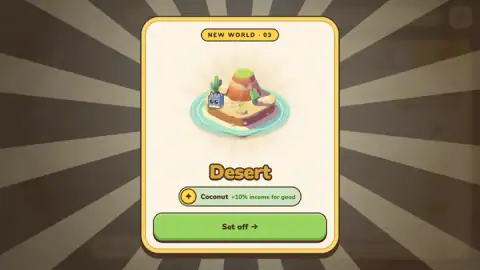
What surprised us is how soon the scenery changes. Sector one is a meadow with a river and a wooden bridge. Sector two opens with a card reading New World 02: Jungle, and the board moves to a sandy island with a volcano smoking on the next island over. Sector four opens New World 03: Desert, and here the game does something we did not expect: the desert sector 4 was played at night, the tiles dark blue under fireflies, before sector five came back in daylight among cacti and pink rocks.
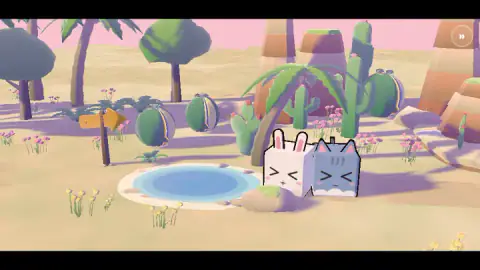
Each new-world card grants a small permanent bonus before you set off. The jungle gave an acorn and the desert a coconut, both worth +10% income for good. Between sectors there is also a short scene of the animals in the new landscape. Our favourite was a grey cat cube sitting in a desert pond while a bunny watched from the bank.
The game's description promises 16 worlds. We saw three, so we cannot tell you how long the rest take.
Upgrades, nursery and animal tricks
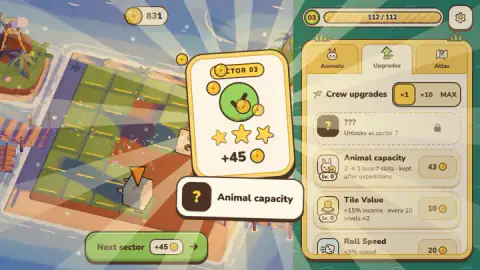
The side panel has three tabs. Upgrades held three things we could buy in our run:
| Upgrade | What it does | First price |
|---|---|---|
| Animal capacity | One more animal on the board, kept after expeditions | 43 coins |
| Tile Value | +15% income per level, doubled every 10 levels | 10 coins |
| Roll Speed | +9% speed per level | 20 coins |
A fourth slot shows only question marks and the words Unlocks at sector 7. A switch at the top lets you buy one level, ten, or as many as your coins allow.
The Animals tab is the nursery: twelve places, an Invite button that hatches a bunny for 12 coins, and a Merge pairs button. Each animal card carries a trick. Our bunnies had Quick Paws; a kitten that turned up at the end of sector three, with a To nursery button, had Claws. Late in the run a panda card filled the screen with the words Heavy Step, "Stomps for four". During play the board flashes short labels like Whirlwind! and Treasure! when a trick fires, and a row of icons in the panel shows which tricks you have found. By the fifth sector, three of them were still question marks.
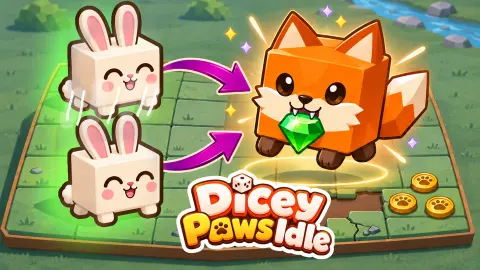
We pressed Merge pairs once and are not sure it merged anything, so we cannot describe merging from experience. The game's description says two identical animals become a new species, and lists a fox and a piglet among them, which we never met.
Expeditions: the idle game's oldest trick
The text on the Animal capacity upgrade says it is "kept after expeditions". That one phrase tells you where this game is heading. An expedition is Dicey Paws Idle's name for a prestige reset: you give up your progress, start again from the first sector, and keep a permanent bonus that makes the next climb faster. The game's instructions say you should start one when sectors begin to drag, and that it pays out in shards.
The idea is older than most browser games. It was made famous by Cookie Clicker, the game Julien Thiennot, known as Orteil, released in August 2013. There, the reset is called ascending, and it pays in Heavenly Chips that boost every future run. Cookie Clicker did not invent idle games, but it set the rhythm most of them still follow: grow until growth slows, reset, grow faster.
That is why the first sectors fly by and why each goal is bigger than the last. The game is built so that, sooner or later, the sensible move is to start over stronger. We did not reach that point in ten minutes, so we have not seen what an expedition costs or what shards buy.
Who it is for
Dicey Paws Idle suits people who like a game they can leave running in a tab: no timer, no way to lose, nothing that punishes you for looking away. The animals are soft and round-eyed, and the settings even let you make the cursor bigger, which helps younger players and anyone on a small screen. It will bore anyone who wants to do something with their hands every second.
Ads exist but were light in our run. The one break we hit came between sectors four and five. There is also an optional button marked AD in the top-left corner for a reward, and a gift button whose value grew from 185 to 353 coins while we played.
If you like your cats with a click counter, Click Kitty Idle is a quicker, timed take. Mergetopia does the merge part with sea creatures, and Merge Plane Tycoon does it with biplanes on a track. There are more games that play themselves in our clicker and idle games.
Screenshots
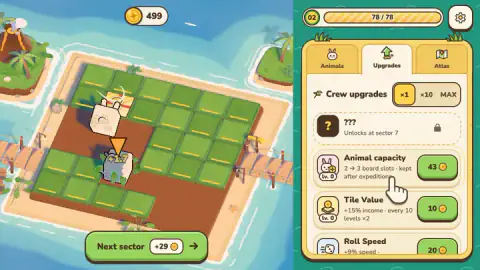

Taken by opening the game ourselves and letting it run — not supplied by the publisher, and not the same picture every other site shows.
How to play Dicey Paws Idle
- Let the first two animals work. The game opens on a green meadow with two bunnies already on the board. They roll on their own and flip the tiles they land on.
- Watch the bar at the top right. It counts flipped tiles against the sector goal. When it is full, a green Next sector button appears at the bottom with a coin reward on it.
- Press Next sector. You collect the reward and the board resets with a bigger goal. Every so often the next sector is in a new world.
- Spend coins in the side panel. The Animals tab is where you hatch and place animals; the Upgrades tab is where you make all of them better.
- Fill the field. The board holds a limited number of animals. Buy more slots, then drag animals from the nursery onto the field.
Tips from our run:
- Buy Animal capacity first. It is the first upgrade the tutorial points at, it took us from two animals on the board to three for 43 coins, and the game says it survives expeditions. The next level, three to four, costs 112.
- Tile Value is the cheap one. At 10 coins it is the lowest price in the panel, and its text says the bonus doubles every ten levels.
- Invite costs 12 coins, always. In our run the price of a new bunny did not rise, so a full nursery is cheap to build. The bottleneck is board slots, not animals.
- Close the panel to see the board. The side panel stays open most of the time. Clicking the gear by mistake opens the settings card, called A Little Breather; the green Back to the dice button closes it.
- Do not chase the cubes. Clicking an animal or a tile did nothing for us. The game moves at its own pace, and the coins keep coming whether you watch or not.
Controls
| Nothing | The animals roll across the board and flip tiles by themselves |
|---|---|
| Drag on the board / arrow keys or WASD | Roll an animal yourself, according to the game's own instructions |
| Drag a card from the Animals tab | Put an animal from the nursery to work on the field |
| Click Invite | Hatch a new bunny for 12 coins |
| Click Next sector | Collect the sector reward and move to the next board |
| Gear icon | Opens the settings card, A Little Breather |
Features
- Animals shaped like dice that tumble over the board on their own and turn each tile into coins
- Sectors with a tile goal that grows each time: 50 for the first, 194 by the fifth
- Three worlds in our first ten minutes, a meadow, a jungle island and a desert, each with a permanent +10% income bonus
- An Upgrades tab with board slots, tile value and roll speed, buyable one, ten or as many as you can afford at a time
- Animals with named tricks: the bunny has Quick Paws, the kitten Claws, and a panda card reads Heavy Step
- A nursery with twelve places, a 12-coin Invite button and a Merge pairs button
- A settings card that also lets you make the cursor bigger
Game details
- Developer
- HordorDev
- Release date
- October 2026
- Last updated
- October 27, 2026
- Added here
- October 2026
- Technology
- HTML5 (3D)
- Platforms
- Browser (desktop, mouse), Browser (mobile & tablet, touch)
- Saved progress
- Saving, when available, is managed by this game. Mava cannot confirm your level.
FAQ
What kind of game is Dicey Paws Idle?
Dicey Paws Idle is a calm idle game. Small cube-shaped animals roll across a square board like dice, and every tile they land on turns into coins. You spend the coins on more animals and upgrades, fill each sector's tile goal and move on to the next board and, every few sectors, a new world.
Do you have to click to play Dicey Paws Idle?
Not much. The animals move and earn by themselves, so most of the game is choosing what to buy and pressing Next sector when a goal is full. The game's instructions say you can also roll an animal yourself by dragging on the board or with the arrow keys or WASD, and that doing so pays more. In our session we mostly let them work.
How do you finish a sector in Dicey Paws Idle?
Each sector has a tile goal shown in the bar at the top right, such as 50 for the first and 78 for the second. When the animals have flipped that many tiles, a Next sector button appears with a coin reward on it. Pressing it pays the reward and loads the next board.
What is the best first upgrade in Dicey Paws Idle?
Animal capacity. It raises the number of animals on the board from two to three for 43 coins, and the game says this upgrade is kept after expeditions. One more animal is the biggest jump in income early on. Tile Value, at 10 coins, is a cheap second pick.
How do you get new animals in Dicey Paws Idle?
Open the Animals tab and press Invite to hatch a bunny for 12 coins. New animals wait in the nursery, which has twelve places, and you drag them onto the field when there is room. There is also a Merge pairs button; the game's description says two identical animals merge into a new species such as a kitten or a panda.
How many worlds does Dicey Paws Idle have?
The game's description promises 16. In our first ten minutes we reached three: a green meadow, a jungle island with a volcano and a desert. Each new world opens with a card that grants a small permanent bonus, such as an acorn worth +10% income.
Is Dicey Paws Idle free and does it work on mobile?
It is free to play in the browser. It is listed for phones and tablets as well as computers, and the game's instructions describe a touch joystick. We played it on a computer with a mouse.
Who made Dicey Paws Idle?
The game is credited to HordorDev. It was published on 26 October 2026.