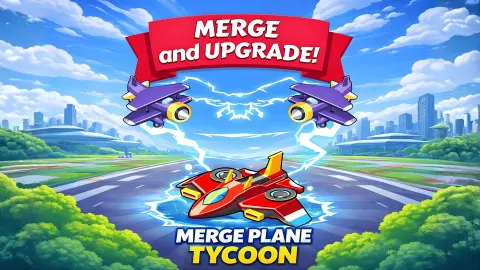










About Merge Plane Tycoon
A tycoon game usually starts you at nothing. One stall, one customer, one coin, and the pleasure is in watching a number climb from a standing start. Merge Plane Tycoon starts you at five thousand coins and a pointing hand, and across the four minutes we played it the only direction that number went was down.
That is not a complaint. It is the shape of the thing. The coins are a float, the planes you spend them on are supposed to earn them back, and the distance between those two halves of the sentence is where your first session lives.
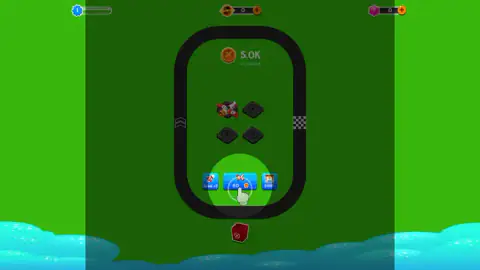
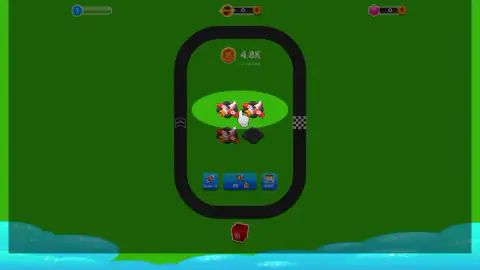
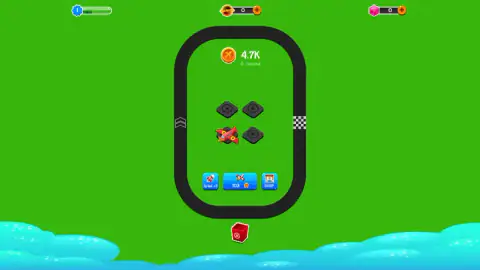
The board is small and easy to read. A black track shaped like a tall rounded oval stands in a field of bright green, with a strip of pale blue sea along the bottom of the screen. Inside the oval sit four dark pads in a square. One pad has a plane on it when you arrive — a small red and white biplane with a gold radial engine at the nose and a pale blue canopy — and the other three are empty, each stamped with the outline of the plane that belongs there.
Three blue buttons run along the foot of the track. The left one says Speed x2 and carries a rocket. The right one says SHOP. The middle one is the one that matters, and it shows a plane, a number and a gold coin. That number is a price.
The game is credited to John Hany.
The number on the button only goes one way
Three prices passed under our eyes in a single session, and we read all three off the screen: sixty coins, then eighty-six, then one hundred and three. Look at the gaps rather than the numbers. Each price is not a fixed step above the last one. It is roughly a fifth bigger than the last one.
That difference is the whole economy. Add a flat amount each time and the price marches politely up a staircase. Multiply by the same fraction each time and it bends upward until it leaves the page.
Put a number on the bend and you can see where the game is heading. At a fifth per purchase, the tenth plane costs about five times the first. The pile of coins you are handed at the start stops looking generous surprisingly fast.
It is also the oldest trick in the genre, and it has a known birthday. Cookie Clicker went up on the web in August 2013, written in an evening by the French programmer Julien Thiennot, who signs his work Orteil. In the version that first went round, every building you already owned pushed the price of the next one up by a tenth.
The modern version of that game uses fifteen per cent. Merge Plane Tycoon's planes step at about twenty. The constant changes; the shape never does.
Why does any of it matter when you are sitting there dragging aeroplanes? Because the rising price is what forces you to merge. If a new plane always cost sixty coins, filling the board with small ones would be a perfectly good strategy. Once the fourth one costs nearly twice the first, buying stops being the answer and the two-by-two square starts being a puzzle: which two do I combine, and which pad do I want free when I do it?
The counter that never moved
Under the coin pile, in smaller grey letters, sits a line that reads how many coins you make per second. In all eight pictures we took, across four minutes, it read zero.
We want to be exact about what that does and does not prove. It does not prove the game never pays. It does prove that in the opening stretch — the part every new player actually sees — the income side of this tycoon had not started. Our pile went from five thousand to around four thousand seven hundred, and every one of those coins left because we spent it.
So the first session is not an idle game at all. It is a small puzzle about four squares, funded by a loan. The idle half is a promise the game makes on the listing page and did not keep inside our four minutes, and we would rather print that than round it up to something warmer. If it starts paying later, it starts later than we got.
The two counters at the top of the screen tell the same story from the other side. A gold propeller sits at the top centre and a magenta gem at the top right, each with its own orange plus button beside it. Both read zero when we arrived and both read zero when we left. The plus buttons are the clue to what they are for, and we did not press them.
A loop, not a runway
The shape of the board is a decision worth noticing, because it would have been easier to draw something else.
An airline game could have given you a runway: a straight line, planes leaving, planes gone. Instead the four pads sit inside a closed circuit, with a chequered flag painted on the right rail and a white double chevron on the left. Nothing about it reads as a departure. It reads as laps.
That is the right shape for a game whose central number is coins per second. A plane that takes off and leaves is a plane you have to imagine; a plane going round and round past a flag is a plane you can watch earning. The track turns an abstract rate into something with a position on the screen — which is exactly the problem idle games spend their design budget on, because a number that rises on its own is hard to care about and a thing that moves is not.
We should be plain here: we never saw a plane fly. Ours sat on their pads for four minutes while we bought and dragged, and the chequered flag stayed decoration. The track is built for motion. We did not earn it.
One more thing about the shape. The whole board is a tall narrow column, and the game is listed as portrait. On a wide screen that leaves a lot of green on either side, which looks like waste and is not: every control is a large target near the bottom edge, where a thumb already is.
More boards worth filling
If the plane half is what drew you, Idle Airport Tycoon runs the same promise at a much larger scale and lets the money counter do the work. If the merging is what you came for, Merge Mania strips the idea back to the combining and nothing else. And John Hany has a shelf of these: Animal Care Tycoon is the same economy with animals instead of aircraft, Block Bloom swaps it for a quiet puzzle board, and Snake Arena is the odd one out, with no economy at all. More of the genre sits in clicker games.
Screenshots
How to play Merge Plane Tycoon
- Press the middle blue button to buy a plane. It lands on an empty pad, and the number on the button goes up for next time.
- Drag one plane on top of an identical one. The two become a single better plane, and the pad underneath is yours again. This is the whole game.
- Keep the pads turning over. Four is all you get, so a board full of small planes is a board with nothing left to do on it.
- Watch the small grey line under the coin counter. It reads how many coins you earn each second, and it is the only honest answer to whether any of this is working yet.
- Mind the red bin on the grass below the track. It sits close to where your fingers already are.
What we only learned by being there:
- The number on the button is money leaving, not money arriving. We read it the wrong way round at first, and the coin counter settled it: every press took coins off the pile.
- The tutorial does not hand the board back quickly. For most of our session the screen was dimmed except for a circle of light around whatever it wanted pressed, with a white hand resting on it. Only in our last picture was the green bright from edge to edge, with no hand anywhere.
- Merging changes the colour, not just the size. The planes we started with were red and white. After merging we had green ones with a gold nose, which makes the state of the board readable from across a room.
- The board can go backwards. Two green planes stood on the pads at one point; a minute later a single red one sat alone on an otherwise empty board. We cannot tell you what happened in between, because we did not catch it.
Controls
| Drag one plane onto an identical plane | The merge. This is the one action the game is built on, and it works with a mouse or a thumb because the planes are large targets on a small board |
|---|---|
| The middle blue button, with a plane and a number on it | Buys one more of the smallest plane. The number is the price in coins, not a payout — we watched the coin pile fall every time we pressed it |
| The left blue button, Speed x2 | Unconfirmed. We pressed it and nothing in our pictures changed, so we will not tell you what it speeds up |
| The right blue button, SHOP | Opens the shop. We never got a picture of what is inside it, so there is nothing here we can describe honestly |
| The red cube with a white cross, below the track | By every visual cue, the place you drop a plane you do not want. We never saw it swallow anything we could point at |
| The orange plus beside the propeller and the gem | The two top-up buttons for the game's other two currencies. We left both alone and both counters stayed on zero the whole session |
| Keyboard | Nothing we could confirm. This is a drag-and-drop board and everything we made happen, we made happen by dragging or pressing |
Features
- Four pads, no more: the whole board is a two-by-two square inside an oval track, so a fifth plane has nowhere to go until two of the first four become one
- The price of the next plane climbs about a fifth every time you buy one — we read 60, then 86, then 103 off the screen in a single session
- A rate line sits under the coin counter and reads how much you earn per second. Ours read zero in every picture we took
- Three currencies in three corners: coins with a plane stamped on them, a gold propeller and a magenta gem. Only the coins ever moved for us
- Merging changes the colour, not just the number: three identical red biplanes on the board became green ones with a gold nose
- A red bin with a white cross sits on the grass just below the track, within easy reach of a clumsy drag
- Built as a tall, narrow column — it is listed as portrait — so on a wide screen the board sits in the middle with green field on both sides
Game details
- Developer
- John Hany
- Release date
- January 2026
- Last updated
- October 24, 2026
- Added here
- November 2025
- Technology
- HTML5
- Platforms
- Browser (desktop), Browser (mobile & tablet, touch)
- Classification
- Clicker , Driving , Puzzle , Simulation , Strategy
- Saved progress
- Saving, when available, is managed by this game. Mava cannot confirm your level.
FAQ
What kind of game is Merge Plane Tycoon?
It is a free browser merge game with an idle economy attached. You drag one small plane onto an identical one, the two become a better plane, and the better planes are supposed to earn you coins. The board is four pads inside an oval track, and everything you do happens on those four pads.
How do you play Merge Plane Tycoon?
Drag a plane onto another plane of the same kind and they combine into one better plane. That frees a pad, and the blue button at the foot of the track buys a fresh small plane to fill it. The whole loop is buy, drag, repeat, with the price of each new plane climbing as you go.
What does the number on the blue button mean?
It is the price of the next plane, in coins, and not a reward. We misread it as a payout at first and the coin pile settled the argument: it fell every time we pressed. We watched it read 60, then 86, then 103 inside one session.
Why does the next plane keep costing more?
Because the price is multiplied rather than added to. Each purchase in our session cost roughly a fifth more than the one before, which is the standard shape for this kind of game: the cost curve bends upward so that buying more planes stops being the easy answer and merging them starts being the only one.
Does Merge Plane Tycoon really earn money while you are away?
The listing says it does. We cannot confirm it from our own session, and we would rather say so: a line under the coin counter reads how many coins you earn each second, and in every single picture we took it read zero. Our coin pile only ever went down, by about three hundred coins in four minutes of buying.
How far did you get in Merge Plane Tycoon?
Not far, and the numbers say it plainly. The level badge in the top-left corner read 1 from our first picture to our last, and its progress bar only reached about a third of the way across. We got three identical red planes onto the board at once and green ones later, and we never once saw a plane move.
Can you play Merge Plane Tycoon on a phone?
It is free, it runs in the browser on this page with nothing to install, and it is listed for desktop, Android and iOS alike. It is also listed as a portrait game, and it plays like one: a tall column of board with everything inside thumb reach. We played with a mouse, so how it feels under a thumb is the listing's claim rather than ours.
Who made Merge Plane Tycoon and when did it come out?
It is credited to John Hany, who has forty-seven games on the same platform. The listing gives January 2026 for the release and August 2026 for the most recent update. Only the months are published on the visible page, which is why this page does not claim a precise day.