












About Idle Train Empire Tycoon
The word train is in the title, and in our first four minutes with Idle Train Empire Tycoon we did not see one. What we saw was a hall with a tiled floor, a strip of red-and-white tape across it, and three people standing around with nowhere to buy a ticket.
That is the real subject of the game, at least at the start. You are not a train driver and not yet a railway baron. You are the person who decides where the ticket machine goes, how fast it works, and what the passenger meets next. Each room is a step in a line of people, and the money comes from keeping that line moving.
The game is credited to Vladimir Kharitonov. It was published in October 2024.
A word on what this page covers. We played about four minutes, all of it inside the guided opening: one ticket terminal, one metal detector, a waiting hall and a café. The developer describes trains to buy, routes, platforms and daily tasks. We did not reach any of them, so this page explains the station floor and leaves the railway for a longer session.
Visitor flow is one division away from the service time
Every machine panel shows a Service Time, and every room panel shows a Visitor Flow. They look like two separate figures. They are the same one.
Our ticket terminal served a visitor in 9.7 seconds, and the room's flow read 6.19 a minute. Divide 60 by 9.7 and you get 6.19. The metal detector in the next room took 8.85 seconds and showed 6.78 a minute, which is the same sum again.
So the flow is not how many people want to come in. It is how many one machine can get through. We watched it happen: five visitors stood in a row at the metal detector, with a green ring above it filling up for each one in turn.
This tells you what an upgrade buys. The next step on our terminal would have cut its time to 8.8 seconds, worth a little over half a visitor more per minute. The grid also holds five more grey terminals. We did not install a second one, so we cannot say whether two machines double the flow, though that is what the layout suggests.
Four rooms, four different ways to count
The opening walks you through four rooms, and each panel measures something slightly different.
| Room | First thing installed | What the panel showed |
|---|---|---|
| Ticket Office | Ticket Terminal | 6.19 visitors a minute, profit 10 an hour |
| Security Checkpoint | Metal Detector | 6.78 visitors a minute, profit 10 an hour |
| Waiting Hall | Rest Area | No flow figure; profit 15 an hour |
| Café | Cash register | 5.16 visitors a minute, profit of 1 per visitor |
The first two rooms are gates. Everyone has to pass through them, so what matters is speed.
The waiting hall has no flow at all. It is a room of seats, and each seat block adds to an hourly profit. We bought the rest area and raised it twice. Each step added the same amount to the profit, while the price went up by about a quarter each time.
The café brings in a third way of counting. It earns per visitor, so its income depends on how many people the gates before it let through. Its panel is also the only one we saw with two tabs, Room and Content. We did not open the second.
One thing we cannot explain: while we were furnishing the waiting hall, our cash went from 384 to 720, although the panels were quoting profits of 10 or 15 an hour. Something paid us that we did not see. It may have been a reward for a tutorial step.
Electricity and water are the budget nobody mentions
At the top left sit two meters the tutorial never stops to explain: a lightning bolt out of 300 and a water drop out of 320.
Everything you install draws on them. A terminal or a detector used 2 electricity. A rest area added water on top, twice as much as its electricity. The café took 10 of each just for existing.
We ended the session at 45 electricity and 18 water. That is a long way from either ceiling, so we never found out what a full meter does. But the numbers set a shape for the long game. Cash comes back; these two do not, unless something later raises the limits. A room full of cheap seats is cheap in cash and expensive in water.
There is also a clock in that corner. It read 05:05 in every picture we took, from the first minute to the last, so it is not counting the session. We did not find out what it counts.
The idea behind it is older than the railways' computers
The sum that links service time to flow has a name. It comes from queueing theory, the study of lines, which began with a Danish engineer called Agner Krarup Erlang. He worked for the Copenhagen Telephone Exchange Company and published the first paper on the subject in 1909. His problem was telephone calls waiting for a free line, not passengers.
The lesson carried over to every counter, till and gate since. A server that needs ten seconds per customer handles six a minute and no more. If people arrive faster than that, the line grows, and nothing behind the counter can earn until it is served.
Idle Train Empire Tycoon puts that on screen without the mathematics. The ticket office feeds the checkpoint, and the checkpoint feeds the hall and the café. Our detector was a little faster than our terminal, so the terminal was the slow point of our station. In a chain like this the slowest room sets the pace for all the rest, which is a good reason to look at every room's flow before spending on any one of them.
Who it is for
It suits players who like to watch numbers go up for a reason. The opening is slow and fully guided, with a hand on every click and no way to lose that we could see, so a child who can read short English sentences can follow it.
It is less suited to anyone who came for locomotives. They may well be there, and the developer says they are, but the game makes you earn the station first.
More tycoon games to try next
Idle Airport Tycoon moves the same kind of job to an airport. Idle Supermarket Tycoon and Idle Cinema Tycoon swap the passengers for shoppers and filmgoers, and Idle Zoo Tycoon does it with animals. The rest are under clicker and idle games.
Screenshots
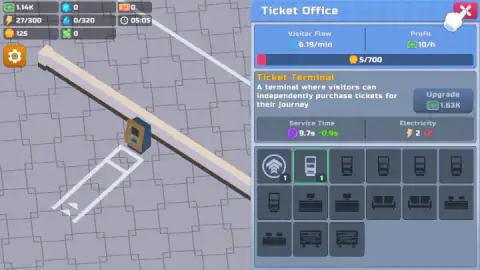
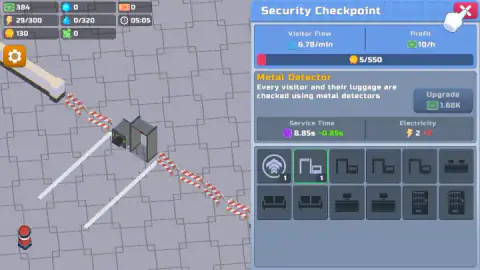
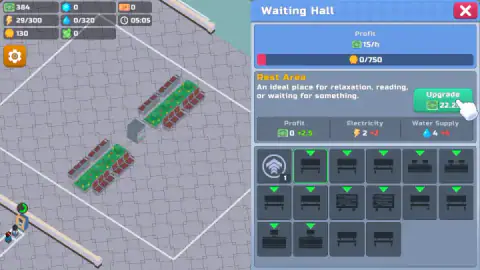
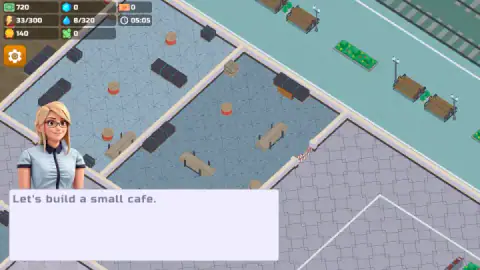
Taken by opening the game ourselves and letting it run — not supplied by the publisher, and not the same picture every other site shows.
How to play Idle Train Empire Tycoon
- Click a room. Its panel slides in on the right, with the room's figures at the top and a grid of items below.
- Pick an item from the grid. The panel shows what it does and, in green, what the next step would change.
- Press Upgrade. The same button installs an item for the first time and improves it afterwards.
- Close the panel with the red X. Visitors walk in and start using what you bought.
- Follow the hand. An assistant with glasses talks you through the first rooms, and a white hand points at each click.
What our session taught us:
- Read the green numbers before you pay. Beside every figure the panel prints the change the next step brings. On our first terminal it read 0.9 seconds off the service time and 2 more electricity.
- A second step on a machine costs far more than the first. Installing the terminal took about 700 of our cash. Raising it one step was priced at 1.63K, more than we had left.
- Seats are the cheap way to add profit. The first step of a rest area in the waiting hall cost 22.2 and added 2.5 an hour. No machine in the first two rooms was anywhere near that price.
- The café is a different kind of room. It is paid per visitor, not per hour, and it draws five times the electricity of a single machine.
Controls
| Left click on a room | Opens that room's panel on the right, with its figures and a grid of things to install |
|---|---|
| Left click on an item in the grid | Selects it and shows what the next step costs and what it changes |
| Upgrade button | Buys the selected item or raises it one step |
| Red X (top right of the panel) | Closes the panel and returns to the station |
| Plus and minus keys | Change the camera size, according to the developer's instructions; we did not test them |
Features
- A railway station seen from above, built room by room in a guided order
- Four rooms in the opening minutes, each with its own panel, a ticket office, a security checkpoint, a waiting hall and a café
- Machines with a service time in seconds, which sets how many visitors per minute the room can pass
- Two supply meters to budget, electricity out of 300 and water out of 320
- A progress bar per room, filled with sun points earned by installing things
- Visitors who walk the station and queue at each machine under a small green ring
- Made by Vladimir Kharitonov
Game details
- Developer
- Vladimir Kharitonov
- Release date
- October 2024
- Last updated
- August 10, 2026
- Added here
- March 2025
- Technology
- HTML5 (Unity WebGL)
- Platforms
- Browser (desktop, mouse), Browser (mobile & tablet)
- Classification
- Clicker , Driving , Simulation , Strategy
- Saved progress
- Saving, when available, is managed by this game. Mava cannot confirm your level.
FAQ
How do you play Idle Train Empire Tycoon?
You click a room in the station, pick an item from the grid in its panel and press Upgrade to install it or improve it. Visitors then walk in, queue at your machines and pay. An assistant leads you through the first rooms with a pointing hand, one click at a time.
What does Visitor Flow mean in Idle Train Empire Tycoon?
It is how many visitors a room can serve per minute, and it follows from the service time of its machine. Our first ticket terminal took 9.7 seconds per visitor and the panel showed 6.19 visitors a minute, which is 60 divided by 9.7. Shortening the service time is what raises the flow.
What are electricity and water for in Idle Train Empire Tycoon?
They are two limits shown at the top left, electricity out of 300 and water out of 320. Each thing you install draws on them: a ticket terminal or a metal detector used 2 electricity, and the café took 10 of each at once. We did not get near either limit, so we cannot say what happens when one is full.
Do you buy and drive trains in Idle Train Empire Tycoon?
Not in the opening minutes. The developer describes buying and upgrading trains and setting routes later on, but our four-minute session was spent entirely inside the station building, and no train arrived. One platform with a track was visible at the edge of the screen.
What is the sun counter in Idle Train Empire Tycoon?
Each room has a bar with a sun icon and a target, such as 700 for the ticket office. Installing our first terminal moved that bar to 5 and added 5 to the sun counter at the top of the screen. The room icon in every panel showed level 1 for us; we did not fill a bar to see the next level.
Can you play Idle Train Empire Tycoon on a phone?
It is listed for desktop, mobile and tablet. We played it with a mouse in a desktop browser, where everything is a left click, so we cannot describe how the panels feel on a small screen.
Who made Idle Train Empire Tycoon?
It is credited to Vladimir Kharitonov. It was published on 6 October 2024.