






About Pongoal
Pong gave you two white lines and a dot and never pretended otherwise. The lines were not people. The dot was not a ball. The whole thing fit on a screen that could only draw straight edges, and it still emptied arcades of coins for most of a decade.
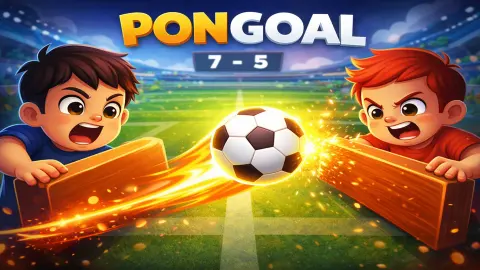
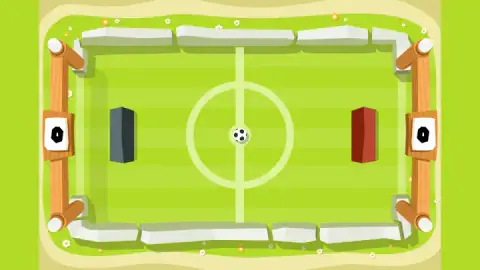
Pongoal lays a football pitch underneath that arrangement, and the interesting part is not the decoration. It is the shape of the room. Your platform still slides up and down, the ball still crosses between the two of you, but the field is walled: grey stone blocks run along the top edge and along the bottom, and the only openings in the whole board are the goals at either end.
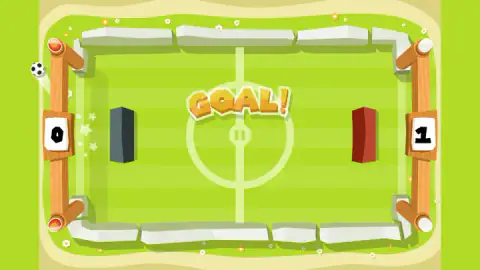
Those goals are gaps in a pair of wooden frames, and the score hangs on the frames themselves, one white card with a black number on each. There is no scoreboard across the top of the screen. You find out how the match is going by looking at the thing you are supposed to be protecting.
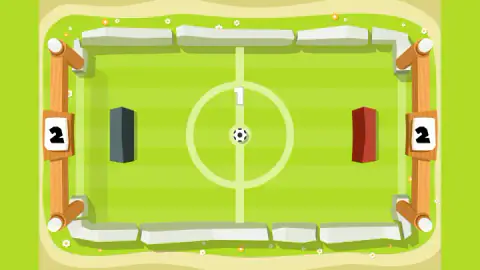
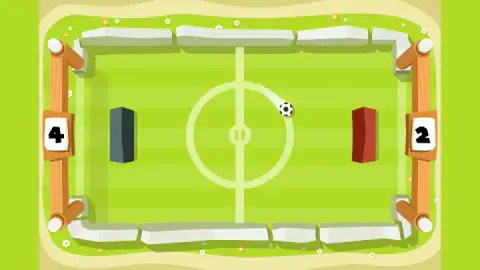
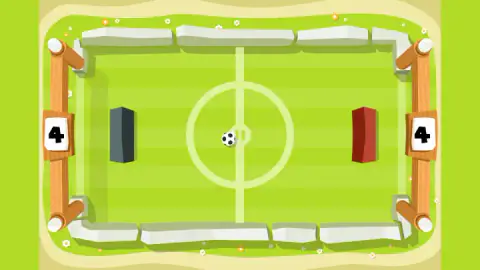
It is by Vagstech, and it was published on 1 April 2026. Our own session was a single match in Classic Mode on a desktop, and it went the distance: level at kick-off, then one at the left end, then two apiece, then four to two, then four each. The instruction board had already told us what that meant. First to five.
The angle is the game, and Atari worked that out in 1972
Pong was built at Atari in 1972 by Allan Alcorn, who had been handed it as a warm-up exercise rather than a product, and it became the machine that proved people would pay to play a video game at all. Almost everything about it was forced by the hardware. What was not forced, and what made it a game instead of a test, was one decision about the paddle.
Alcorn divided each paddle into bands, eight of them, and made the ball leave at a different angle depending on which band it struck. Hit it with the middle of your paddle and it comes back flat. Hit it with the top or bottom edge and it leaves at a sharp angle. The paddle stops being a wall you hold up and becomes an instrument you aim with, and the rally turns into an argument about where the other player cannot get to in time.
Everything that descends from Pong inherits that idea, and Pongoal's platforms are built to look like it matters. They are not thin white lines. They are chunky blocks with visible depth, wide enough along their length that where you meet the ball is plainly meant to be a choice. We cannot tell you how many bands this one is divided into, or how steeply its edges throw, because that is not something a scoreline shows you. What we can tell you is why to pay attention to it: in this family of games, the player who treats the paddle as a wall loses to the player who treats it as a racket.
A goalkeeper narrows the angle. Your platform is not allowed to.
Here is the part of real football that this board is quietly built on.
A full-size goal is 7.32 metres wide. A keeper standing on the line has to be ready to cover all of it, which is more than any human can do against a shot taken from close in. So keepers come off their line. Walking a couple of metres towards the striker does not make the keeper any bigger, but it does shrink the angle the striker has to shoot through, because the two posts are now further out to the sides from the shooter's point of view. The keeper covers the same body width over a narrower opening. That is the whole trick, and it is geometry rather than bravery.
The risk is equally simple: a keeper who has come off the line has left space behind, and a striker who sees it early can lift the ball over the top into it. Off your line you win the angle and lose the roof.
Pongoal has made that decision for you and then taken the rest of it away. Your platform stands permanently off its line, out where a keeper would be if the keeper had come to meet the shot. But it cannot advance any further, and it cannot retreat. You have been given the keeper's advantage and denied the keeper's judgement.
The punishment that balances the trade in real football is missing here too, because the board has no third dimension. The camera looks straight down, the ball stays on the grass, and nothing goes over your head. You are a keeper who has come out to narrow the angle and cannot be chipped. All the risk has been moved onto a single axis, which is why a goal here almost always means you were in the wrong place rather than beaten by a better shot.
What we saw, and what we are not going to tell you
Three things on that title screen are promises we did not cash in, and naming them is better than letting the page imply otherwise.
Timer Mode sits behind a purple stopwatch next to the mode we played. The icon makes a timed match the obvious guess, but a guess is all it would be. Options sit behind the grey gear, with sound and music on sliders and a difficulty switch beside them; we passed through that panel rather than studied it, and never confirmed how many settings the switch has. And the game's own listing advertises a local two-player mode that the title screen does not name. If it is in there, it is behind a door we did not open.
One claim in that listing we can settle. It files the game under penalties, and there is no shootout anywhere in it: no spot, no run-up, no keeper guessing a side. Every restart puts the ball in the middle of the pitch with both platforms level, which is the opposite of a penalty in every way that matters.
More balls bouncing off things
Idle Pong takes the same ancestor in the other direction entirely, turning the rally into something that keeps paying out while you are not there. Keepie Uppie Paddle Pong keeps the paddle and throws away the opponent, which leaves you with the purest version of the contact-point problem this page has been describing. For football played from the same height but with actual players, Power Ball Soccer is the top-down one with characters and special moves, and Pill Soccer is another kickabout on a small enclosed field, where the bodies do the bouncing instead of the walls. The rest are in soccer games.
Screenshots
How to play Pongoal
- Choose a mode on the title screen. The orange play button is Classic Mode, the purple stopwatch beside it is Timer Mode, and the small grey gear between them opens the options. We played Classic.
- Read the board that interrupts you. Before the first kick-off a wooden panel comes up headed How to play, showing both platforms and the ball. It is two lines long: the up and down arrow keys move your platform, and the first to score five goals wins. Green OK clears it.
- Hold your line and meet the ball. Your platform slides along a fixed track on your side of the pitch. It cannot come forward and it cannot drop back, so every exchange is the same question asked again: are you in the right place yet.
- Wait out the restart after each goal. "GOAL!" lands across the middle in fat orange letters, the ball returns to the centre spot, a countdown runs inside the centre circle, and play begins again on "GO!"
- Get to five. That is the match. Both platforms go back to the middle of the pitch for every restart, so nobody carries an advantage of position into the next point.
What our match taught us:
- Everything you do happens on one axis. Two keys, up and down, and no third option. A game that gives you one degree of freedom is a game about anticipation rather than reaction, and you will feel the difference within a minute.
- You are not standing on your line. Both blocks sit well inside the pitch, roughly a sixth of the way in from their own goal, and they never come any further forward. Anything that gets past you has clear grass between it and an open net. There is no second chance behind you.
- Leads do not hold. In the sequence we published the score went from level to two each, then to four two, then straight back to four all. Two goals is not a cushion in a game that restarts both platforms in the same place every time.
- The pause button is on the pitch. Two small white bars sit inside the centre circle, not in a corner. That is easy to miss and easy to hit by accident if you are clicking around the middle of the board.
- Do not wait for sound to tell you anything. We pressed the arrows during our checks and got nothing audible back, and we logged no goal chime and no defeat sting across the whole match. The board tells you what has happened in pictures and nothing else.
Controls
| Up arrow | Moves your platform up the pitch. The game's own How to play board names this key and its opposite, and nothing else |
|---|---|
| Down arrow | Moves your platform down the pitch. There is no shot, no tackle and no boost: position is the whole of your input |
| Orange play button, title screen | Starts Classic Mode, the one we played. First to five goals wins it |
| Purple stopwatch button, title screen | Starts Timer Mode. We did not open it, so we cannot tell you how it is scored |
| Grey gear, title screen | Options. Sound and music sit on sliders and there is a difficulty switch beside them |
| Green OK button | Clears the wooden How to play board that comes up before the first kick-off |
| Two white bars in the centre circle | Pause. It sits on the pitch itself rather than in a corner, right in the middle of the centre circle |
Features
- A pitch seen from straight above, closed off top and bottom by a line of grey stone blocks, so the only way off the field is through one of the two goals
- The goals are gaps in wooden frames at either end, and each side's running total hangs on its own frame as a white card: there is no scoreboard across the top of the screen
- First to five goals takes the match, which the game states on its own instruction board before the first kick-off
- Two modes on the title screen: Classic Mode behind an orange play button and Timer Mode behind a purple stopwatch
- Every goal is followed by GOAL! in orange, the ball going back to the centre spot and a countdown inside the centre circle that ends on GO!
- The platforms are chunky blocks with visible depth rather than the thin white lines of the game it descends from: slate blue on the left, dark red on the right, each one standing a good distance in front of its own goal
- It was published on 1 April 2026
Game details
- Developer
- Vagstech
- Release date
- April 2026
- Added here
- February 2026
- Technology
- HTML5 (2D)
- Platforms
- Browser (desktop), Browser (mobile & tablet, touch)
- Classification
- Arcade , Multiplayer , Soccer , Sports
- Saved progress
- Saving, when available, is managed by this game. Mava cannot confirm your level.
FAQ
How do you play Pongoal?
You move a platform up and down one side of a football pitch with the up and down arrow keys, and you try to send the ball past the platform on the other side. The goals are the gaps in the wooden frames at the left and right ends of the field. After each goal the ball returns to the centre spot, a countdown runs inside the centre circle, and play restarts on GO!
How many goals do you need to win Pongoal?
Five. The game says so itself on the wooden How to play board that comes up before the first kick-off: the first side to score five goals wins the match. Our own Classic Mode match reached four each before it was settled, which is as close as that format gets.
What are the controls in Pongoal?
Two keys. The up arrow and the down arrow slide your platform along its side of the pitch, and the game's instruction board lists nothing else. There is no shot button and no way to move forwards or backwards, so the only decision you ever make is where to be when the ball arrives.
What is the difference between Classic Mode and Timer Mode in Pongoal?
Classic Mode is a race to five goals and it is the mode we played. Timer Mode sits beside it on the title screen behind a purple stopwatch, which suggests the clock decides it rather than the scoreline, but we did not open it and we would rather say that than guess at its rules.
Can two people play Pongoal on the same keyboard?
We cannot confirm it. The game's listing advertises a local two-player mode, but the title screen we saw offers Classic Mode and Timer Mode and neither is named for two players. If it is in there, it is behind something we did not open. Our match was against the CPU.
Is there a penalty shootout in Pongoal?
No, not in what we played. The game is filed under penalties on its listing, which is misleading: there is no spot kick, no run-up and no keeper diving along a line. Every restart puts the ball back on the centre spot with both platforms level, and the match is decided by open play.
Who made Pongoal?
Vagstech. The game is published, and it was published on 1 April 2026. That listing date is when the game reached that platform, which is not necessarily the day it was first released anywhere.
Can you play Pongoal on a phone?
It is listed as playable on phones and tablets, and a game whose entire input is up and down is a natural fit for two thumb buttons. Our own session was on a desktop with the arrow keys, though, so we cannot tell you how the touch controls feel or how well the wide pitch scales down.