








About Mars Colony
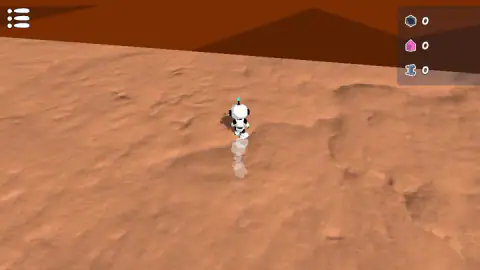
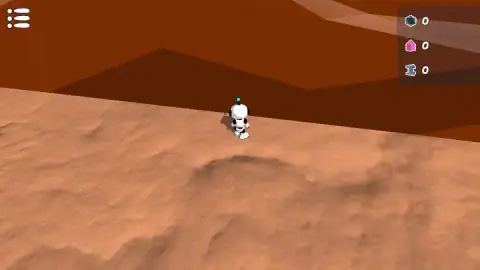
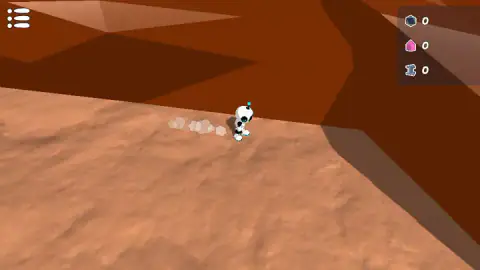
Three counters sit in the top right corner of Mars Colony: a dark blue hexagon, a pink house, a pale blue bolt. Across four minutes on the surface, every one of ours stayed on zero. That is the honest headline of our visit, and it is also the most useful thing we can tell you about how this game opens. It hands you a planet and no arrow.
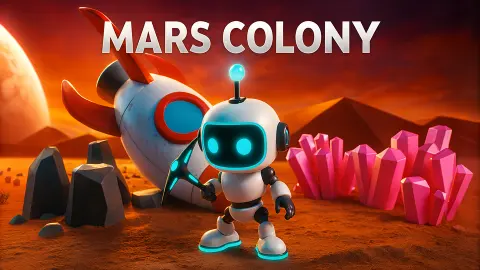
What you get is Rob, a small white robot with a teal light on his head, standing in the middle of a dust bowl the colour of old brick. The camera rides just behind and above him. Push a direction and he trots off, leaving a short line of pale puffs in the dust. There is a three-line menu icon in the top left corner, the counters in the right, and nothing else on the screen at all.
That emptiness is the design, not a fault. Mars Colony has no mine button, no build button and no inventory to open. Contact is the only verb it has: by its own instructions, walking Rob into a rock starts him mining, walking him into a factory starts him processing, and walking him into a construction zone pours what he is carrying into a building. The three counters are the three links of that chain — raw rock, buildings, parts. The consequence is that your first job is not strategy. It is navigation.
TurtleGamesStudio made it, and it has been available since October 2025. The game's own description names My Little Universe as its model, and that is a fair signpost: one little character, a gather-process-build loop, and a map that opens as you feed it.
Why the ground is that colour, and what living on it would actually take
The brick-red dust under Rob's feet is the one part of Mars Colony that is not invented. Mars is red because its surface dust is rust — iron oxide, raised by global dust storms and smeared evenly over the whole planet, which is why there is no corner of it that looks like anywhere else.
Which rust, exactly, has only recently come into focus. A study led by Adomas Valantinas and published in Nature Communications in February 2025 made replica Martian dust in the lab from different iron oxides and compared each one against what orbiters and rovers actually see. The best match was ferrihydrite, an iron oxide that holds water in its structure and forms in cold, wet conditions — not the dry hematite long assumed. If that holds up, the colour of the ground in this game is a fossil of the time Mars had liquid water on it.
The air above that ground is the reason Rob is a robot. A suit on Mars is not warm clothing, it is the only thing standing between a person and physics: surface pressure there averages around six millibars, well under one per cent of what you are breathing now, and roughly a tenth of the point at which body fluids boil at body temperature.
That atmosphere is also almost entirely carbon dioxide, which is why NASA bolted an experiment called MOXIE to the Perseverance rover to pull breathable oxygen out of it. It worked, and the total across sixteen runs came to about 122 grams — a few hours of breathing for one person, and a landmark anyway.
Then there is the dirt itself. Martian soil carries perchlorate salts, first found by NASA's Phoenix lander in 2008, so it is not something you plant a tomato in without treating it. But the same loose surface material is also the cheapest radiation shielding on the planet, which is why serious habitat proposals keep arriving at the same answer: pile the regolith on the roof.
Put those together and the cartoon loop in this game is closer to the real plan than it looks. You mine the ground, you process what you mined, and the first thing you build with it is somewhere to be. The order is the order.
What four minutes on the surface really looked like
We want to be exact about this, because the gap between what the game promises and what a first session delivers is the thing nobody else will tell you.
We played on a desktop on 22 October. Rob moved: the dust trail behind him is there in two of our three screenshots, and he answered both w and the arrow keys. The pause sign came and went. And the counters never moved. We did not reach a factory, a construction zone, a warehouse or the transport assistant the instructions describe. We did not watch a single building go up. The three published screenshots are an honest record of the session: one robot, a lot of orange, three zeroes.
So everything above about mining, processing and recycling is what Mars Colony says about itself, and we are passing it on as that. What we can confirm is the movement, the silence, the pause behaviour and the emptiness of the starting ground — and that last one matters more than it sounds, because it is the thing most likely to make somebody close the tab in the first thirty seconds.
On advertising, the news is mild. There is a slot before the game begins; the screen we got in its place said the advert had been skipped and offered a Continue playing button. Nothing interrupted the surface once we were on it. One session is one session, so treat that as a data point rather than a guarantee.
More games like this one
The Adventures of Big Joe is the other TurtleGamesStudio game in our catalogue that runs on the same instinct — a small character, a shovel and ground that hides everything. Pocket Universe is the closest relative here: gather wood, stone, metal and crystal, then spend them to unlock the next patch of land. Craftsman Land takes the same rebuild-from-nothing idea down to a flooded farm town, and Miner Builder strips the loop back to collecting blocks and stacking them into a tower. More in strategy games.
Screenshots
How to play Mars Colony
- Clear whatever is on top of the game first. We came in through a sound panel with a speaker and a green tick, then a screen offering Continue playing, before the surface appeared.
- Walk Rob with WASD or the arrow keys. On a phone, the game puts an on-screen joystick under your thumb instead.
- Pick a direction and commit to it. There is no minimap and no marker, so the only way to find the first resource is to cross ground you have not crossed yet.
- Drive Rob into things. Rocks, factories, construction zones and warehouses all start their own job the moment he touches them, with no button to press.
- When a factory is working, the game says a speed-up panel appears. Clicking that panel quickly is the one place where your hands matter more than your feet.
What we learned the slow way:
- The game pauses the second it loses focus. A "Click to keep playing" sign dropped across the top of the screen three separate times in four minutes. A single click on the ground clears it; clicking the sign itself is not what it wants.
- Standing still achieves nothing. There is no passive income ticking away in the background while you think, despite the idle label. Rob only earns while he is touching something.
- The counters are your map legend. The hexagon is what comes out of the ground, the house is what you put up, the bolt is what the factories turn one into the other. If a counter is not moving, that whole stage of the chain is still ahead of you.
- Quiet is normal. Nothing chimed, buzzed or congratulated us in the whole session. This game saves its feedback for progress it has not shown you yet.
Controls
| WASD or the arrow keys | Walk Rob across the surface; he leaves a trail of dust when he moves |
|---|---|
| On-screen joystick | Move Rob on a phone or tablet, according to the game's instructions |
| Walk Rob into a resource | He begins mining it on contact — there is no separate mine button |
| Walk Rob into a production facility | He starts processing the resource and a speed-up panel appears, which you click repeatedly |
| Walk Rob into a construction zone | He invests the resources he is carrying into the building there |
| Click anywhere on the ground | Clear the "Click to keep playing" sign and start the surface moving again |
| Click the three-line icon, top left | Open the game's own menu |
Features
- A third-person Martian surface you walk rather than click, with the camera riding just behind the robot
- Three counters in the top right corner — a rock hexagon, a house and a machine part — which are the three stages of the game's chain: mine it, build with it, recycle it
- Contact is the only verb: walking into a rock, a factory or a building site is what starts the work
- A speed-up panel that appears while a factory is processing and rewards rapid clicking, per the game's instructions
- Warehouses for moving resources around and a transport assistant with its own control panel, per the game's instructions
- A surface that pauses itself the moment it loses your attention, behind a "Click to keep playing" sign
- Listed for desktop, mobile and tablet, with an on-screen joystick for touch
Game details
- Developer
- TurtleGamesStudio
- Release date
- October 2025
- Last updated
- October 23, 2026
- Added here
- August 2025
- Technology
- HTML5 (3D, browser)
- Platforms
- Browser (desktop), Browser (mobile & tablet, touch)
- Classification
- Clicker , Simulation , Strategy
- Saved progress
- Saving, when available, is managed by this game. Mava cannot confirm your level.
FAQ
What is Mars Colony?
Mars Colony is a free browser game by TurtleGamesStudio in which you steer a small robot called Rob around the surface of Mars. The game describes itself as an idle game built on a three-stage chain: mine raw rock, process it in factories, and spend the result on buildings. It has been available since October 2025.
How do you play Mars Colony?
You move Rob and nothing else. On a desktop that is WASD or the arrow keys; on a phone there is an on-screen joystick. Everything else happens on contact — according to the game's instructions, walking into a resource starts him mining, walking into a factory starts him processing, and walking into a construction zone pours his materials into the building.
Why are the resource counters stuck on zero?
Because nothing is mined until Rob physically touches something worth mining, and the opening area is wide and empty. In our four minutes on the surface all three counters stayed on 0, and the three published screenshots show that. The practical answer is to stop looking for a button and spend the first minute walking in a straight line until the scenery changes.
Who made Mars Colony?
Mars Colony was published on 14 October 2025 and was last updated in June 2026.
Does Mars Colony have ads?
There is an advert slot before the game starts — the screen we got in its place said the advert had been skipped and offered a Continue playing button. Once we were on the surface nothing interrupted us for the rest of the session. We only played once, so we cannot promise that is every visit.
Is Mars Colony the same as My Little Universe?
No, but the game's own description names My Little Universe as its model, and the shape is the same: one small character, a gather-process-build loop, and territory that opens up as you feed it resources. Mars Colony swaps the floating island for a Martian plain and a robot.
Can you play Mars Colony on a phone?
It is listed for desktop, mobile and tablet, and its instructions describe an on-screen joystick for touch players. We played on a desktop with a keyboard and mouse, so we have not tested the joystick ourselves and cannot say how precise it feels on a small screen.
Why is Mars red?
Because its dust is rust: iron oxide, spread over the whole planet by global dust storms. A study led by Adomas Valantinas, published in Nature Communications in February 2025, argued that the specific mineral is ferrihydrite, a water-bearing iron oxide that forms in cold water. If that holds, the colour of the ground in this game is evidence that early Mars was wet.