

About Hexlands
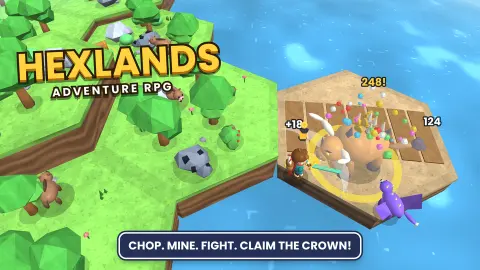
Most games about building something give you a hammer. Hexlands takes the hammer away. Your hero chops the trees, breaks the rocks and fights the slimes by himself, as soon as he stands next to them. There is no attack key and no chop button. What you decide is where he stands.
That sounds like a game that plays itself, and for the first minute it nearly is. Then the map tells you what it wants. Your island is a handful of hexagon tiles in a dark sea, and the tiles around it are pale, see-through and locked. Each one has a little card floating above it with a price in wood and stone. To raise that land you walk onto the glowing yellow circle beside it and pay.
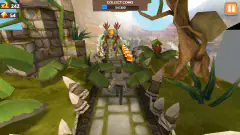
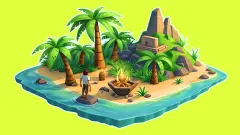
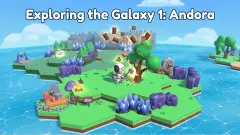
Hexlands is by CONVELISS and was published on 26 October 2026, with an update the next day. It is a low-poly 3D game seen from above at an angle, with chunky trees, grey boulders and a trader's stall under a red and white awning. A counter at the top reads 0/13 crowns from the very start. That is the long road. The short road is the next hex.
We played one session of about ten minutes on a computer, and we did not unlock a single hex. The reason is the most useful thing on this page, so it gets its own section below.
The card remembers what you paid
This is the detail that is not obvious at first, and it changes how you should play.
The hex to our east started with a card asking for 34 wood and 8 stone. In the first two minutes we paid in 18 wood and 3 stone, everything we had cut and broken so far.
The card then read 16 wood and 5 stone, with a thin green bar underneath showing how far along the payment was. Nothing was lost. Every log already paid stays paid.
So the right rhythm is short trips: gather, pay, gather, pay. Our mistake was the opposite. After that first payment we stood on the circle with empty pockets for most of the session, and the game answered "Not enough materials" every time. The Collect 30 Wood quest stayed at 18 out of 30 for the same reason. The trees were a few steps away the whole time.
Why the world is made of hexagons
Hexlands could have used squares. It uses hexagons for the same reason board wargames switched to them more than sixty years ago: on a hex grid, the centre of every tile is the same distance from the centre of all six of its neighbours. On a square grid the diagonal neighbours are farther away, so a piece moving diagonally covers more ground than one moving straight.
According to The Strong National Museum of Play, the honeycomb board was used at the RAND Corporation in the 1950s, and Avalon Hill's games of 1958 to 1961 made hexes the standard for commercial wargames.
And so, when you play, no hex is a corner. Each tile you raise touches six others, the islands grow out evenly in every direction, and the nearest locked land is always one short walk away, never a long diagonal trip. That is why the glowing circles sit on every edge of your land instead of only four sides.
Levels, perks and quests
The hero levels up as he works, and our first two level-ups arrived within about five minutes. Each one pauses the game on a card that says Choose a perk, with three options. Ours were small and specific: Swift Feet for 4% more walking speed, Lucky Hands for an 8% chance of bonus resources, and Second Wind to heal faster out of combat.
The second level-up offered Vitality for more health and Sharp Eye for a chance at a double-damage hit. Maximum health also went up with each level, from 100 to 118 by level three.
The quests are short and pay coins. Collecting 30 wood and unlocking two lands are worth 26 coins each, and defeating nine monsters paid us 22. That last one we finished without touching a key, because the slimes kept coming. It was replaced at once by a much bigger job: collect 70 fiber. Fiber comes from somewhere we did not reach, which hints at where the game goes after the first island.
Day, night and rain
Hexlands keeps a clock in the top-left corner, and it runs fast. One in-game hour passed in about fifteen seconds for us, so a whole day takes roughly six real minutes. Each morning opens with a banner that reads "A new day!".
At night the screen goes dark blue and you only see a pool of light around the hero, with the next tiles fading into black. During the day the sea turns bright turquoise and you can see the whole island. It also rains: a banner says "It started to rain" and diagonal streaks cross the screen. The game's listing says a lantern from the Forge widens the light at night, and that monsters get bolder after dark. We did not reach the Forge.
Ads, saving and settings
Nothing forced us to watch an ad. There are optional buttons on screen: 2x LOOT for two minutes of double gathering, a green bubble offering a gift of 78 wood, and a dice button on the level-up card to roll different perks. You can ignore all three and lose nothing you already have.
The settings panel switches sound and music, changes the language, resets your progress and brings back the tutorial hints. It showed version 1.0.7. The game's listing says progress saves automatically.
What we did not see
Ten minutes on one island is a small slice of this game. The game's listing describes 13 islands with deserts, swamps, frostlands and a volcano, bridge guardians, dungeons, pets hatched from eggs, and workshops that turn logs into planks and ore into bars. We saw none of it. We did not open the Trader, the shop or the backpack, and we did not unlock a hex. We also only played with a keyboard; the game says that on a touch screen you drag anywhere to move.
Who it is for
Hexlands suits players who like a slow, tidy kind of progress: a counter going up, a tile rising, a new corner of map to walk into. It has no timer to beat and no way to lose that we found. If you want to steer every swing yourself, it will feel passive.
For the same idea in a different shape, Pocket Universe also has you chopping wood and paying it into hexagons that rise from the sea. Grass Land is a 3D gathering game with wood quests, and Mars Colony trades the islands for a Martian plain you mine and build on. There are more worlds to wander in our adventure games.
Screenshots
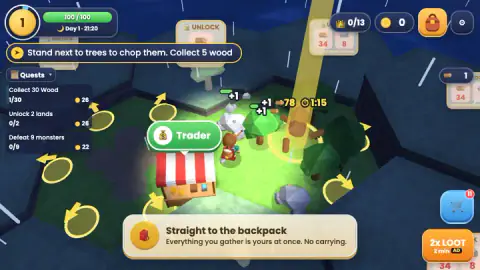
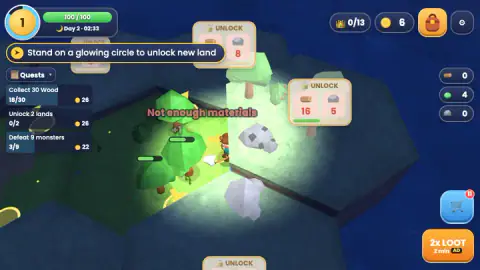
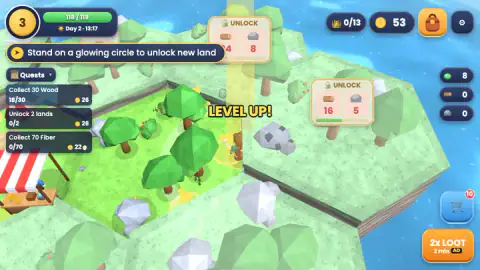
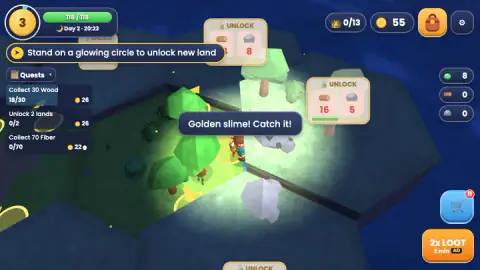
Taken by opening the game ourselves and letting it run — not supplied by the publisher, and not the same picture every other site shows.
How to play Hexlands
- Walk to a tree. Use the arrow keys or WASD. The first instruction is to stand next to trees and collect five wood, and the hero starts swinging as soon as he arrives.
- Watch the counters on the right. Wood, stone and slime goo go straight into your backpack. The game's own hint says it plainly: everything you gather is yours at once, no carrying back.
- Stand on a glowing circle. The locked hex next to it takes what you carry and its card counts down.
- Claim your quests. The panel on the left lists three jobs with a coin reward each. When one is done, a yellow Claim button appears there and you tap it.
- Pick a perk when you level up. The game pauses and offers three cards. Choose one and carry on.
Tips from our session:
- The circle only takes, it never gives. If you have nothing on you, standing there just repeats "Not enough materials". Leave and gather.
- Stone is the bottleneck early. We had plenty of trees around us and only a few rocks, and the stone counter sat at zero long before the wood did.
- Coins are not only for upgrades. A hint card says you can spend them at the Trader on missing materials. We finished with 69 coins in our pocket and a hex we could not afford. That is the mistake to avoid.
- Let the monsters come to you. Slimes wander up while you stand still, and the hero fights them without being asked.
- Chase the golden slime. A banner calls "Golden slime! Catch it!" every so often. We never caught one, because we were not moving.
Controls
| Arrow keys or W A S D | Walk the hero across the hexes |
|---|---|
| Stand next to a tree, rock or monster | The hero chops, mines or fights on his own; there is no attack key |
| Stand on a glowing circle | Pays whatever wood and stone you carry into the locked hex next to it |
| E (or tap the bubble) | Opens buildings and traders, according to the game's own instructions |
| Drag anywhere (touch) | Moves the hero on a phone or tablet, according to the game's own instructions |
Features
- Every action except walking is automatic: the hero chops, mines and fights whatever he stands next to
- Locked hexes show their price on a card, and the card keeps whatever you have already paid
- A crown counter that starts at 0 out of 13 and is the long-term goal on screen
- Each level-up offers a choice of three small perks, such as 4% faster walking or 10% more health
- A day and night cycle of about six real minutes, with rain, and nights where you only see the pool of light around you
- Short quests in a side panel that pay coins, starting with 30 wood, two new lands and nine monsters
- Optional ad buttons for double loot or a gift of wood, none of which you need to press
Game details
- Developer
- CONVELISS
- Release date
- October 2026
- Last updated
- October 27, 2026
- Added here
- October 2026
- Technology
- HTML5 (3D, WebGL)
- Platforms
- Browser (desktop, keyboard and mouse), Browser (mobile & tablet, touch)
- Saved progress
- Saving, when available, is managed by this game. Mava cannot confirm your level.
FAQ
What kind of game is Hexlands?
Hexlands is a cozy 3D exploration game played on islands made of hexagon tiles. You walk a small hero around, he chops trees, mines rocks and fights slimes on his own, and you spend what he gathers to unlock new tiles. It runs in the browser, and it is listed for computers, phones and tablets.
How do you unlock new land in Hexlands?
Walk onto one of the glowing yellow circles at the edge of your land. The hex next to it has a card showing its price in wood and stone, and standing on the circle pays in what you carry. You do not need the full amount at once: in our game the card went from 34 wood and 8 stone down to 16 and 5 after a partial payment.
Why does Hexlands say Not enough materials?
It means your pockets are empty and the hex still wants more. Standing on the circle longer does nothing. Walk off, cut trees and break rocks until the counters on the right go up, then come back. The game's own hint also says coins can buy missing materials from the Trader.
Do you have to attack in Hexlands?
No. There is no attack or chop key. Stand next to a tree, a rock or a monster and the hero does the work by himself. We completed the Defeat 9 monsters quest without pressing anything, because slimes kept walking up to us.
What are the crowns in Hexlands?
The counter at the top of the screen reads 0/13 from the start, and it is the long-term goal. The game's listing says there are 13 islands, each with a bridge guardian, on the way to a Lost Crown. We did not reach a bridge, so we did not see a crown awarded.
What happens at night in Hexlands?
The screen goes dark except for a pool of light around the hero, so you see much less of the map. A full in-game day passed in roughly six minutes of real time for us. The game's listing says a lantern from the Forge lights up more, which we did not get to buy.
Does Hexlands save your progress?
The game's listing says progress is saved automatically, and the settings panel has a Reset progress button, which only makes sense if there is something stored to reset. The same panel switches sound and music, changes the language and brings back the tutorial hints.
Who made Hexlands?
Hexlands is by CONVELISS, the developer named on its listing. It was published on 26 October 2026 and was updated the next day, and the version shown in its settings was 1.0.7.