
About Hexholm
Most games wait until you have lost before they admit how hard they are. Hexholm prints it on the shop window. Page through the campaign and every stage carries a figure in red under its map preview: WIN RATE 16% on Storm Moor, the large map at stage 58. You can read that before taking a single turn, and it cannot be your own record, because at that point you have cleared nothing at all.
Under the preview sit the factions waiting on that map, each with a little castle and a number beside it. You get eight castles. The three of them hold thirty-one between them.
What you are playing is a strategy game built out of provinces. A province is a clump of hexagons with a capital in it, and it keeps its own purse. Every turn that purse grows by one gold for every hex the province holds. You spend it on soldiers, and soldiers draw a wage every turn for as long as they live. Take more ground and you earn more; take it with the wrong troops and the wage bill swallows the difference before you notice.
sublevelgames built it, and the studio's catalogue is the revealing part: small-board chess, Korean janggi, sudoku, mahjong, dominoes, sorting puzzles — board games almost without exception. Hexholm is the one war game on that shelf, and it plays like something made by people who make board games: short rules, every number on a panel you can open, no combat animation keeping you waiting. It was listed in June 2026.
One thing to say before anything else, because it bears on all of it: our own session reached the second turn of the first stage and no further.
One gold a hex, and a wage bill that never stops
The whole economy fits in two lines of a panel. Open any capital and the income block reads LANDS first: the raw figure, a gold a turn for every hex the province holds.
The arithmetic checks out on screen. The hexagon counter beside our faction card read eleven, and the panels of our two capitals read seven and four. Our neighbour's panel told the same story with smaller numbers, and the little coloured map in the corner of the screen tells it a third time, in squares you can count.
The second line is NET, and it is the one that matters. NET is what survives after the soldiers have been paid: a farmer takes one gold a turn, an infantryman three, a cavalryman five. On our opening turn the two lines were identical for every faction on the board, because nobody had bought anything yet. The moment you do, NET starts falling away from LANDS, and a province that looks like it is winning can be quietly running at a loss.
You can watch the purses move. Every capital on our map began with the same ten gold; a turn later three of them had grown by exactly the figure their income line promised, and the last had dropped sharply because its owner had gone shopping. It is also why the tray changes colour between turns: at first only the farmer was affordable, and a turn later the infantryman had lit up too, the cavalryman still stubbornly grey.
So the real question here is never whether you can take a hex. It is whether that hex pays for the soldier who took it.
Hexagons are not a decoration
There is a reason the panel can say MOVE COST 1 and leave it there, and it is older than browser games.
War games were played on squares for years. The hex map took over in 1961, when Charles S. Roberts of Avalon Hill put one on the second edition of Gettysburg. The argument is geometric, not decorative: on a hex grid every neighbour sits the same distance away and meets you along an edge. On squares the diagonals sit further off and touch at a single corner.
That is why Hexholm can print one number on a hex and be done. A move cost of one means one thing, whichever way you go. A game on squares has to charge more for diagonals, ban them, or lie about distances, and each of those needs a paragraph of rules. Hexholm needs none, which is how its movement fits in a panel three lines deep.
The shape charges for it elsewhere. Six neighbours means no straight horizontal line across the map, so travelling sideways makes you zig-zag — look at any province border here: the outlines stagger rather than run straight.
A hundred stages, and two of the three modes are locked when you arrive
The main menu is short and unusually frank about what you have not earned. CAMPAIGN sits at the top with your progress written under it out of a hundred. Below it, DAILY RUN carries a padlock and the line CLEAR STAGE 3 TO UNLOCK, and GENERATE carries another and asks for stage five. RANKING is open from the start, and a small tutorial button wears a red exclamation mark.
The listing promises a daily challenge and a quick random skirmish, and both are true in the long run and false on the day you arrive. Nothing but the campaign exists until you have won three times.
The stage browser, on the other hand, is generous in a way we did not expect. You can page through stages you have not unlocked, read each one's name, see its board in miniature and whether it is marked as a large map, read the win rate, and see which factions it holds and how many castles each of them starts with. The play button stays padlocked, but the reconnaissance is free.
Those faction names are a design decision rather than flavour. HOARDER, SWARM and AGGRESSOR are behaviours, not species, and the game is telling you what sort of opponent is waiting. The portraits move around between stages — the green orc that was us on the first map turns up as AGGRESSOR on the fifty-eighth — but the names stay put.
What we did not get to see
An honest ledger. We opened the menu, read the stage browser, started the first stage, placed units, opened hex panels and ended a turn, and that is where we stopped. We never finished a stage, never won or lost one, and — the real gap — never watched a fight resolve, so we cannot tell you how combat is decided. The listing says matching units merge into upgrades, and that eliminating every rival faction wins the map; both sound right for the genre and neither is ours to confirm. The daily run and the generator stayed padlocked, and we played with a mouse, so the touch version is the game's claim rather than our experience.
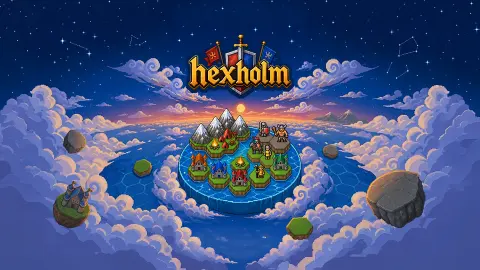
What we can report is the first few minutes, which is all most people ever see of any game: a clean board over a sunset sky, a panel that answers every question you can ask of a hex, and an economy fully on show and still easy to lose to.
More games by sublevelgames
The studio's other work on our shelf is quieter and sharper: Mini Chess, chess on boards as small as four squares by four, and Checkmate, which hands you a position and the number of moves to mate in. If it is the map-taking you want rather than the board, try War Groups, where you take ground sector by sector, or Clash of Armour for the same spend-and-push rhythm on a shorter fuse. The rest are under strategy games.
Screenshots
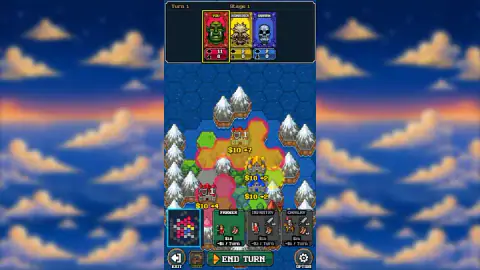
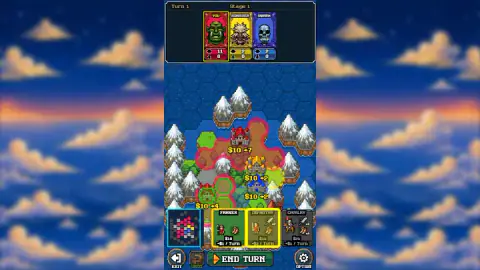
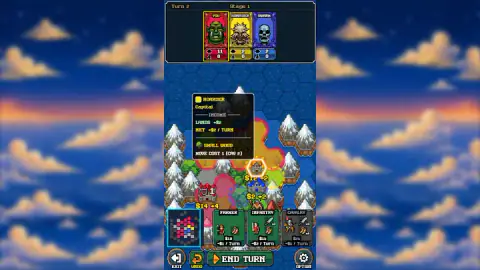
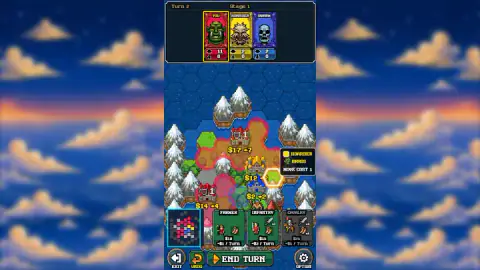
Taken by opening the game ourselves and letting it run — not supplied by the publisher, and not the same picture every other site shows.
How to play Hexholm
- Tap one of your own hexes. A panel names the owner, the terrain and the move cost, and on a capital it splits the income into LANDS and NET.
- Pick a unit from the tray along the bottom — farmer, infantryman or cavalryman — and place it on an empty hex inside your land. Cards you cannot afford stay grey.
- Tap a unit on the board and every hex it may legally take lights up, outlined in bright green.
- Tap one of those green hexes to move. Neutral and enemy ground joins your province, and your income rises by one the same turn.
- Press END TURN, the green bar at the foot of the screen, and the computer factions move.
What only sitting in front of it teaches:
- Green is the whole interface. An enemy-held castle in range is drawn exactly like empty grass: tinted green, outlined green. If a hex is not green, the game will not let you go there.
- UNDO wakes up. It sits grey at the start of every turn and lights orange the moment you have acted, so you can see the turn has become undoable rather than clicking to find out.
- The purse belongs to the province, not to you. This is the thing that catches people. There is no single treasury, and a rich province cannot bail out a poor one.
- A large wood is a wall for horses. Open one and the panel reads a move cost of two and, under it, NO CAVALRY. A small wood is gentler: one for most units, two for cavalry.
- No keyboard. Arrow keys and letters gave us nothing back; this is a pointer game, which is no surprise in a phone-shaped window.
Controls
| Click or tap a hex | Opens its panel — owner, terrain, move cost, and for a capital the income split into LANDS and NET |
|---|---|
| Click or tap a unit card in the bottom tray | Picks a farmer, an infantryman or a cavalryman to place; cards you cannot afford stay grey |
| Click or tap a unit on the board | Lights up every hex it may legally take, outlined in bright green |
| Click or tap a green hex | Moves there, or takes it if it is neutral or enemy ground |
| END TURN, the green bar at the foot of the screen | Ends your turn and hands the board to the computer factions |
| UNDO, beside it | Stays grey until you have acted, then lights orange |
Features
- Every campaign stage carries a win rate printed in red under its map preview before you play it; Storm Moor, the large map at stage 58, shows sixteen per cent
- A province pays one gold a turn for every hex it holds, and the capital's panel shows that figure as LANDS
- Each province keeps its own purse: the four capitals on our map all started with ten gold and drifted apart from the second turn onwards
- Soldiers charge a wage every turn, from one gold for a farmer up to five for a cavalryman, and the NET line is what is left after it
- Terrain is a rule, not scenery: small woods cost cavalry double, and a large wood will not take cavalry at all
- Three computer factions are named for how they behave — HOARDER, SWARM and AGGRESSOR — and you can see which of them a stage holds before you commit
- A hundred campaign stages, plus a daily run and a random-map generator that stay padlocked until you have cleared the third and fifth stages
Game details
- Developer
- sublevelgames
- Release date
- June 2026
- Last updated
- October 24, 2026
- Added here
- May 2026
- Technology
- HTML5 (2D)
- Platforms
- Browser (desktop), Browser (mobile & tablet, touch)
- Classification
- Strategy
- Saved progress
- Saving, when available, is managed by this game. Mava cannot confirm your level.
FAQ
How do you play Hexholm?
You hold provinces made of hexagons, and each province earns a gold a turn for every hex it owns. Tap your land, buy a farmer, an infantryman or a cavalryman from the tray along the bottom, and place it on an empty hex inside your territory. Tap a unit and the hexes it can legally take light up in bright green; take neutral and enemy ground to grow your income, then press END TURN and let the computer factions move.
What are the units in Hexholm and what do they cost?
Three cards sit in the tray. A farmer costs ten gold and charges one gold a turn in wages, an infantryman costs fifteen and charges three, and a cavalryman costs twenty-five and charges five. The cards you cannot afford are greyed out, so the tray doubles as a reminder of how poor you are. On our first turn only the farmer was in colour.
What is the difference between LANDS and NET in Hexholm?
Open a capital and the income panel splits in two. LANDS is what the ground pays you, one gold for every hex that province holds. NET is what reaches the purse once your soldiers have taken their wages. On our first turn the two lines read the same, because neither we nor the computer factions had put a single unit on the board yet.
Does terrain matter in Hexholm?
It does, and the game tells you so plainly. Tap any hex and the panel gives its move cost. Grass costs one. A small wood costs one for most units but two for cavalry. A large wood costs two and will not admit cavalry at all, which turns a stretch of forest into a wall your horses have to ride around.
What are HOARDER, SWARM and AGGRESSOR in Hexholm?
They are the computer factions, and they are named for the way they play rather than for a species. Each stage shows you which of them you are up against before you start, along with how many castles each one begins with. The faces change from stage to stage; the names do not.
Is there a daily challenge or a random map in Hexholm?
Both are in the main menu and both arrive padlocked. DAILY RUN asks you to clear stage three before it opens and GENERATE asks for stage five. There is also a RANKING button, open from the start, labelled as a campaign ranking. We never cleared a stage, so we cannot tell you what any of the three looks like from the inside.
How many levels does Hexholm have?
The campaign button on the main menu reads out of a hundred, and you can page through all of them in the stage browser before you have unlocked them. Each stage has a name, a size and a win rate — Storm Moor at stage 58 is marked as a large map with a win rate of sixteen per cent — but the play button stays padlocked until your progress reaches it.
Who made Hexholm and is it free?
sublevelgames made it, and the studio's name is printed in the corner of the title screen. It is free and runs in a browser with nothing to install. Almost all of the studio's other games are board and logic puzzles — small-board chess, Korean janggi, sudoku, mahjong, dominoes — which makes Hexholm the one war game on the shelf.