

About EdgeFire 2
Our match ended 41-42. One point, settled in the last second of a two-minute clock, after a scoreline that had been level three separate times on the way down.
Add those two numbers together and you have the shape of the whole game: eighty-three kills shared out across a hundred and twenty seconds. That is one somewhere on the map every second and a half, for the entire match, without a pause.
The reason it can run that hot is printed on the screen the moment you lose a fight. Rebirth through: 2. Two seconds. In EdgeFire 2 dying is not a setback, it is a short wait, and that single rule rewrites what cover is for.
The game is credited to a developer called Nikita. This is the sequel.
What follows is an account of one session on a desktop: the menu, the map screen, and one complete match on the desert map from 0-0 to the final whistle. We never opened the weapon rack and never loaded the second map, and we say so again further down rather than pretend otherwise.
Eighty-three kills in two minutes, and what that does to cover
Most shooters make you price a single decision: is it worth stepping out from behind this wall? The answer depends almost entirely on what dying costs. EdgeFire 2 answers that question before you ask it, and the answer is two seconds.
Work it through. A death puts you out of the match for about the time it takes to read this sentence. Walking a long way round to a safer angle costs you far more than that, and so does waiting for an enemy who may be busy elsewhere. The arithmetic of our own match makes the point: the two totals together climbed past eighty before the clock ran out, and they climbed steadily, not in bursts.
So cover stops being a place to sit and becomes a thing to move through. The walls on the desert map are low and widely spaced for exactly that reason — they break a line of sight for a second or two, which is all anyone needs at this speed.
There is a second effect, and it is the reason the scoreline stayed close. Because every kill is worth the same hundred points and nothing carries over between lives, nobody can run away with the match on a lucky streak. A good run is worth two or three points before someone catches you. That is why we were level at thirty-three apiece, level again at forty, and still lost by one.
The two numbers at the top are the oldest idea in shooters
Those paired team totals have a history, and it is close to the beginning of the genre. The word deathmatch was coined by designer John Romero while he and programmer John Carmack were building the local-network multiplayer for Doom — the first game their studio shipped with competitive multiplayer at all, since its predecessor had none. Romero later put the creative spark down to the Japanese fighting games the team played between shifts.
The variant that followed is the one EdgeFire 2 runs on. In a team deathmatch, two or more sides each keep their own running count of kills — a frag count, in the vocabulary that stuck — and the side with the higher count when time expires wins. Not a flag, not a captured point, not a last survivor: a tally.
That matters more than it sounds, because it decides what your individual performance is worth. Your hundred points do not belong to you; they go into one of the two piles at the top of the screen. A player having a terrible match still contributes by occupying somebody, and a player having a brilliant one cannot finish the job alone.
It also explains the clock. In the other great shooter tradition, one life per round and no coming back, the round ends when a side is wiped out and the drama lives in the silence between shots. Give everyone a two-second respawn and that structure collapses, because nothing can be eliminated. Something else has to end the match, so a timer does, and the pressure moves to the final ten seconds instead of the first.
Desert, warehouse, and the grey room in the middle of the desert
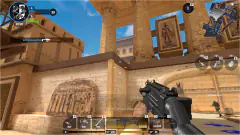
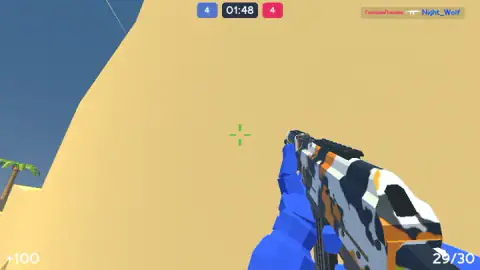
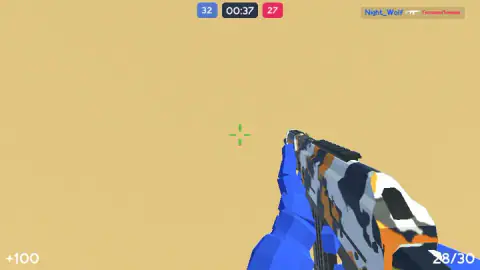
The map screen offers two choices and we took the first. Desert is sand dunes, palm trees, pale block walls the colour of dried mud, and a flat blue sky with nothing in it.
The art is deliberately plain: big untextured surfaces, hard edges, no clutter on the ground. Played for ten seconds it looks cheap. Played for two minutes it looks like a decision, because a blue figure against a beige wall is the only thing on screen worth looking at, and at a kill every second and a half you need to recognise a silhouette before you have consciously seen it. Visual noise would cost more here than it does in a slower game.
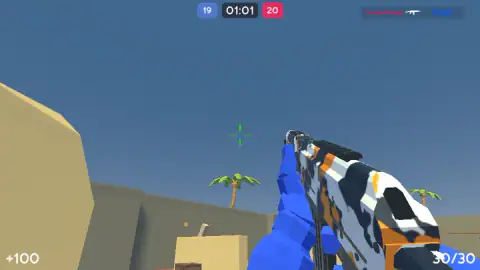
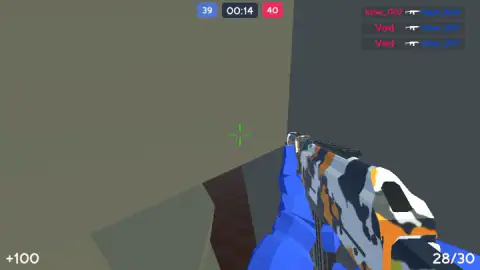
One honest surprise: the desert map is not all desert. With twenty seconds left we were between grey concrete walls and a dark doorway, with the scoreboard and the clock running on unbroken from the sand outside. So there is an interior section inside the outdoor map — we never loaded warehouse at all, and this page cannot tell you what is in it.
What we could not check
We would rather mark the edges of what we know than fill them in.
The weapon panel on the menu was never opened, so we cannot tell you how many guns there are or what they cost. The whole match was fought with one rifle in orange, white and black camouflage and a thirty-round magazine. The tasks panel we saw and closed; what it asks for is unknown. The thousand from the daily reward was collected and never spent.
We also cannot tell you who we were playing against. The kill feed named them steadily — Night_Wolf, Void, Killer_007, one written in Cyrillic — and they shot back competently, but no lobby, player count or connection reading ever appeared on screen. And we played on a desktop, so the touch controls that the listing's Android and iOS listing implies are outside what we can describe.
More shooters in the catalogue
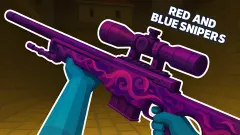
Red and Blue Snipers is the obvious next stop: same developer, and it trades this game's sprint-and-spray for patience and a scope. Hazmob FPS: Online Shooter keeps the pace but gives you several modes to spend it in, and Special Ops: GO builds its matches around fixed five-a-side teams rather than a scrum. MFPS: Military Combat is the closest thing here to a straight swap. The rest are in shooting games.
Screenshots
How to play EdgeFire 2
- Clear the menu before you reach for PLAY. A daily reward card opens first, with day 1 highlighted and a yellow receive button under it; ours was worth 1000. Until that card and the tasks card are closed, the big yellow play button in the bottom right corner will not respond, however precisely you click it.
- Pick a map. The next screen offers desert and warehouse. The one you have selected carries a yellow outline, back sits bottom left, play bottom right.
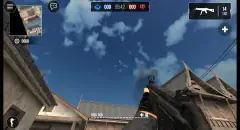
- Move and shoot. W A S D walks, the mouse aims a small green cross, the left button fires. The scoreboard is the three badges at the top: your team, the clock, their team.
- Reload with R, early. The magazine holds 30. The counter in the bottom right corner is the number that decides close fights, not the one at the top.
- Die, count to two, carry on. The respawn card does the counting for you. There is no penalty beyond those seconds.
What the session taught us:
- Camping loses. The scoreboard climbed roughly a point every second and a half whether or not we were involved. Every second spent waiting behind a wall is a second the other team is scoring in.
- Read the kill feed, top right. Each line names who killed whom, with the weapon between them, coloured by team. Three lines stacked up at once in our closing seconds, which is a reliable sign the fighting has drifted your way.
- Reload the moment a fight ends, not when the fight starts. At this tempo the next one is already walking towards you.
- If you click away from the page, the match pauses behind a card reading Click to keep playing. One click in the middle of the screen hands control back. We lost several seconds the first time it happened.
- The clock is the referee, not the score. A four-point deficit with twenty seconds left is genuinely recoverable here. Ours nearly was.
Controls
| W A S D | Walk. There is no stand-still option worth taking; the score moves too fast for it |
|---|---|
| Mouse | Aim. The sights are a small green cross in the middle of the screen |
| Left mouse button | Fire |
| R | Reload. The magazine holds thirty rounds and the counter sits in the bottom right corner |
| Esc | Pause menu |
| Click in the centre of the screen | Gives you back control after the game pauses itself behind a card reading "Click to keep playing" |
| PLAY, bottom right | The yellow button on the level screen and again on the map screen. It will not answer while a card is open over it |
Features
- Two-minute matches on a clock that counts down from 02:00 and ends the game by itself: there is no target score to reach
- Two team totals side by side at the top of the screen, blue on the left and red on the right, with the clock between them
- A hundred points for every kill, announced in the bottom left corner
- Respawn costs two seconds, counted down by a card that reads "Rebirth through: 2"
- Two maps to choose from before the match: desert and warehouse
- A rifle with a thirty-round magazine and a reload key you will use more often than you expect
- A daily reward on the menu screen, worth 1000 on the day we collected it, plus weapon, tasks and settings panels
Game details
- Developer
- Nikita
- Release date
- November 2025
- Last updated
- August 10, 2026
- Added here
- September 2025
- Technology
- HTML5 (WebGL)
- Platforms
- Browser (desktop), Browser (mobile & tablet, touch)
- Saved progress
- Saving, when available, is managed by this game. Mava cannot confirm your level.
FAQ
How do you play EdgeFire 2?
It is a first-person team shooter played in two-minute matches. You walk with W, A, S and D, aim with the mouse, fire with the left button and reload with R. Every kill adds a hundred points and raises your team's total, which sits at the top of the screen next to the other team's. When the clock reaches zero, whichever total is higher wins.
How long is a match in EdgeFire 2?
Two minutes. The clock starts at 02:00, runs down in the middle of the scoreboard and ends the match on its own. There is no score to reach and no sudden death we saw: our match was still level at forty apiece with eight seconds left, and finished 41-42.
What happens when you die in EdgeFire 2?
Very little. A card appears reading "Rebirth through: 2" and you are back in the match two seconds later, which is the single most important rule in the game. Dying does not take you out of the round, so standing still to stay safe costs you more than being shot does.
What are the controls for EdgeFire 2?
W, A, S and D to move, the mouse to aim, the left mouse button to fire, R to reload and Esc for the pause menu. The menus themselves are clicked: a yellow PLAY button in the bottom right corner starts the match, and a BACK button in the bottom left leaves a panel.
What maps does EdgeFire 2 have?
The screen before the match offers two, labelled desert and warehouse, and the one you have picked is outlined in yellow. We played desert: sand dunes, palm trees, pale block walls and a flat blue sky. It is not all sand either, because the last stretch of our match ran through a grey-walled interior with the same clock still counting.
Who made EdgeFire 2 and when?
It is credited to a developer called Nikita. The page gives a release date of November 2025 and a last update in August 2026.
Are the other players in EdgeFire 2 real people?
We cannot tell you. The kill feed in the top right corner names them — Night_Wolf, Void, Killer_007, one in Cyrillic — and they behave like a full roster, but we never saw a lobby, a player count or a connection reading. Treat it as a match against named opponents and nothing more.
Can you play EdgeFire 2 on a phone?
It is listed for PC, Android and iOS, and our catalogue flags it as playable on touch. We played it on a desktop with a mouse and a keyboard, so this page does not describe what the on-screen controls look like or how aiming feels under a thumb.