





How this list is put together
Times tables games are built for memory, not for working out
The Common Core standards set a plain goal for the end of 3rd grade: know from memory all products of two one-digit numbers. Not work them out. Remember them, the way you remember a word, so the rest of the problem gets your full attention.
That is why a good multiplication game feels slightly unfair at first. Maths Puzzle gives you a squared sheet with sums down one side and answers down the other, and you join the pairs. The right answer is already on the page, among five others, so the question is whether you recognise 3 × 8 at sight. Level 1 is drawn fresh every visit: our two first sheets, weeks apart, had no sum in common.
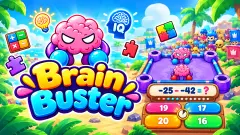
Brain Buster adds a rival. Fourteen questions, four answers each, and the first right answer lands the punch. The wrong answers sit one or two away from the right one: for 12 ÷ 6 the choices were 1, 2, 3 and 4. Its trickiest questions are not big products but subtractions with a negative, like 6 minus minus 7. Taking away a negative is adding, so it is 13. Negative numbers are a middle school topic, so younger players should expect to drop those points.
Three ways to answer: match, pick or type
- Match. Maths Puzzle has no clock on the sheet, and a wrong pair costs one of three hearts.
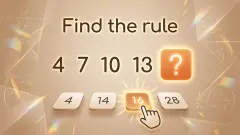
- Pick one of four. Fast, but you can guess. Find the Rule builds its wrong answers from rules that are nearly right: for 6, 10, 14, 18 it offered 21, 23 and 26 next to 22. When you miss, it tells you the rule.
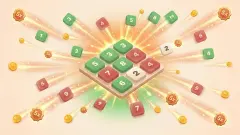
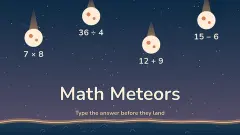
- Type it. Math Meteors, according to its description, has you type each answer on a keypad, and it has a times tables mode.
SUM+SUM runs the other way. The grid starts full, and you remove numbers until each row and column hits its target. Add up the row, subtract the target, and the difference is what has to go.
Division and number patterns come next
Division is multiplication read backwards, and Slide And Divide makes you read it. Drop a tile beside a number it divides and the board prints the sum: 12 ÷ 6 = 2. A twelve accepts a 2, 3, 4 or 6. A 7, 11 or 13 accepts nothing but 1 and itself, because it is a prime number, and it can sit on the board for a whole game.
Number patterns that follow a rule are a 4th grade standard. Find the Rule covers them. So does the Numbers family in Thinking Games, our own set of 22 logic puzzles, with no timer anywhere. One of them, The Scale, asks what each shape weighs: algebra before anyone calls it that.
Counting change in dollars and cents
Word problems with dollar bills, quarters, dimes, nickels and pennies are a 2nd grade standard. Shop Cashier Simulator 3D is the one game here in dollars. The till does the subtraction, $1.50 change on an $8.98 sale for us, and you build that amount from the drawer. Nothing in the drawer subtracts, so a wrong note sends the total the wrong way. The drawer also holds a 50c coin, rare in real American change.
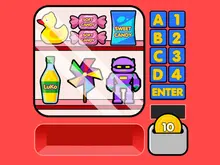
Wonder Vending Machine is stricter: it gives no change at all. Pay one coin too many and the meter jumps back to the full price. Its coins are euro cents, made by an Italian studio, but the arithmetic is the same in any currency.
These games are light. The math games we measured weigh, at the median, less than half the typical game on the site, which helps on a school laptop. For logic without sums, try the sudoku and logic games.