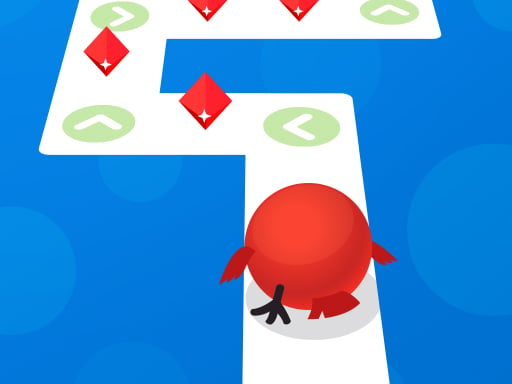
About Tap Tap Reloaded
The description attached to this game promises song requests, practice sections, clan battles and weekly tournaments with cash prizes. Press play and you get a red bird running along a white corridor on an orange background, collecting diamonds. There is no music track, no note highway and no multiplayer. The two things have nothing to do with each other, and the game does not even pretend otherwise: the browser tab and the footer both read Tap tap run, and so does the title screen.
What actually loads is a one-tap maze runner. Your animal moves forward on its own along a path one tile wide, drawn on a flat colour field seen from directly overhead. Every so often the path turns. A click turns you, and that is the entire control scheme — no steering, no speed, no second button. Get it right and you keep running; get it wrong and you sail off the edge, a black X lands on your face, and the word "FAILED!" appears over a frozen screen. Fifty levels, laid out on a map of five pages, unlocked one at a time.
The interesting part is how narrow the timing is, and how thoroughly the game hides that from you. There is a grey arrow at every upcoming corner and it turns green when the corner becomes yours. Most players read that as a cue and press. It is not a cue — it is a warning, and pressing on it is fatal.
Who built it is genuinely unclear, and worth stating plainly. The Unity configuration inside the page names the company as Pony game and the product as Tap tap run; the compiled C# sits in a namespace built from a Vietnamese personal name; GameMonetize's own listing for this URL credits Angry Games, whose company page lists thirty other games, every one of them a Christmas or celebrity title; and a second GameMonetize listing serves the same game under its correct name, in an older Unity export, and credits Kizi10. The scene file we serve even carries a GameMonetize key that is not the one in its own URL, and that key resolves to a third copy of the identical build. We name what the build declares and leave the rest open.
The tap window is about a quarter of a second long
This is the number that explains why the game feels unfair before it feels fair. Recording level 1 at 60 frames per second and then replaying it with a single click fired at fixed delays gives a clean answer: a tap at 2.70 seconds turns too early and the run dies with 10 points. A tap at 2.75, 2.85 or 2.95 seconds turns correctly. A tap at 3.00 seconds is too late and the run ends with exactly the 70 points you would score by never touching the mouse. The window is roughly 2.72 to 2.98 seconds — about 250 to 300 milliseconds wide.
Put that next to what a human body can do. The median simple visual reaction time on Human Benchmark, pooled over tens of millions of "click when it turns green" trials, is 273 milliseconds, with a mean of 284. The window this game gives you at each corner is, near enough, the length of one complete human reaction. That is why the green arrow exists and why it fires so early: without six tenths of a second of forewarning, a corner would be pure chance rather than a test. The arrow buys you the reaction time; the window itself has none to spare.
There is a second tax that no mobile version pays. This is a WebGL build, so your click travels through the browser's event loop and Unity's input polling before it reaches the game, and it is displayed on a compositor that is not synchronised to anything. On a laptop that is a handful of milliseconds; on a tired school machine running a WebGL canvas at 30 frames per second it is not. A quarter-second window absorbs that badly, which is the honest reason this game reads as harder in a browser than the same idea does on a phone.
The 50 levels, the six animals, and what the game never tells you
The level map is five pages of twelve buttons, ending at 50. Levels unlock strictly in order — clear 1 to see 2 — and the game stores a separate best score for each one, so replaying an early level to collect every diamond is a real activity rather than a cosmetic one.
The Select Characters screen, reached by clicking the animal portrait in the top-left corner of the retry screen, holds six animals in a three-by-two grid: a red bird, a cat, a rabbit, a honey badger, a squirrel and a pig. Each one has its own set of jump sounds baked into the build. Only the bird is available. The other five are grey silhouettes, clicking them produces nothing — no price, no requirement, no message — and there is no shop, no coin counter and no purchase anywhere in the game. The only quantity that goes up is levels cleared, so that is presumably the key, but the game refuses to confirm it.
Under the surface the level builder is more capable than the first few levels let on. It assembles each map from named pieces — a start tile, path tiles, edge tiles, a leap tile, a circular leap tile and a finish tile — and marks each tap point with one of four types: turn up, turn left, turn right, and jump. All four are triggered by the same single press. That is the design idea worth noticing: one input whose meaning is defined entirely by where you are standing, which is what lets a game with no buttons keep introducing new demands for fifty levels.
Playing Tap Tap Reloaded unblocked at school
It is a static WebGL page: one HTML file, one Unity loader, one data file. Nothing installs, no account is created, and it will run on a locked-down Chromebook provided the host itself is reachable. Two warnings worth having before you try it in a computer lab.
First, you need a pointing device. The keyboard is completely inert here. Space, Enter, the arrow keys and WASD were all pressed repeatedly through a full run and the bird died exactly as if nothing had been touched. A trackpad click works fine; a keyboard alone will not get you past level 1.
Second, retrying plays an ad. On the distributor's build, failing and pressing the retry button hands you a video interstitial — skippable after five seconds, closed after twenty-five — behind a cookie consent dialog. That is the distributor's ad SDK rather than anything the game does, and given how often you will fail in the first ten levels it is the single biggest thing standing between you and level 50.
If the one-press-one-decision format is what you came for, the same shelf has ZigZag Snow Mountain, where a single click flips a skier between two diagonals and nothing else exists, and Dune Surfer 3D, where you hold to bury yourself in a dune and release to fly. For the same top-down running with a lot more scenery, Relic Runway is a full 3D endless runner. All three, and everything else built to be understood in one screen, live in Arcade.
How to play Tap Tap Reloaded
- Press the green button. The title screen shows one play button labelled "Continue !" and a settings cog. Play opens the level map; the map's own play button starts the highest level you have reached.
- Watch the corner, not the arrow. Your animal runs at a constant speed toward the first turn. The arrow ahead will switch from grey to green roughly six tenths of a second before the turn can actually be taken.
- Press once, when you are on the corner. One click, one turn. Nothing is buffered and nothing is held.
- Collect the diamonds on the way. Each one is worth 10 points. They sit on the path, so a clean line picks them all up without any extra effort.
- Reach the finish tile. Clearing a level unlocks the next one on the map and stores your best score for that level. Fail and you land on a retry screen with the level map one button away.
Tips from playing it:
- Never tap on the green. Measured in level 1: the arrow goes green about 2.1 seconds into the run, the turn is only accepted from about 2.72 seconds, and the animal is gone by 3.0. Tapping the moment the arrow lights is 600 milliseconds early, and 600 milliseconds early is a fall.
- Do not spam the button. Clicking every tenth of a second from the start of level 1 kills you at 30 points — worse than doing nothing at all, which gets you to 70. A tap away from a corner still turns you, straight off the path.
- Use the diamonds as a metronome. They are spaced evenly along the path, so the last diamond before a corner is a far better timing reference than the arrow.
- The colour means nothing. The background changes on every single attempt. It is decoration, not a difficulty tell.
Controls
| Click or tap, anywhere on the screen | Turn at the corner you are standing on, or jump the gap. One press, one action — the level decides which. |
|---|---|
| Timing | The turn only registers while you are inside the corner. In level 1 that window lasts roughly a quarter of a second. |
| Green arrow | Not a "press now" cue. It arms about 0.6 seconds before the turn is accepted, so it is a warning, not a signal. |
| Keyboard | Dead. Space, Enter, the arrow keys and WASD do nothing in this build — it is mouse and touch only. |
| Map button (after a failure) | Back to the 50-level grid. The bird portrait in the top-left corner opens the character select. |
Features
- 50 hand-built levels laid out on a five-page map, unlocked strictly one at a time — no shortcuts, no level skip
- Six animals to run with (bird, cat, rabbit, honey badger, squirrel and pig), five of them locked from the start
- Diamonds are worth 10 points each and the game stores your best score for every level separately
- Four kinds of tap point built into the level generator — turn up, turn left, turn right and jump — all mapped to the same single press
- No coins, no shop, no upgrades and no in-app purchases of any kind; levels cleared is the only currency
- The background colour changes on every attempt — orange, green, pink, magenta, blue — so no two retries look alike
- Retrying on the distributor's build plays a skippable video ad; the game itself has no ads in it
Game details
- Developer
- Pony game
- Release date
- February 2022
- Added here
- April 2023
- Technology
- HTML5 (Unity 2020.3 WebGL, 2D top-down sprites, 960×600 canvas with a portrait play area)
- Platforms
- Browser (desktop), Chromebook
FAQ
Is Tap Tap Reloaded a rhythm game?
No. The description that travels with this game describes a different product — Tap Tap Reloaded, an Android rhythm game by Partycubed LTD built as a community successor to Tap Tap Revenge. What actually loads here is a Unity game called Tap Tap Run, a top-down one-tap runner with no music track and no notes to hit.
How do you play Tap Tap Run?
Your animal runs forward on its own along a white path. Every corner carries an arrow; one click or tap turns you. Miss the turn and you run off the edge and fall, which ends the level immediately. There is nothing else to press.
Why do I keep falling off even though I tapped?
Almost always because you tapped too early. The arrow goes green well before the turn is accepted, and a tap outside the corner turns you where there is no path. Wait until your animal is physically on the corner, then press once.
How many levels does Tap Tap Reloaded have?
Fifty. The level map is five pages of twelve, and the last page holds levels 49 and 50. The counter in the top-left corner of the HUD reads "Level 1 / 50" and counts up as you clear them.
How do you unlock the other characters?
The game never says. Five of the six animals are greyed out on the Select Characters screen and tapping a locked one produces no message and no price. There is no coin, no shop and no purchase anywhere in the build, so the only thing you can accumulate is cleared levels.
Can I play Tap Tap Reloaded unblocked at school?
It is a plain WebGL page with nothing to install, so it runs on a school Chromebook as long as the site itself is reachable. You need a mouse or a trackpad, though — the keyboard does nothing at all in this build.
Does Tap Tap Reloaded work on a phone?
Not really. The page itself puts up a banner saying WebGL builds are not supported on mobile devices as soon as it sees a phone or tablet browser, and the canvas is a fixed 960×600. Play it on a laptop or desktop.
Who made Tap Tap Reloaded?
Nobody can say for certain. The Unity build declares its company as "Pony game" and its C# code sits in a namespace named after a Vietnamese first name, while GameMonetize credits Angry Games on this listing and Kizi10 on a second listing of the identical build. We publish what the build itself declares and flag the disagreement rather than pick the most convenient answer.