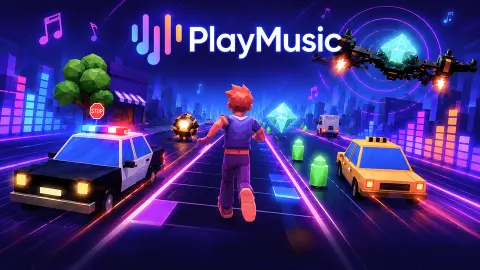


About PLAYMUSIC
Most games tell you what they are before you touch anything. The name sits on the tab, the first screen agrees with it, and you know where you stand. We opened this one under a title made of the words play and music, filed under rhythm and running, and then spent the entire session driving a car.
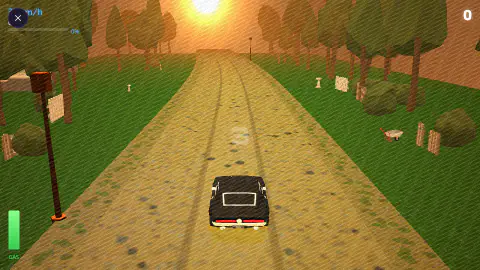
Not a metaphorical car. A dark saloon with a red strip across its tail, seen from directly behind and sitting low in the frame, rolling down a dirt track with two wheel ruts worn into it. Grass either side, blocky trees, a wooden fence, a wheelbarrow parked on the verge, and at the end of the road a low white sun bleaching the sky orange. The title card before our first run gave the thing we were about to play a name of its own: No Brakes - City.
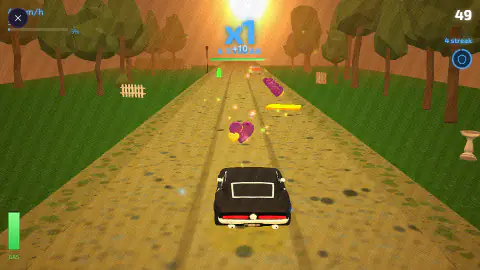
What you collect are hearts, and they are broken ones — a fat magenta heart split down the middle with a smaller gold heart wedged into the crack. They lie on the road singly, or in a line of four curving across a lane, and driving through one pops a +10 into the air above the bonnet. Take enough without hitting anything and a counter in the corner starts tracking the streak, with a multiplier climbing beside it. Hit anything at all and the run is over. Not a life lost: the run, finished, with a card that reads CRASHED and prints a score and a distance in metres.
The game is credited to STYNGR, has been available since May 2026. Our best run ended on seven hundred and forty-eight points and two hundred and thirty-six metres. That is not far, and a good deal of what follows is about the parts we never got near.
Ten points a heart, and a multiplier doing the real work
Score systems in endless driving games usually pay by the metre. This one pays by the pickup, and the difference shows in how the number moves: it sits still through a clear stretch and then jumps in steps of ten, or twenty, or thirty.
The step size is the whole game. Each heart is worth ten, flatly, and the corner of the screen counts how many you have taken in a row without crashing. Beside that count sits a multiplier, which starts at x1. Our longest run pushed the streak to eleven and the multiplier to three, and from there every heart on the road was worth thirty.
That is why a score looks strange from the outside. Four hearts in we had forty-nine points; later in the same session, eleven in, seven hundred and forty-seven. Anyone watching would assume something enormous had been collected. Nothing had: the same small magenta heart was being paid out at triple.
It also changes what a line of hearts is for. Four of them curving down the right-hand side of the road is not four times ten points — it is four consecutive additions to a streak, so the fourth is worth more than the first and the heart after the line more again. Breaking a chain halfway is worse than never starting it, because the back half is where the money is. The game never says this. You work it out by watching the corner.
A mode called No Brakes, and a road with no city on it
Take the brake off a driving game and you remove most of the decisions a driver makes. No lifting before a corner, no choosing between a fast entry and a fast exit. What is left is one axis: left, or right, and when.
That is what this is, and the mode name says so plainly. There is no brake key and no accelerator either — the countdown releases the car and the car goes — and the up and down arrows did nothing we could detect. Every run asks the same question over and over: given what is coming, which part of this road do you want to be on? The hearts answer it half the time, because a row of them works as a signpost. The traffic asks it the rest of the time, since every vehicle ahead is something you must commit to passing on one side or the other, with no option to slow down and look.
A design like that lives or dies on how readable the road is, and this one is very readable: a pale dirt strip with two dark ruts, flat green grass either side, and almost everything you must not hit standing clearly off the ruts.
The other half of the name is harder to defend. We never saw a city. The road we drove was a country track between trees, fences and a parked wheelbarrow, with a sunset at the end, and that held in every capture across every run. Either the city arrives further along than two hundred and thirty-six metres, or the name belongs to a stretch we never reached.
What the music does, and why we will not pretend to know
A game called PLAYMUSIC ought to be judged on its music, and here is the honest position: across our whole session we could not confirm that there was any. We pressed every key we could think of and registered nothing audible. Nothing on screen appeared timed to a beat — the hearts did not arrive on a pulse we could count, the traffic did not move in step, and the multiplier changed when we collected rather than on any rhythm.
That is not the same as saying the game is silent. What we can tell you is that the driving stands up without it: nothing in the run we played needed a sense of timing beyond what your eyes give you.
The same caution covers the rest. We reached one road and one mode, never found a way to another and never saw a menu offering one. We do not know what the small upright green object in the road does, what the outlined badge under the streak counter means, whether the purple blocks and yellow bars are hazards or pickups, or what happens when the GAS bar finally moves. If any of that is where the music lives, we missed it.
More roads, and one game that really is about the music
Race Through Traffic is the nearest relative we have: an endless highway, four lanes, one car and a distance counter that never stops. Traffic Racer 3D offers a sixty-second timed mode alongside an endurance run, which is the obvious thing to try if the one-mistake rule here feels harsh. Mr. Drifter: Car Chase Simulator puts a pursuit behind you instead of points in front of you, in the same chunky low-poly scenery. And if you came for the music and found a car, Jump to the Rhythm of Songs! Musical Ball! is one where the song genuinely is the mechanic. The rest of the road is in driving games.
Screenshots
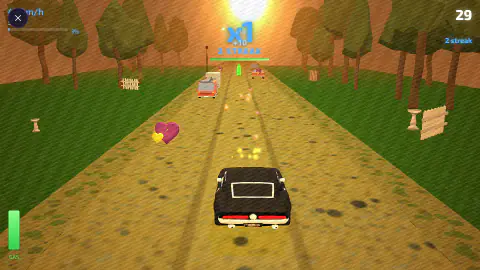
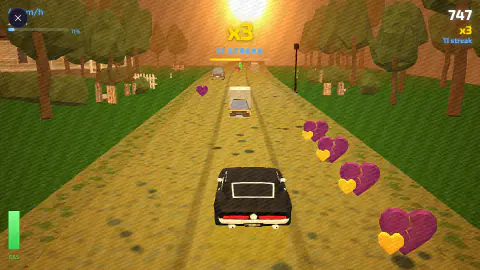
How to play PLAYMUSIC
- Click PLAY and wait out the countdown. A large number counts down over the stationary car, and nothing we pressed during the count changed what happened next.
- Steer with the left and right arrow keys. That is the entire control surface we could find. The car accelerates by itself; the only thing you decide is which part of the road it occupies.
- Drive through the hearts. Ten points each before any multiplier, and they are laid out as a path rather than scattered. A line of them curving across a lane is the game showing you where that lane is clear.
- Keep away from anything solid. The other vehicles are all slower than you, and so are the posts and fences on the verge. One contact of any kind ends the run.
- Click PLAY AGAIN on the crash card. Your score and distance are printed on it. Between one run and the next the game puts a card on screen that has to be clicked before the road comes back — that slot is where its advertising goes.
What the session taught us:
- The streak is worth far more than the hearts. At four hearts in a row the corner read forty-nine; later, at eleven in a row with the multiplier showing three, it read seven hundred and forty-seven. The hearts did not get bigger. The arithmetic around them did.
- A crash costs you the multiplier, not just the run. That is the real reason short runs stay small: you restart at nothing, and the first hearts of a new run are worth ten apiece until the streak rebuilds.
- The verge is not an escape route. Swinging wide to dodge a truck put us into a fence post more than once. The usable road is narrower than it looks: the scenery is as solid as the traffic.
- You cannot read your own speed. In all four of our captures a round close button sits over a readout ending in m/h, covering the digits. The thin bar beneath it is legible — it crept to eleven per cent over a run — but what it measures we never established.
- Fuel is not your problem yet. A green bar labelled GAS stands in the bottom-left corner, full in every capture we took. Whatever drains it, we crashed long before it mattered.
Controls
| Left arrow | Steers the car towards the left of the track. The car drives itself forward; all you choose is which part of the road it is on |
|---|---|
| Right arrow | Steers towards the right. Held down for a second and a half at a time, it is what moved us across the road in every run |
| Swipe left or right | The same two moves on a phone or tablet. The game is listed as playing on desktop, mobile and tablet; our own session was on a desktop keyboard |
| Click PLAY | Starts a run from the title card. A large countdown then runs over the stationary car before it is released |
| Click PLAY AGAIN | On the crash card, which prints your score and your distance, this starts the next run |
| Up, down and space | We pressed all three repeatedly and could not tie any of them to anything on screen. There is no brake key we could find, and no pause |
Features
- A third-person driving run on a dirt track with two worn wheel ruts, grass verges, blocky trees and the sun sitting low and white straight ahead
- Broken hearts as the collectible: a magenta heart split down the middle with a small gold one in the crack, worth ten points each before any multiplier
- A streak counter that climbs with every heart taken cleanly and a multiplier that climbs with it — our best run ran the streak to eleven and the multiplier to three
- Traffic sharing the road: trucks, a pickup and smaller cars, all slower than you and none of which you can touch
- One crash ends the run. The card that appears names the mode No Brakes - City and prints a score and a distance in metres
- A green bar labelled GAS in the bottom-left corner, full in every capture we took, and a percentage bar in the top-left that crept from zero to eleven
- Credited to STYNGR, up since May 2026
Game details
- Developer
- STYNGR
- Release date
- May 2026
- Last updated
- July 27, 2026
- Added here
- March 2026
- Technology
- HTML5 (3D)
- Platforms
- Browser (desktop), Browser (mobile & tablet, touch)
- Classification
- Driving
- Saved progress
- Saving, when available, is managed by this game. Mava cannot confirm your level.
FAQ
What is PLAYMUSIC?
It is filed under music and rhythm, but what loaded for us and what we played is a driving game. You sit behind a dark car rolling down a dirt road at sunset, you steer left and right to drive through floating hearts, and the run ends the moment you hit a vehicle or a fence. It is free, needs no download and plays in a browser tab.
How do you play PLAYMUSIC?
With the left and right arrow keys, or a swipe on a touchscreen. The car accelerates on its own after a countdown, so steering is the only thing you control. Drive through the broken hearts for points, keep clear of the traffic and the roadside posts, and when the crash card appears click PLAY AGAIN to start over.
What are the hearts in PLAYMUSIC?
They are the points. Each one is a magenta heart cracked down the middle with a smaller gold heart in the break, and taking one pops a plus ten into the air. They arrive singly or in a line of four curving across a lane, which makes a row of them a useful hint about where the road is clear. They are not health: nothing we collected ever gave us a second chance after a crash.
What does the streak counter do?
It is the difference between a small score and a large one. A number in the top-right corner counts the hearts you have taken without crashing, and a multiplier rises alongside it. At four in a row we were scoring single-figure multiples; at eleven in a row the multiplier read three, so each heart was worth thirty rather than ten. A crash resets both to nothing.
What does the music actually do in PLAYMUSIC?
We cannot tell you, and we would rather say so than guess. The name promises music and the platform files the game under rhythm, but across our whole session nothing we pressed produced a sound we could register, and nothing on screen — not the hearts, not the traffic, not the multiplier — appeared to be timed to a beat. Treat the driving as the part we can vouch for and the music as an open question.
Why does the crash card say No Brakes - City?
That is the name the game gives the mode we were playing, printed on its own title card and again on every crash card. It fits what we drove: there is no brake key, the car is released by a countdown and the only decision left is which part of the road to be on. The City half fits less well, since the road we saw was a dirt track between trees, fences and a wheelbarrow.
How does a run in PLAYMUSIC end?
At the first contact. Touch a truck, a car or something on the verge and the run stops dead, the car tips over and a card appears reading CRASHED with your score and the distance you covered. There is no damage meter and no second life. Our longest run reached two hundred and thirty-six metres, and most of them ended inside fifty.
Who made PLAYMUSIC and when?
It is credited to STYNGR and dates the page to May 2026, with an update in July of the same year. Those are the platform's own records for the game and the most reliable ones we found; we did not find a separate developer site to check them against.