

About Only Jump RPG
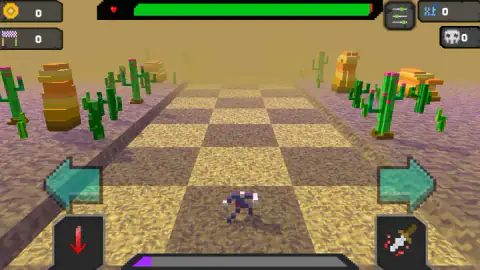
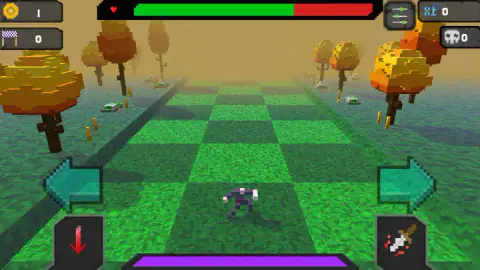
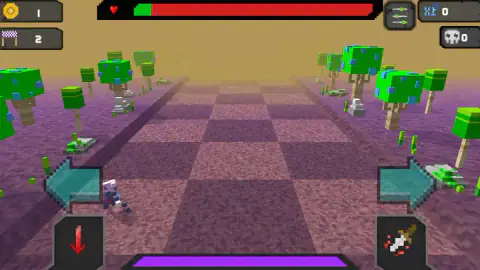
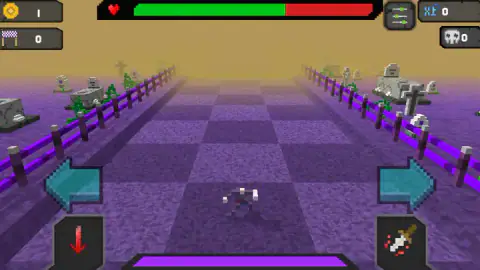
The road in Only Jump RPG is a chequerboard, and in one short session it stayed a chequerboard through four completely different places. A desert of flowering cacti and stacked sandstone. A meadow of bright green squares under orange autumn trees. Bare purple ground with green trees standing on it. A graveyard behind purple fences, with stone crosses, a long grey tomb and a skull lying in the grass. The scenery was swapped out each time. The road was not: the same squares, the same width, the same vanishing point in the same haze of yellow sky.
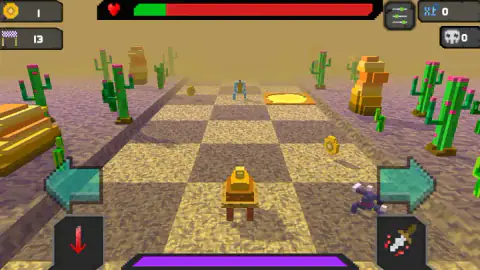
What you do on that road is step sideways. Two big pale blue arrows sit at the left and right edges of the screen, and the figure you control — purple and indigo, white hands, a dark red sash, a blue sword — slides between the lanes. We caught him dead centre in one frame, hard against the right-hand edge in another with a broad yellow creature filling the middle of the road, and pinned to the far left edge in a third. Two more buttons wait in the bottom corners: a sword on the right, a red arrow pointing down on the left.
Two bars run across the screen, and they move in opposite directions. The long one at the top has a red heart beside it, starts green and turns red from the right as the run goes on. The short one along the very bottom starts as a purple stub and fills. In our first frame the top bar is green end to end and the bottom bar is barely started; a little later the top bar is down to about a seventh of itself and the bottom one is solid purple.
The game is credited to Ermac Alex.
Our own session lasted about four minutes — long enough to describe this road honestly and nowhere near long enough to finish anything on it. The rest of this page is careful about which is which.
One road, four places
This is the first thing a new player should know, because the game does not explain it. The backdrop changes completely from run to run, and the thing you actually play on never changes at all.
Count what stays. The road is a chequerboard of two shades, the same width every time, running to a point lost in a yellow haze. The arrows are in the same two places. The sword is in the same corner, the red downward arrow in the other. The four counters read the same things from the same corners. Then count what goes: sand and cacti and sandstone become green grass under orange autumn crowns, then bare purple earth, then a graveyard with purple rails along both verges and crosses leaning behind them.
That split is a deliberate piece of design and it is worth saying why. A runner lives or dies on whether you can read the road at a glance, because you have perhaps a second to decide. Keep the geometry identical and that reading time survives wherever you are. Change everything else and the fifth run does not feel like the first one again.
What the scoreboard counts, and what it does not
When a run ends, a dark card headed HIGH SCORE covers the road. It has three rows on it, and each row carries an icon you have already been staring at for the whole run.
DISTANCE is marked with the purple chequered flag — the icon in the top-left corner under the coins. STREAK is marked with the white skull, the icon in the top-right corner under the score. SCORE is marked with the letters XP in blue, which is the top-right counter itself. So the corners of the screen are not decoration and they are not a status display: they are the scoreboard, live, while you play. The flag ticking over is your distance going up in real time.
One counter is missing from that card, and the absence is the point. The gold coin has a corner of its own, it went up when we walked over a coin, and it is on no row of the scoreboard. Coins in this game are money. They are not points.
Under the three rows sits a bar reading LEVEL 1 with 0 / 50 beside it. Ours read the same at the end of our first run and at the end of our last one. So there is a progression here, and fifty of something fills its first step. Whatever that something is, ordinary play did not produce a single one of it in the time we had.
Our side of the scoreboard, for the record: a best distance of 13, a streak of zero, a score of zero, one coin. A steep opening by any measure, and we would rather print it than round it up.
Why the score is XP, and why the coins are not
The blue letters in the top-right corner are doing more work than they look like they are doing. A game that wanted a score could have written SCORE. This one writes XP — and that choice is where the RPG in the title actually lives, because XP is a word with a history and the history explains the layout of this screen.
Experience points were invented for tabletop role-playing: the term comes from Gary Gygax and Dave Arneson building Dungeons & Dragons, published in 1974. The idea was that a character should be permanently changed by what they survived, so you kept a running total of it and crossed a threshold into a new level.
The abbreviation is the part that goes straight to the point. The natural short form of experience points is EP — and in D&D, EP was already taken. It meant electrum pieces, a coin. One of the first people TSR hired, Lawrence Schick, suggested XP instead, so that the manuals could go to press without the money and the experience sharing a name.
So the oldest thing in this corner of game design is a rule that coins and experience are two different quantities and must not be confused. Look back at the screen. The gold coin has the top-left corner, the blue XP has the top-right, and only one of them appears on the HIGH SCORE card. Fifty years on, in a voxel runner that explains nothing to you, the money and the experience are still kept in separate corners of the page.
The skull row is the counterweight. A streak is the opposite kind of number to a total: experience accumulates and cannot be taken off you, while a streak is lost the moment you miss. Having both on the same card is the bargain this game offers — survive for the one, chain for the other, and expect to lose the second first.
More roads worth running
If a single lane rushing at you is the shape you want, Ninja Frog Runner and Bike Race Rush both put you on one and keep you there. One Bit is the opposite end of the same idea — everything stripped back until only the timing is left. And if what you came for is the sword rather than the road, Stickman Ghost Online gives you more to swing at than this one did. We have not run any of those four to a scoreboard the way we ran this one, so read them as signposts and nothing firmer. The rest of the shelf is in adventure games.
Screenshots
How to play Only Jump RPG
- Press the big arrow at the left or the right edge to move across the road. That is the whole of the steering, and the figure changes lane rather than drifting across.
- Use the sword square in the bottom right on whatever is standing in the road ahead of you. Things do stand in the road: we met a broad yellow creature square in the middle of the lane and a smaller pale blue one further up.
- Walk over the coins. They stand upright on the squares like tokens on their edges, and the counter for them sits in the top-left corner.
- Watch the bar at the top. It is your health, it fills with red from the right, and nothing we did put green back into it while a run was going.
- When a run ends, a dark card headed HIGH SCORE drops over the road. Clear it and you are on a road again — often somewhere else entirely.
What we only learned by being there:
- The scenery changing is not progress. We went desert, meadow, purple ground, graveyard, and the level bar sat on zero through all of it. A new backdrop means a new run, not a reward.
- The two bars are worth reading separately. Health only ever went down inside a run; the purple bar at the bottom only ever went up. Whatever the bottom bar is for, it is the one thing that gets better while you are losing.
- We never caught the figure in the air. Not once, in any frame. If the jump the title promises is in there, it was not in anything we managed to photograph.
- The skull counter is harder to move than it looks. We pressed the sword button and it stayed on zero for the entire session.
Controls
| The big pale blue arrow at the left edge | Moves the figure across the road to the left. It is drawn on the screen, so it works the same under a thumb or a mouse |
|---|---|
| The big pale blue arrow at the right edge | Moves the figure across the road to the right. The two arrows are the whole of the steering we could confirm |
| The square in the bottom right, with the sword | The attack button, by every visual cue the game gives. We pressed it and never once got the skull counter off zero, so we cannot tell you what a successful hit looks like |
| The square in the bottom left, with the red downward arrow | Unconfirmed. It is the fourth button on the screen and nothing we did with it produced a change we could point at in a capture |
| The small slider button, top right | Settings. We can see the button in every frame; what it opens we did not get a picture of, so we will not describe it |
| Keyboard | Nothing we could confirm. The arrow keys, A and D were all tried and none of them produced a response we could verify. That is not the same as proving they are dead |
Features
- One road in four places: a cactus desert, a green meadow under orange autumn trees, bare purple ground, and a graveyard behind purple fences — all in a single short session
- The road itself never changes between them. Same chequerboard, same width, same vanishing point in the same yellow haze
- Two bars that move opposite ways: health runs out from the right as the run goes on, and a second bar along the bottom fills up with purple
- Four counters, one in each top corner area: coins, distance, XP and skulls, with no lives counter anywhere
- The end-of-run card is headed HIGH SCORE and holds exactly three rows — distance, streak and score — which is the game telling you what it counts
- Underneath that card a bar reads LEVEL 1 with a 0 / 50 beside it. Ours never left zero
- Coins stand upright on the squares, waiting to be walked over; the counter for them sits apart from the score and does not feed it
Game details
- Developer
- Ermac Alex
- Release date
- November 2025
- Last updated
- October 23, 2026
- Added here
- September 2025
- Technology
- HTML5
- Platforms
- Browser (desktop), Browser (mobile & tablet, touch)
- Saved progress
- Saving, when available, is managed by this game. Mava cannot confirm your level.
FAQ
What kind of game is Only Jump RPG?
It is a free browser runner played on a chequered road that stretches away from you to the horizon. You control a small blocky figure that moves across the lanes of that road while things stand in the way of it. The scenery changes completely between runs — we saw a desert, a meadow, bare purple ground and a graveyard — but the road underneath is identical every time.
How do you control Only Jump RPG?
The game draws its own controls on the screen. Two large pale blue arrows at the left and right edges move the figure across the road, a square in the bottom right holds a sword, and a square in the bottom left holds a red downward arrow. We played with a mouse on those on-screen buttons; the keyboard produced nothing we could verify, though that is not proof it does nothing.
Is there actually a jump in Only Jump RPG?
We have to be straight about this one: in a whole session of captures we never once caught the figure off the ground. What we did see is the figure moving from one side of the road to the other. The name promises a jump and we are not calling it a lie, but we did not photograph one, so we are not going to describe it either.
What do the counters in the corners mean?
There are four. Top left is a gold coin and below it a purple chequered flag; top right is XP in blue letters and below it a white skull. The end-of-run card settles what they are for: it lists DISTANCE against the flag, STREAK against the skull and SCORE against XP. The coin is the one counter that is not on that card.
How far did you get in Only Jump RPG?
Not far, and the numbers say so plainly. Our best distance was 13, our score and our streak both finished on zero, and the level bar under the score card never moved off 0 of 50. We collected exactly one coin in the whole session. Treat that as a reading of how steep the opening is, not as a tour of the game.
Does Only Jump RPG have levels?
The card you get at the end of a run has a bar under it reading LEVEL 1, with 0 / 50 beside it. So there is a progression of some kind and fifty of something fills it. We never moved that bar off zero, so we cannot tell you what feeds it or what happens when it is full.
Who made Only Jump RPG and when did it come out?
It is credited to Ermac Alex, who has forty-seven games on the same platform. The listing gives November 2025 for the release and August 2026 for the most recent update. Only the months are published anywhere we could find, never a day, which is why this page does not claim a precise date.
Can you play Only Jump RPG on a phone?
It is free, it runs in the browser on this page with nothing to install, and it is listed for desktop, mobile and tablet alike. Every control is drawn on the screen as a large button in a corner or against an edge, which is a layout built for thumbs. We played with a mouse, so how it reads under a thumb is the listing's claim rather than ours.