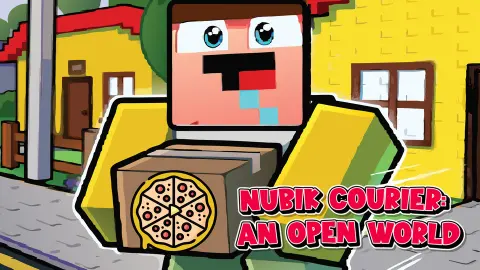




About Nubik Courier: An Open World
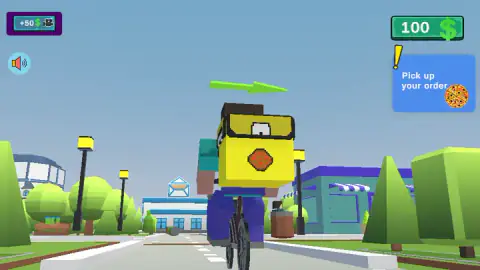
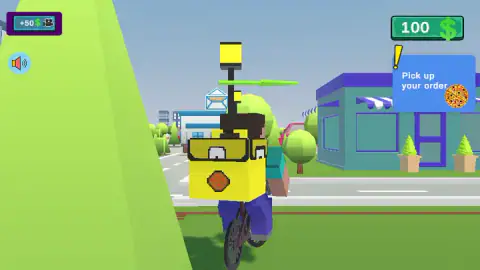
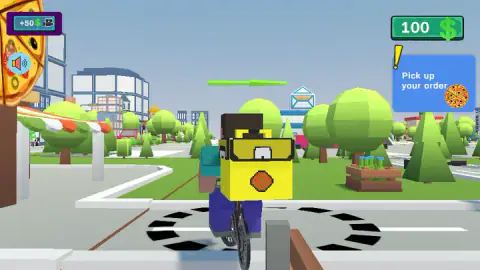
Every delivery game you have played put a clock on you. This one does not. We rode the streets of Nubik Courier: An Open World looking for the timer, the fuel bar, the star rating, the thing that was going to punish us for being slow, and found nothing of the kind. A money counter that never moved. A green arrow floating over the rider's head. A blue card in the corner reading Pick up your order. That is the entire instrument panel.
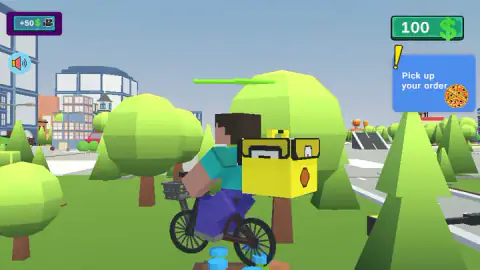
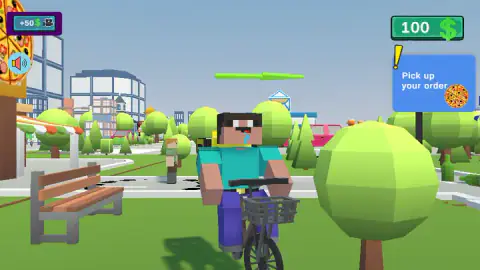
The courier is a blocky figure in a cyan t-shirt with a yellow box strapped to his back, an orange pizza badge on the side of it, and a bicycle under him with a wire basket on the front. The city is built out of plain shapes: flat-topped trees, lamp posts with yellow cubes for lamps, a blue building with an envelope over the door, a shop with a striped awning and two conifers in pots outside it. Benches, crossings, parked cars, the odd pedestrian. Everything is readable in a single glance, which matters a great deal in a game whose only instruction is an arrow.
It is credited to Studio6905, and not one of the studio's other games is a driving title. A hair salon. A merge puzzle. An emoji puzzle. A tank game. This city is their only one.
The game went up on the portal in November 2024 and was last updated in August 2026.
Now the part most pages about this game will leave out. We played on a desktop with the keyboard for about four minutes and never completed the first pickup. Most of that time we were pressed into a hedge. So this page can tell you exactly what the game asks of you, what it shows you and how it steers. It cannot tell you what a finished order pays, or what the city does once you have delivered one.
The green arrow is the entire map
Open-world driving games almost always give you a minimap: a little square in the corner with your dot on it, the target on it, and the road layout between the two. This game gives you an arrow floating in the air above your own head, and nothing else.
That is a real design choice with a real consequence, and the consequence is that you cannot plan. A minimap tells you there is a river between you and the pizzeria and the bridge is two blocks north. An arrow tells you only the direction a crow would take. Every obstacle between you and it — a hedge, a building, a fence, a flowerbed — arrives as a surprise, and the arrow keeps calmly pointing through it as if you could ride straight on.
It also means the whole screen stays clear. There is no second window to read, no overlay to interpret, no legend to learn. A child who cannot read the blue card can still follow a green arrow, and we think that is the point: the game explains itself to someone who has never played a driving game, at the cost of being almost impossible to navigate efficiently. In a game with a clock that trade would be unbearable. In this one it costs you nothing but a few more corners.
One small touch we only saw once, early on: a speech bubble reading High five popped up over the rider's head as he sat in the street. It did not come back, and we never worked out what triggered it.
A pizza round with no clock on it
A delivery game without a timer is strange, because the clock is the thing that made pizza delivery famous in the first place.
The best-known promise in the business was thirty minutes or the price came down, and it worked exactly as intended: it sold pizzas, it built a brand, and it put drivers under a stopwatch in traffic. The reckoning arrived in a courtroom in St. Louis. In December 1993, a jury awarded a woman injured when a delivery driver ran a red light 78 million dollars in punitive damages on top of her actual damages. Within days the chain dropped the thirty-minute guarantee across the United States, and its founder said plainly that the verdict had pushed it over the edge. The case was later settled for an undisclosed and much smaller sum.
So the pizza industry's most famous feature was removed, on purpose, because a timer makes couriers take risks. Thirty years later, this is what a delivery game looks like when nobody is holding the stopwatch. You can stop at a crossing. You can ride across the grass between the trees. You can lose four minutes to a hedge, as we did, and nothing in the city minds.
The bicycle fits the same logic. Real courier work in dense cities moved towards two wheels and pedals for reasons that have nothing to do with speed records — a bike parks anywhere, fits where a van cannot, and does not need a space to stop in. A game that cares about a stopwatch gives you a car. This one gives you a basket on the front and lets you take your time.
What a bad run can still tell you
We never picked up the order, so everything past the first job is unknown to us: what it pays, what the next card says, whether the city changes. What we can describe is the first five minutes anybody will have, because we had them several times over.
You arrive on a street with a crossing ahead and the arrow pointing down it. The counter already reads a hundred dollars, and a purple badge marked plus fifty sits in the far corner. Pedal and the city slides past; steer and it swings. Ride onto the grass and nothing stops you. Ride into the shrubs along the pavement and everything stops at once — and with no crash sound and nothing that dents, the only way you know is that the picture has gone still.
More ways to work a city
City Tuk Tuk Simulator: Racing Game 3D is this game with all the instruments bolted back on: an auto rickshaw, a minimap, a five-minute clock and passengers to find. Grand Truck Simulator hands you a flatbed recovery truck with folding ramps and a window of a few minutes to reach a broken-down car across town. Moto Traffic Rider keeps the two wheels and the traffic but puts you in first person on a highway with written goals and a career across three cities. Santa Gift Delivery Christmas Game is the delivery job with the steering taken away: one sleigh, one lane of ice, crates and snowmen to dodge. And Troll Rider is the bicycle on its own, pointed downhill, where the only thing being scored is the landing. The rest of the shelf is in driving games.
Screenshots
How to play Nubik Courier: An Open World
- Click your way in, then put the mouse down. It took several clicks through the opening screens before the street appeared. From there the keyboard is everything and we found nothing left for the pointer to do.
- Up pedals, Left and Right turn. There is no brake and no accelerator button. The bicycle has one speed and two directions you can point it in.
- Follow the arrow, not a map. The green arrow hovers over the rider's head and swings as you turn, so the way to use it is to rotate on the spot until it points straight ahead, then pedal.
- Read the blue card before you set off. It names the current job — ours said Pick up your order, with a pizza drawn beside it — and it does not go away until the job is done.
- Go around the greenery, not through it. This is the one that cost us the run, and it is the next section.
What four minutes actually taught us:
- Hedges are walls. A row of shrubs stops the bicycle as completely as a building. Nothing crumples, nothing bounces, nothing warns you: you simply stop moving and the scenery stops changing.
- Nothing is counting. No timer, no lives, no distance, no delivery number. If you want to know how you are doing, the money counter is the only figure on screen, and it will not move until you have earned something.
- The game is silent. After the sound that plays when it opens, we heard nothing at all: no crash, no horn, no jingle for getting it wrong. Silence is not a bug here, but it does remove the usual way of telling whether something just happened.
- Reverse your way out early. The moment the view stops changing, you are already stuck. Turning on the spot inside a hedge does not free you; backing off the way you came and taking a wide line does.
Controls
| Arrow Up | Pedals the bicycle forward. It is the only key that got us anywhere |
|---|---|
| Arrow Left and Arrow Right | Steer. We found no brake key and no separate accelerator; the bike has one speed and two directions to point it in |
| Space | Nothing we could get out of it. We pressed it and the ride carried on unchanged |
| Mouse or tap | Needed to get through the opening screens. Once we were on the street we found nothing left for it to do |
| Speaker icon (top left) | The sound control, and the only button drawn on the play screen itself |
Features
- A delivery game with no clock in it: four minutes of riding and nothing on screen was counting down, counting up or warning us we were late
- Navigation is one green arrow floating over the rider's head — no minimap, no road names, no route line on the ground
- A blue card in the corner holds the current job, Pick up your order, and stays there until the job is done
- The money counter reads 100 dollars before you have earned anything, and a purple plus-fifty-dollars badge sits in the opposite corner from the start
- A city of plain shapes: flat-topped trees, lamp posts with yellow cubes for lamps, a building with an envelope over the door, benches, crossings and parked cars
- The hedges are solid walls. A line of shrubs stops a bicycle as dead as a building does, which is how most of our run was spent
- Made by Studio6905
Game details
- Developer
- Studio6905
- Release date
- November 2024
- Last updated
- August 10, 2026
- Added here
- March 2025
- Technology
- HTML5 (Unity WebGL)
- Platforms
- Browser (desktop, keyboard), Browser (mobile & tablet, touch)
- Saved progress
- Saving, when available, is managed by this game. Mava cannot confirm your level.
FAQ
How do you play Nubik Courier: An Open World?
You ride a bicycle around a city carrying a pizza order. A blue card in the top-right corner tells you the current job and a green arrow floats over the rider's head pointing at where to take it. The arrow keys do everything: Up pedals, Left and Right steer. There is no map to open and no menu we could find once the ride starts.
What are the controls in Nubik Courier: An Open World?
The four arrow keys, and really only three of them. Up pedals the bicycle forward, Left and Right turn it, and we found no brake key at all. Space did nothing we could detect. A mouse or a tap is needed to get through the opening screens, after which the keyboard is the whole game.
Is there a timer in Nubik Courier: An Open World?
We never saw one. No countdown, no stopwatch, no late warning and no star rating appeared on any screen we played or in any picture on this page. That makes it unusual among delivery games, which almost always put a clock on you, and it means a slow, wrong-turn-heavy ride costs you nothing but your own time.
What does the green arrow do in Nubik Courier: An Open World?
It is the entire navigation system. The arrow hovers above the rider rather than sitting on a map, and it swings around to keep pointing at the current objective as you turn. Follow it and you are heading the right way; what it does not do is tell you how far away the target is or route you around anything in between.
What is the money counter in Nubik Courier: An Open World?
A green panel in the top-right corner that read one hundred dollars for us from the first screen to the last. A separate purple badge marked plus fifty dollars sits in the opposite corner and never changed either. We never completed a pickup, so we cannot tell you what an order actually pays.
Can you get stuck in Nubik Courier: An Open World?
Easily. The hedges that line the pavements are solid, and a bicycle pressed into one stops as completely as if it had hit a wall. We lost most of a four-minute run to a single row of shrubs. Backing out and taking a wide line round the greenery is the only fix we found — there is no reset button on the play screen.
Who made Nubik Courier: An Open World?
Studio6905, according to the game's listing. This one was published in November 2024 and was last updated in August 2026. We found no studio website to confirm the name against a second source, so it rests on the portal alone.
Does Nubik Courier: An Open World work on a phone?
It is listed for Android and iOS as well as PC, and lists it as a landscape game, which matches the wide view we played in. How well a game built around four arrow keys survives the move to a touchscreen is the open question, and we only played it on a desktop with a keyboard, so we have not checked it ourselves.