
About Geometry Open World
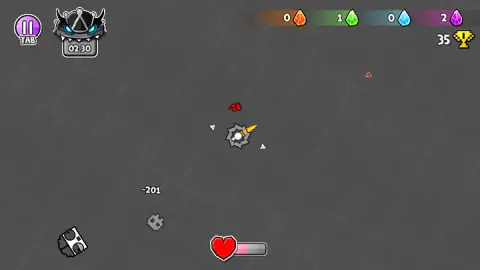
A game with open world in its name is making a promise about time: that it is yours, and you can spend it how you like. This one starts a clock instead. It sits in the top-left corner, tucked inside the head of a horned creature with pale blue eyes, and it counts down. The earliest we ever caught it was 02:57, a moment after a run began.
What it counts down over is a flat grey arena of tiles. You are a small white cog with a dark core, and a yellow flash keeps firing out of one side of it without being asked. Pale triangles drift near you, red ones come in from further out, and red damage figures pop up over the floor. A heart with a bar beside it sits at the bottom of the screen and drains.
The game is credited to farenlait and lists it there from 25 December 2024.
We should say how far we got. We played two sittings of about four minutes each, and a good part of both went on the hub screen and on a card that appears between runs rather than inside the arena. We never opened the chest screen, the hero screen or either of the upgrade screens, and we never met a boss. What follows is the loop, which we saw go round four times, and not the game sitting behind it.
Three minutes is the whole level
The countdown changes what the arena is. It is not a place you are exploring, it is a shift you are working. Every second spent looking around is a second not spent collecting, so the natural instinct of a game with a map, which is to go and see what is over there, is exactly the instinct this one punishes.
That shows up in the small decisions. A blue drop floating two screens away is not a free pickup, it is a trade: the time to reach it against the trophies you would have earned standing where the fighting is. We mostly lost that trade, which is why our trophy counters stayed low.
The clock is a ceiling rather than a length. Not one of our runs reached zero. Each one ended earlier, with the heart bar down to its last sliver and the reward card dropping over the arena. So three minutes is the longest a run can be, and the heart bar decides how much of it you actually get.
What a run is worth
The card at the end explains the game better than the arena does. It is not a prize list, it is a conversion chain, drawn with arrows: a gold trophy with your run's figure on it, then a purple gem, then a blue gem with AD stamped across the corner.
The free side of that chain is stingy on purpose. Sixty-two trophies bought no purple gems at all, and our best run, worth 220, bought two.
The advert side offered around ten blue gems on every card we saw, which is the whole business model stated in one picture: the gems you earn by playing arrive slowly, and there is a faster road with an advert on it.
Then comes the part that makes the loop work. Press TAKE, the card closes, and the hub comes back with that same trophy figure written under the volcano. Across one sitting it went from 62 after the first run to 220 by the end. When we came back later it was showing 111, so we cannot tell you whether that figure is a lifetime tally or simply what your last run was worth. What we can tell you is that the run is disposable and the number is not, and that is the hook the whole game hangs on.
The hub, and four doors we did not open
The hub is a small floating scene: the volcano in the middle, a pink crystal island to one side, a spiked golden one to the other, a blue planet overhead. Four doors sit around the edge. CHESTS and EXCHANGE on the left, HEROES and ENHANCEMENTS on the right. Across the top are four gem counters, orange, green, blue and purple, and those gems are what the trophies turn into.
We did not open any of the four, and that is the honest limit of this page. What we can report is that the counters move in both directions. Over one sitting three of them went up and the green one went down to nothing, and we never found out what spent it. Something in that hub costs green gems, and finding out what is the first thing we would do with a fifth minute.
What "open world" means here
Most of what we played was the one grey arena. One run left it: the tiles gave way to a darker stretch with floating platforms under a large moon, and a small map icon appeared in the corner of the screen. That was a single sighting in two sittings, and it is the thinnest thing on this page, but it says there is more than one place in the game.
The countdown is what keeps you from seeing them. A world you are let into three minutes at a time is a world you learn in slices, and the game seems to know it: the way back in is not a save file, it is that figure under the volcano.
Who it suits
It suits a player who likes a short, bounded run and a number that climbs between them, and who is happy to be handed a counter and left to work out what it buys. The restart is one click on a volcano and you are straight back in.
It suits less a player who came for the second half of the name. There is no map to settle into here, no stretch of quiet, and nothing on screen explains the gems or the chests before you earn them. You find out by playing, and the game only lets you play in three-minute pieces.
More games by farenlait
Mine Jump keeps the quick-reflex half of this one and drops the hub. Palkovil The Way Home goes the other way: a winter world with quests, animals and cards to collect, with no clock pushing you along. TCG Shop: Maps, Toys and Comics hands you a card and collectibles shop to run, and Robbie: TikTak Slot Machines is a set of arcade mini-games with pets and prizes to unlock. The rest are under adventure games.
Screenshots
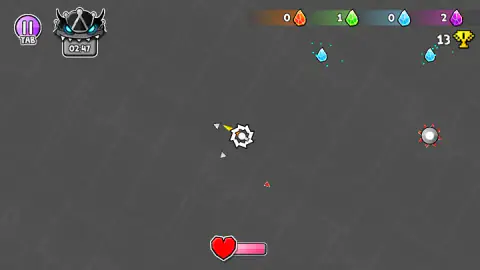
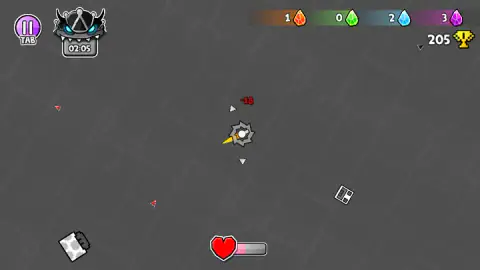
Taken by opening the game ourselves and letting it run — not supplied by the publisher, and not the same picture every other site shows.
How to play Geometry Open World
- Press START. It is written in white letters across a small volcano in the middle of the hub screen, with a figure underneath it.
- Steer with the arrow keys, or with A and D. Nothing carries you along. Hold the direction or the ship stands still while the arena moves around it.
- Let the cannon work. Ours was already firing a yellow flash before we pressed any key for it.
- Watch the heart, not the clock. The bar at the bottom is what actually ends the run, and it drops faster than the countdown does.
- Take the reward. When the run stops, a card headed REWARD appears. The left button, TAKE, is the free one.
What we picked up while playing:
- The game pauses the moment the window loses focus. A dark banner reading Click to keep playing drops across the top, and the arena freezes until you click. In a three-minute run that is real time lost, so play it in a window you are not clicking away from.
- The red figures are not all the same thing. The two-digit ones, around -16 and -18, appeared directly over our ship. The three-figure ones, well over two hundred, always landed somewhere else on the floor. We never once saw a big number sitting on top of us.
- The control list is longer than what we could confirm. The game publishes Q for a shield and E for the cannons. We pressed both and never identified either on screen.
- Nothing on the card needs an advert. The second button is stamped AD. We did not press it and the run ends just as cleanly without it.
Controls
| Left arrow or A | Moves the ship left |
|---|---|
| Right arrow or D | Moves the ship right |
| Q | Shield, per the game's own control list; we never managed to see it work |
| E | Cannons, per the game's own control list; our ship was already firing on its own |
| Left mouse button | Works the menus, the START button on the volcano and the card between runs |
| Pause button (top left, labelled TAB) | Pauses the run |
Features
- Runs are capped by a countdown clock set inside a horned monster's head; the highest we ever caught it was 02:57
- A trophy counter in the top-right corner climbs while you fight, and a card at the end of the run turns it into gems
- The free TAKE button closes that card; the IMPROVE button beside it is stamped AD, and offers about ten blue gems
- Four gem counters, orange, green, blue and purple, sit across the top of both the run and the hub
- The hub is a volcano with START written over it and four doors around the edge: CHESTS, EXCHANGE, HEROES and ENHANCEMENTS
- Your ship is a white cog that fires a yellow flash without being asked; a heart bar at the bottom is what ends a run
- Made by farenlait
Game details
- Developer
- farenlait
- Release date
- December 2024
- Added here
- April 2025
- Technology
- HTML5 (Unity)
- Platforms
- Browser (desktop, keyboard & mouse), Browser (mobile & tablet, touch)
- Saved progress
- Saving, when available, is managed by this game. Mava cannot confirm your level.
FAQ
How do you play Geometry Open World?
You click START on the hub screen, which drops you into a grey tiled arena as a small white ship. You steer left and right with the arrow keys or A and D while the ship fires on its own, and you survive as long as the heart bar at the bottom holds out. A countdown in the top-left corner caps the run at about three minutes.
How long is a run in Geometry Open World?
Three minutes at most. The clock in the horned head counts down, and the earliest we ever caught it was 02:57. None of our runs lasted that long: each one ended with the heart bar nearly empty and a reward card on screen, so the clock is the ceiling rather than the length.
What are the trophies for in Geometry Open World?
They are what a run is worth. A trophy counter in the top-right corner climbs while you fight, and when the run ends a card converts the total into gems. The same trophy figure then appears under the volcano on the hub screen, so the run is disposable and the number is not.
Do you have to watch an advert in Geometry Open World?
No. The reward card at the end of a run has two buttons, TAKE and IMPROVE. IMPROVE is stamped AD and offered around ten blue gems on every card we saw. TAKE is free, closes the card just as well, and keeps the trophies and the purple gems. We used TAKE every time.
What is in the hub in Geometry Open World?
A volcano with START written across it, a figure underneath it, and four doors around the edge of the screen: CHESTS, EXCHANGE, HEROES and ENHANCEMENTS. Four gem counters run along the top. We never opened any of the four doors, so we cannot say what the chests hold or which heroes you can pick.
Is Geometry Open World really an open world?
Not in the sense of a map you wander at your own pace, going by what we played. Runs are timed and most of ours were spent in one grey tiled arena. One run did leave it for a darker stretch with floating platforms and a map icon appeared in the corner, so there is more than one place in it, but the clock keeps you from seeing much.
What do Q and E do in Geometry Open World?
The game's own control list gives Q for a shield and E for the cannons. We pressed both and never identified what either did on screen, partly because our ship was already firing by itself. Moving left and right was the only input we could confirm by watching the ship.
Who made Geometry Open World?
It is credited to farenlait. It was published on 25 December 2024, with an E10+ age rating. It runs on desktop browsers and is listed for Android and iOS as well, in landscape.