



About Eternal Dance
The countdown at the top of Eternal Dance starts at one minute and runs backwards, and you want it to reach zero. That is the whole inversion, and it takes a moment to stop fighting it. In most browser arcade games the timer is the thing chasing you. Here it is the thing you are waiting for: survive until 0:00 and the level is yours.
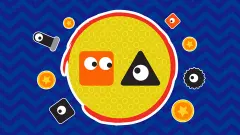
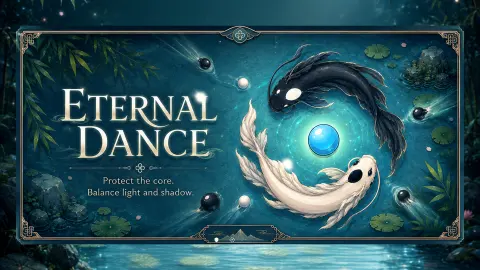
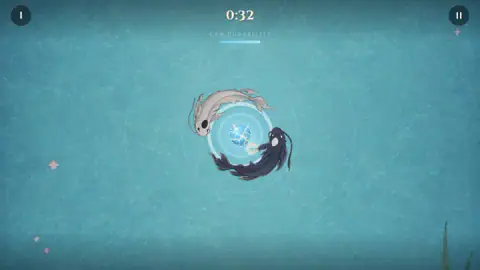
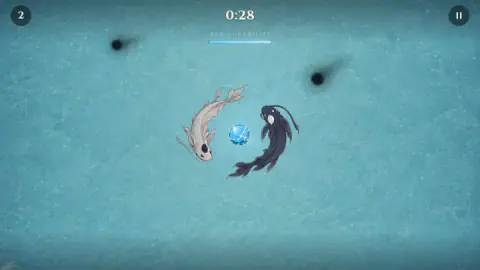
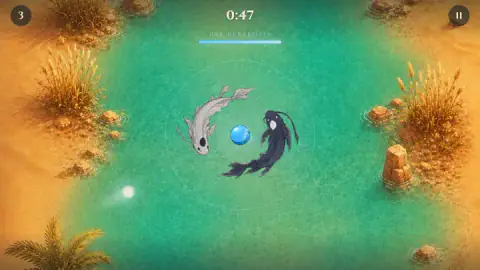
What you are surviving is ink. Two koi — one cream-pale, one black — circle a small blue orb in the middle of a pond, and blots of ink drift in from the edges of the screen to break it. The rule the game gives you fits in a sentence: meet each enemy with the koi of its colour. The black koi dissolves black ink. The pale koi dissolves white ink. Send the wrong one and it passes straight through, and the ink carries on into the orb.
There is one meter for all of that, a short pale bar under the timer labelled ORB DURABILITY, and in our run it never grew back. The orb tells you the same thing without the bar. On our first level it was a blue sphere webbed with white cracks; on the two levels after it, a clean blue ball. You can read your own health by looking at the thing you are protecting, which is a neater piece of design than the bar it duplicates.
Gala Software made it, and Eternal Dance was published at the end of July 2026. We played it on a desktop in October 2026: cleared the first level, lost the orb on the second, cleared it on the retry, and got partway into the third before we stopped.
A level is a minute of not losing
Strip out the fish and the pond and the structure is unusually bare. No score counts up, and there is nothing to collect, no combo, no coins. A level number, a countdown, a durability bar and a pause button: that is the complete interface.
So a level is a minute of not losing, and the game's job is to make that minute harder than the one before it. Our three were identical in length — 1:00 each — and different in what they sent. Level 1 drifted a little ink at us and let us flail. Level 2 put two blots on screen at once, in opposite corners, which is exactly the situation the single input is designed to punish: both of them want you somewhere, and you can only be in one place. That is where our orb went.
How many levels follow, we genuinely cannot tell you. We played three. The NEXT LEVEL button kept appearing, the water changed character once, and we stopped before the game ran out of ideas. What we can say is that the difficulty curve is about the number of threats arriving at once, not about speed or reflexes. Nothing in this game asks you to move quickly. It asks you to be in the right half of the circle already.
Two fish, each wearing the other's eye
Enlarge the picture and there is a detail the game never mentions. The pale koi carries a black spot on its head. The black koi carries a white one. Each fish is wearing the other's mark.
That is not decoration, it is a quotation. The familiar black-and-white emblem — two curved halves nested head to tail, each with a dot of the opposite colour — is a taijitu, the diagram of the supreme ultimate, and the two dots are its most-cited feature: the seed of yin inside yang, and of yang inside yin. Neither half is ever pure. The sinologist Isabelle Robinet described the whole figure as a pair of fishes nestling head to tail, which is, more or less exactly, the thing circling the orb on your screen.
The history is less tidy than the symbol suggests. Zhou Dunyi, writing in the eleventh century, is the name attached to the taijitu, but what he actually drew was not the swirl at all — it was a stack of five separate figures, of which the familiar emblem is only the second. The curling version turns up some three hundred years later: Zhao Huiqian (1351-1395) introduced the swirling variant in the 1370s, and Lai Zhide (1525-1604) pared it down to the two interlocking spirals with the two dots that everyone now recognises. The dots themselves are a late Ming addition, replacing earlier droplet shapes. The English habit of calling it "the yin-yang symbol" only dates from the 1960s.
The fish are the right species for the job, too: ornamental koi were bred out of ordinary black carp by rice farmers around Ojiya, in Niigata, in the early 1800s, which is why a pond of them holds colours that no wild carp has.
All of which would be ornament, except that the game has turned the idea into a control scheme. One gesture moves both fish. Neither can do the other's work. Protecting one side of the orb exposes the other, and the only way through a minute is to keep both turning rather than park either one anywhere. The symbol is a claim about opposites needing each other; here it is something you feel in your hand within thirty seconds.
What the game says it has, and what we saw
The main menu offers two modes — LEVELS and ENDLESS — and we only ever played the first. The game says Endless ranks how long you last against other players, and the distributor runs a daily board for it. It also says four powers, named Shield, Slow, Cleanse and Heal, unlock as you progress. None of that appeared in our session, so it is the game's account of itself and not ours.
The same caution applies to the controls. The card says to hold the screen, and the game is listed for phones and tablets in both landscape and portrait, so the instruction reads like one written for a thumb. We played with a mouse. How the koi feel under a finger is still the game's word rather than ours.
More quiet games to lose a few minutes in
Zen Garden Match is the closest neighbour in tone, swapping the clock for a board you work through at your own speed. Tiny Fishing keeps the water and the fish but builds a ladder of upgrades on top of them. Geometry Vibes runs the same one-input economy without any of the calm, if the dodging is the part you want more of. Nuts Puzzle: Sort By Color makes colour the only rule it has and then removes the timer entirely, and Bubble Shooter: Tap & Pop does the colour matching with a shooter's aim instead of an orbit. The rest are in arcade games.
Screenshots
How to play Eternal Dance
- Click into the game and read the HOW TO PLAY card. Four rules and a START button, and it is the only instruction you will ever be given.
- Hold on the pond. The two koi swing around the orb while you hold and ease to a stop when you let go. Every input that moved anything for us was a click or a hold on the playing area; the keys we tried did nothing.
- Watch the edges of the screen rather than the middle. Ink arrives as a drifting blot — dark against the water, or a small white point of light that is much easier to miss.
- Put the matching fish in its path. You will usually be turning the pair to get one of them somewhere, which is the catch described below.
- Outlast the clock. At 0:00 you get LEVEL 01 COMPLETED, a row of three stars and three buttons: NEXT LEVEL, RETRY and MENU. If the orb goes first you get ORB SHATTERED instead, with the line "Balance is lost — try again" and a choice of PLAY AGAIN or MAIN MENU.
What we worked out the slow way:
- You never move one koi. There is one input and it turns both. Covering the left side of the orb swings the other fish away from the right, every single time. Defence here is always a trade, which is the thing that takes longest to accept.
- The first level barely tests you. We cleared it while still working out what the controls did. Do not read that as having understood the game; level 2 took the orb off us on the first attempt.
- Damage does not come back. Nothing we did on any level lengthened that bar. A level is not a thing you recover from, it is a budget you spend.
- One of three stars is easy to miss. We finished the second level alive and lit a single star with two sitting empty beside it. Surviving and surviving well are being scored separately.
- Level 3's prettier pond costs you. The water turns green with sandy banks, reeds and lily pads, and a pale enemy against pale sand is much harder to spot than a black blot on turquoise.
- It is almost silent. One sound played as we clicked in and we heard nothing afterwards — not when a level ended, not when the orb shattered. Nothing is going to warn you.
Controls
| Hold on the pond with the mouse, or tap and hold on a touchscreen | The koi swing around the orb while you hold, and ease to a stop when you let go. This is the only instruction the game's own HOW TO PLAY card gives you |
|---|---|
| Click | Every input that moved anything for us was a click on the playing area. The keys we tried did nothing we could detect |
| START | The button at the bottom of the HOW TO PLAY card. It begins the level |
| NEXT LEVEL, RETRY, MENU | The three buttons on the screen you get for surviving a level |
| PLAY AGAIN, MAIN MENU | The two buttons on the ORB SHATTERED screen you get when the orb breaks |
| The round button in the top-right corner | Pause. It is the only control on screen besides the pond itself. We left it alone |
Features
- A countdown you want to reach zero: a level is cleared by keeping the orb intact until the clock runs out, and each of the three we played started at 1:00
- One input moves both fish at once, so you can never cover one side of the orb without uncovering the other
- Colour is the whole rule: the black koi dissolves black ink, the pale koi dissolves white ink, and the wrong one simply lets it through
- ORB DURABILITY is one short bar under the timer, and the orb shows the damage itself: ours was visibly cracked on level 1 and smooth blue on the two after it
- Three stars sit on the end-of-level screen. We finished level 2 with one lit and two empty, so surviving and scoring well are not the same thing
- The pond changes as you climb: flat turquoise water on the first two levels, then green shallows with sandy banks, reeds and lily pads on the third
- Almost silent. One sound played as we clicked in and we heard nothing after it, not even when the orb shattered
Game details
- Developer
- Gala Software
- Release date
- July 2026
- Last updated
- October 23, 2026
- Added here
- June 2026
- Technology
- HTML5 (2D)
- Platforms
- Browser (desktop), Browser (mobile & tablet, touch)
- Saved progress
- Saving, when available, is managed by this game. Mava cannot confirm your level.
FAQ
How do you play Eternal Dance?
You hold on the pond and two koi, one pale and one black, swing around a small blue orb in the middle. Blots of ink drift in from the edges of the screen, and each one can only be dissolved by the koi of its own colour. Put the matching fish in the ink's path; send the wrong one and the ink goes through and damages the orb.
How do you win a level in Eternal Dance?
By outliving the clock. The countdown at the top of the screen starts at one minute, and reaching 0:00 with the orb still whole is what clears the level. The timer is not chasing you here, which is the opposite of how a browser arcade game usually works — the thing you are racing is the damage, not the clock.
Why can the white koi not stop black ink?
Because colour is the only rule the game has. The game's own instructions put it in one line: meet each enemy with the koi of its colour. A mismatched fish passes straight through the ink without dissolving it, the ink carries on to the orb, and the bar marked ORB DURABILITY gets shorter.
What is the ORB DURABILITY bar?
It is the orb's health, shown as a short pale bar under the countdown, and we never saw it refill during a level. The orb itself tells you the same story without the bar: on our first level it was a blue sphere covered in white cracks, and on the two levels after that it was smooth. If it shatters completely the level ends with a screen reading ORB SHATTERED.
How many levels does Eternal Dance have?
We do not know, and we would rather say so than guess. We played the first three and the game kept offering a NEXT LEVEL button after each one. What does change between them is the setting: the first two take place on flat turquoise water and the third opens out into green shallows with sandy banks and reeds.
Who made Eternal Dance?
Gala Software. It was published at the end of July 2026 and was last updated the following day. We have not been able to find a studio website we could attribute with any confidence.
Is Eternal Dance free to play in a browser?
Yes. It runs on this page with nothing to install and nothing to buy, and it is listed for desktop, mobile and tablet in both landscape and portrait. We played it with a mouse on a desktop; the instruction the game gives is to hold the screen, which suggests a touchscreen is what it was designed around.
What is Endless mode in Eternal Dance?
The main menu offers two modes, LEVELS and ENDLESS, and the game says the second one ranks how long you survive against other players. We never opened it, so that is the game's description of itself rather than ours. The same goes for the four powers it mentions unlocking as you progress.