



About Crown & Crafts
Most village builders start you on empty ground. A field, a tree line, no clock, and all the time in the world to decide where the first hut goes. Crown & Crafts starts you with eleven people who are already eating.
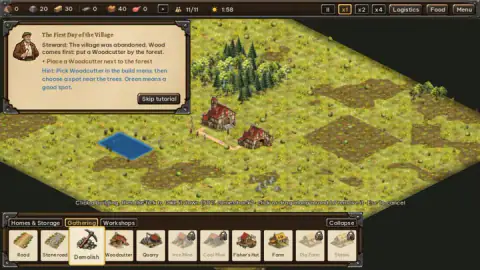
They come with a village, which sounds generous until you look at it. A town hall and a warehouse stand in the grass, joined by a short dirt road, and the stores hold some stone, some timber and a pile of loaves that nothing in the village is replacing. A character called the Steward opens the game with the problem in one line: the village was abandoned, wood comes first, put a woodcutter by the forest.
That is the whole shape of it. Every building is a card in the bar along the bottom, sorted into homes and storage, gathering and workshops. You pick a card, and the ground answers you — the tile tints green where that building is wanted, which is how the game explains, without a word of theory, that a woodcutter belongs beside trees and not in the middle of a meadow.
Suika Studio made it, and it was published on the twenty-second of October 2026. Eight is not a verdict; it is the number you get when a game is days old.
One thing before anything else, because it shapes everything below. Our run stayed inside the first mission and never finished it.
What the first mission actually asks of you
Fold the tutorial away and the objectives panel is unusually honest about the next half hour.
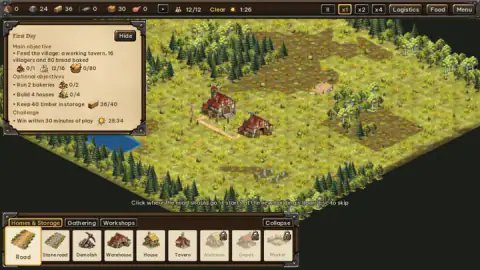
The main objective is a sentence with three counters under it: a working tavern, sixteen villagers and eighty loaves baked. Not eighty loaves owned — baked. The bread already in the warehouse does not count towards it, which is the mission quietly telling you that the point is to build the thing that makes bread, not to hoard what the last owners left.
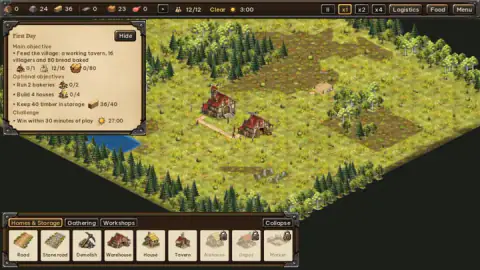
Under that sit three optional objectives: two bakeries running, four houses built, and forty timber kept in store. That third one works differently from the others and it is worth noticing. Its counter read thirty-six of forty at the same moment the top bar read thirty-six timber — it is a live reading of your warehouse, not a medal you win once. The word the game uses is keep.
Then the challenge, which is where we found the sheet's best-kept secret. It asks you to win within thirty minutes of play, and it carries its own clock. We checked it three times across one run, and every time the minutes counted up in the top bar and the minutes left on the challenge line added up to exactly thirty. They are one clock, read from both ends. Pause stops both; the speed buttons spend both.
And the crowd counter does something subtle. It showed eleven of twelve while a space stood empty, then twelve of twelve once somebody had taken it. The second number moves before the first does: you make room, and then people arrive.
A lord was once a loaf-ward
The game is called Crown & Crafts and the crown is in the title, but the first mission is not won with soldiers or walls. It is won at an oven. That is less of a design quirk than it looks.
In Old English, the head of a household was a hlāford — a compound of hlāf, loaf, and weard, keeper. The loaf-ward. His wife was the hlǣfdige, the loaf-kneader. Those two words wore down over the centuries into lord and lady. Before authority was land or title or a crown, it was the right and the duty to hand out bread, and the household that followed you was the household you fed.
Crown & Crafts puts that in a progress bar. Eighty loaves baked, sixteen people to eat them, and a tavern standing to serve them. Meanwhile the warehouse count moves in the only direction it can when nothing is baking: we watched thirty loaves become twenty-three inside a minute and a half of village time, with twelve mouths and not a single oven. That is the entire pitch of the genre compressed into one falling number — a settlement is not a collection of buildings, it is a rate.
It also explains why the woodcutter comes first and why the Steward is so blunt about it. Timber builds the house, the house makes room for the villager, the villager works the farm, the farm feeds the bakery, and the bakery finally moves the counter the mission actually cares about. Every link is a building, and every building needs a place on the ground. Nothing here is a shop where you buy bread with coins.
What we did not get to see
The honest ledger. We opened the game, read the mission in full, worked all three tabs of the build bar, advanced the tutorial through its house and road steps, and watched the clock and the stores move. We never got the woodcutter standing, never baked a loaf, never opened the tavern and never finished the mission.
Which leaves a list of plain gaps. What the Logistics and Food buttons open. What a depot or a market does, or what opens their padlocks. What any building costs, since the cards carry pictures rather than prices. Whether the campaign runs past this first day, and what it turns into if it does. We played with a mouse on a desktop, which is the only way the listing offers it, so we have nothing to say about touch.
What we can report is the first few minutes, and they are well made: a hand-painted village on a diamond of grass with a pond in one corner and pines around the edge, an interface that explains itself in one line at a time, and an economy that starts losing before you have placed anything.
More villages to rebuild
Suika Studio has published nothing else, so the nearest neighbours are other people's. Your Majesty - Build & Conquer takes the same medieval kingdom in a louder direction, and Craftsman Land hands you inherited ground and a trade to learn. For the opposite temperament, Cozy idle village lets the villagers get on with their own lives while you watch. And if what you want from a map is the taking of it rather than the feeding of it, Hexholm is a province at a time. The rest are under strategy games.
Screenshots
How to play Crown & Crafts
- Read the panel at the top left. It names the mission and, once the tutorial steps aside, lists every objective with its counter.
- Click a card in the build bar. Three tabs hold the catalogue: homes and storage, gathering, workshops.
- Move the cursor onto the map and watch the ground. Green means the game will take the building there. Click to place it — hold Shift and you can place several without picking the card again, and Esc backs out.
- When a building goes up the game offers to run a road to it, starting at its own door. Click where you want the road to go, or press Esc to skip it.
- Watch the top bar. Iron ore, stone and timber on one side, fish, bread and meat on the other, a crowd counter, the weather and the clock.
What only sitting in front of it teaches:
- The cards do not drag. This is the one that cost us real time. We tried to drag the woodcutter out of the bar and onto the grass again and again, and nothing happened, because the game places buildings with a second click and says so in a line across the middle of the screen. Read that line before you fight the mouse.
- Green is permission, not a suggestion. If the tile does not light, there is no argument to be had.
- Knocking things down is almost free. Click a building with the demolish tool, then the tick, and the game tells you ninety per cent comes back. A bad layout here costs you minutes, not materials — which is an invitation to try things.
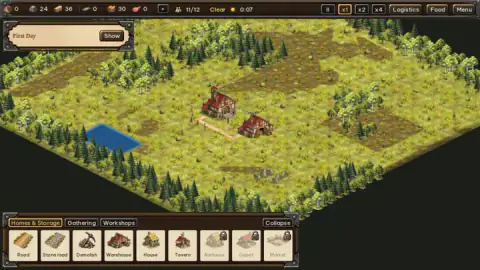
- The locked buildings are on show. Alehouse, depot and market sit in the first tab from the opening minute, greyed out with a padlock drawn in the corner, and the mines, the pig farm and the stable do the same in the second. You can see the whole game you have not earned yet.
- The clock can be stopped. Pause and three speeds sit in the top bar, so nothing forces you to think at the village's pace.
Controls
| Click a card in the build bar | Picks that building; the bar is split into Homes & Storage, Gathering and Workshops |
|---|---|
| Move the cursor over the map | The ground answers in green where the selected building will be accepted |
| Click the ground | Places it. Dragging the card out of the bar does nothing at all |
| Hold Shift while clicking | Places several of the same building without picking the card again |
| Esc | Cancels the placement, and skips the road step the game offers after a new building |
| Click a building, then the tick | Takes it down and returns ninety per cent of what it cost |
| Click or drag along a road | Removes road while the demolish tool is active |
| Pause, x1, x2 and x4 in the top bar | Stop the village clock or run it at up to four times speed |
Features
- You do not start on empty ground: a town hall and a warehouse are already standing, joined by a dirt road, and eleven villagers are already eating
- The build bar shows you the whole shelf from the first minute, padlocks included — Alehouse, Depot, Market, the iron and coal mines, the pig farm and the stable all sit there greyed out with a lock drawn in the corner
- Placement is checked before you commit: the tile turns green where the building is wanted, which is how the game tells you a woodcutter belongs beside trees
- Taking a building down returns ninety per cent of its materials, so a bad layout costs you time rather than resources
- The first mission is won at the oven: a working tavern, sixteen villagers and eighty loaves baked, with bakeries and houses as optional extras
- The thirty-minute challenge runs on the same clock as the village: whatever the top bar has counted up, the challenge line has counted down
- The top bar tracks iron ore, stone and timber on one side and fish, bread and meat on the other, with an arrow that opens the rest
Game details
- Developer
- Suika Studio
- Release date
- October 2026
- Last updated
- October 24, 2026
- Added here
- October 2026
- Technology
- HTML5 (2D isometric)
- Platforms
- Browser (desktop)
- Classification
- Puzzle , Simulation , Strategy
- Saved progress
- Saving, when available, is managed by this game. Mava cannot confirm your level.
FAQ
How do you play Crown & Crafts?
You rebuild an abandoned medieval village by placing buildings from the bar along the bottom of the screen. Click a card to pick a building, move the cursor over the map until the ground turns green, then click to place it. Roads are drawn by clicking where you want them, starting at the new building's door. The mission's objectives sit in a panel at the top left and tell you exactly what the village still owes you.
Why can I not place a building in Crown & Crafts?
Almost always because you are dragging it. The cards in the build bar do not drag onto the map, which cost us several minutes before we read the game's own line — click to place, hold Shift to place several, Esc to cancel. The other reason is the ground itself. A tile tints green when the selected building is welcome there, and if it does not tint, the game will not take it.
How do you win the first mission in Crown & Crafts?
The mission is called First Day and it is won by feeding people, not by fighting. Its main objective asks for a working tavern, sixteen villagers and eighty loaves baked. Three optional objectives sit under it — two bakeries running, four houses built and forty timber kept in store — and a challenge asks you to finish inside thirty minutes of village time.
Can you demolish buildings in Crown & Crafts?
Yes, and it is cheap. Pick Demolish from the build bar, click the building and then the tick that appears, and the game states plainly that ninety per cent of the materials come back. Roads come up the same way, by clicking or dragging along them. Esc cancels before anything is lost.
How long is the thirty-minute challenge in Crown & Crafts?
It is thirty minutes of the village's own clock, not of your afternoon, and the two readouts are the same clock seen twice. We checked it three times across one run: the minutes counted up in the top bar and the minutes left on the challenge line always added up to exactly thirty. Pause stops both, and the speed buttons spend both faster.
What do the greyed-out buildings in Crown & Crafts mean?
They are locked rather than hidden. The Alehouse, Depot and Market sit in the Homes and Storage tab from the first minute with a small padlock drawn in the corner, and the iron mine, coal mine, pig farm and stable do the same in the Gathering tab. We never got far enough to open one, so we cannot tell you what each lock is waiting for.
Is Crown & Crafts free, and who made it?
It is free and runs in a browser with nothing to install. Suika Studio made it, and it was published on 22 October 2026. It — a small number because the game is days old rather than because it was ignored.
Does Crown & Crafts have a tutorial?
It opens with one. A character called the Steward explains that the village was abandoned and that wood comes first, then asks you to place a Woodcutter next to the forest, with a hint telling you that green ground means a good spot. A Skip tutorial button sits under the text, and the objectives panel itself can be folded away with Hide and brought back with Show.