












About Potion Siege
Most tower defence games hand you a map full of empty plots and ask where to build. Potion Siege takes the map away. There is one castle wall, one road, and a column of spaces along the top of the wall. Your towers are potion bottles with faces, and the only way to make them stronger is to throw two of them together.
That single rule changes the whole rhythm. The Summon button brews a fresh potion onto the wall, but space runs out quickly, so every summon is really a bet that you will soon have a twin to fuse it with. Meanwhile the enemy, a clockwork army of walking robots, mechanical rats and steam-powered machines, keeps coming down the road on the right. If they reach the wall and wear it down to zero, the stage is over.
The game is by Tao. It arrived in the catalogue in October 2026 when we looked, so there is no crowd verdict yet. What follows comes from our own time with it on a computer.
Gold is for this battle, diamonds are for the next one
Potion Siege runs on two currencies, and mixing them up is the easiest way to misread the game.
Gold builds up while you fight and is spent inside the battle on Summon and Upgrade. Each new run of ours began with a small purse again. Diamonds are paid out when a run ends, even after a defeat. Our best run, which lasted two minutes, paid 49 of them. A shorter one, under a minute, paid 22.
Diamonds are spent on the Potions screen, where each tonic has its own level. The game is honest about what that buys: its tip reads "Every level adds damage". In our save, Arcane Tonic had already gained a level, worth a 15 percent damage bonus, and its next one cost 70 diamonds. The tonics that had not moved yet cost 60 each for their first step.
The other path is the Workshop, which the defeat screen sums up as "A thicker wall, more starting gold". We did not open it, so we cannot list its prices. But the choice is clear even from outside: potion levels make you hit harder, and the Workshop lets you take more hits. After our second defeat, the game added a small "Do this first" badge to levelling potions.
Skill cards stack, and the pips tell you how far
Every Upgrade shows three cards. The ones we saw in our first battle were "All potions +12% attack speed", "Arcane tonics +40% damage" and "All potions +15% damage".
The tutorial adds the rule that matters most: a card "lasts for the whole battle, and picking the same skill again levels it up". So a card you choose early is not a one-off boost. It is a direction. Pick the same one on later upgrades and it keeps growing.
Look at the row of small squares under each card. The two cards for all potions had five, the Arcane card had three. A new card has one square lit, so they read as the levels each card can reach. A card that helps one tonic is far stronger per pick but tops out sooner, while the cards for all potions take longer to fill. If your wall is mostly one kind of potion, the narrow card is the better deal.
Four tonics at the start, two still locked
The Potions screen shows six bottles. Four are open from the beginning: Arcane (purple), Fire (orange), Frost (pale blue) and Storm (yellow). Two are padlocked. Corrosion Tonic opens when you clear stage 5, and Gale Tonic when you clear stage 10.
There is a second way to Gale. The Welcome Gifts calendar gives you something for each day you play in a week: diamonds on the first six days, rising from 200 to 500, and Gale Tonic itself on day seven. A week of short visits gets you the tonic without beating ten stages.
The defeat screen also keeps score of the tonics. Its "Damage dealt" panel names an MVP, the potion that did most of the damage. In our first run Arcane did 96 percent of it. In another, Fire did all of it. That panel is the quickest way to learn which tonic your defence actually leans on.
Where our runs ended: wave 5, still on Stage 1
We should be clear about how far we got. Our best attempt reached wave 5 of 10, with 245 kills, before the screen announced "The wall has fallen". A later run fell two waves earlier. Every attempt was the first stage of the first chapter, Factory Outskirts, which has ten stages.
Wave 5 is also where the road changed. Early waves were robots and rats; by then a large armoured tank was rolling towards the wall among them. The stage card shows four kinds of enemy, the last one marked BOSS, but we never got far enough to meet it.
So there is plenty we have not seen: a cleared stage and its stars, the boss, the Workshop, the Codex and the Shop. The game's own description also mentions harder modes and an endless mode; we did not reach either. Every defeat offered a revive in exchange for watching an ad, and Continue always worked without one. We played only on a computer.
Who it is for
Potion Siege suits players who like a defence game with small, constant decisions: summon or save, fuse now or wait for a pair, take the same card again or spread out. The art is bright and the tutorial is short, so younger players can follow it. If you want to place towers along a winding map, this is the wrong shape of game.
For classic map-and-plot defence, try Tower Defense or Epic Empire: Tower Defense. Merge Elementals: Castle Defense also fuses fighters on a castle wall, and Summon Tribe is another game about holding a line for a set number of waves. There are more in our strategy games.
Screenshots
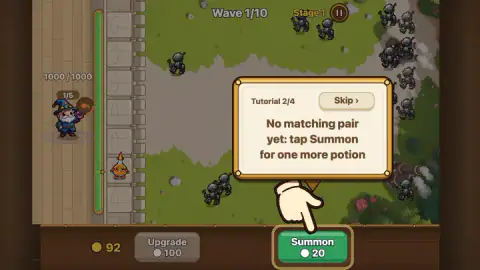
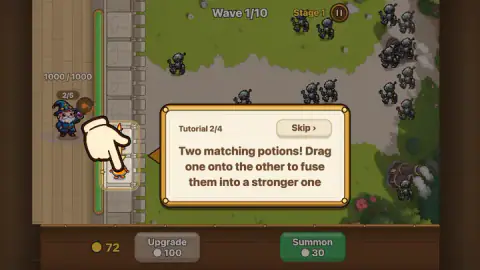

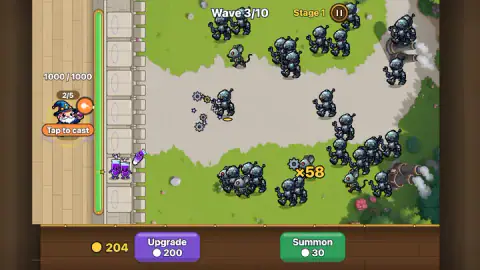

Taken by opening the game ourselves and letting it run — not supplied by the publisher, and not the same picture every other site shows.
How to play Potion Siege
- Summon a potion. The green button costs gold and places a new potion on the wall. The early tutorial walks you through it, and a Skip button lets you leave the lessons at any time.
- Fuse matching pairs. Drag one potion onto an identical one. The game puts it plainly: "Two matching potions! Drag one onto the other to fuse them into a stronger one."
- Upgrade and pick a card. When the purple button lights up, press it and choose one of three skill cards.
- Cast with the alchemist. The old wizard beside the wall charges up over time. When "Tap to cast" appears under him, click him.
- Hold for ten waves. The counter at the top reads Wave 1/10 and climbs. Keep the wall standing to the end to clear the stage.
Tips from our runs. Watch the vertical bar beside the wall, not just the enemies. It starts green and full, and in our best run, by wave 5, it had dropped to a quarter and turned red. Fuse before you summon whenever you can, because a fusion costs nothing and frees a space. Prices also climb: the first Upgrade cost 100 gold and the next one 200, so saving for the second card takes noticeably longer than the first. And read the defeat screen. In one of our runs a single potion did almost all of the work, which tells you where your diamonds should go.
Controls
| Summon (green button) | Spends gold to brew a new potion onto the castle wall |
|---|---|
| Drag a potion onto a matching one | Fuses the pair into one stronger potion and frees a space on the wall |
| Upgrade (purple button) | Spends gold to open three skill cards; you keep one for the rest of the battle |
| Click the alchemist | Casts his spell once his charge is full and he shows Tap to cast |
| Pause (top right) | Stops the battle |
Features
- Your defenders are living potion bottles that stand on the castle wall and fire at a clockwork army coming down a dirt road
- Two matching potions fuse into one stronger potion, so the wall gets tougher without getting more crowded
- Every Upgrade offers three skill cards; a card lasts the whole battle, and picking the same one again levels it up
- Gold is spent inside the battle and its prices rise as you buy; diamonds earned at the end of a run level your potions for good
- Four tonics are ready from the start: Arcane, Fire, Frost and Storm; Corrosion and Gale stay locked behind later stages
- Each stage is ten waves long, and the stage card shows a boss waiting at the end of the chapter
- A defeat screen shows which potion did most of the damage and points you to the two ways to get stronger
Game details
- Developer
- Tao
- Release date
- October 2026
- Added here
- October 2026
- Technology
- HTML5
- Platforms
- Browser (desktop, mouse), Browser (mobile & tablet, touch)
- Classification
- Strategy
- Saved progress
- Saving, when available, is managed by this game. Mava cannot confirm your level.
FAQ
How do you play Potion Siege?
Press Summon to brew a potion onto the castle wall, then drag one potion onto an identical one to fuse them into a stronger one. When you have enough gold, press Upgrade and pick one of three skill cards. The aim is to survive all ten waves of a stage before the clockwork army breaks the wall.
How do you merge potions in Potion Siege?
Drag a potion and drop it on another potion of the same kind and level. The two become one stronger potion, which also frees a space on the wall for the next summon. If there is no matching pair yet, the game tells you to tap Summon for one more potion.
What do the skill cards do in Potion Siege?
Each Upgrade shows three cards, such as extra attack speed for all potions or extra damage for one tonic. The card you choose lasts for the whole battle, and choosing the same card again levels it up. Small pips under each card show how many levels it has.
What is the difference between gold and diamonds in Potion Siege?
Gold belongs to the battle: it pays for Summon and Upgrade, and both get more expensive as you use them. Diamonds are paid out at the end of a run, even a lost one, and are spent outside battle to level up your potions for good. Each potion level adds damage.
Which potions are in Potion Siege?
You start with four tonics: Arcane, Fire, Frost and Storm. Corrosion Tonic unlocks when you clear stage 5 and Gale Tonic when you clear stage 10. The Welcome Gifts calendar also hands out Gale Tonic on the seventh day you play in a week.
What happens when the wall falls in Potion Siege?
The run ends on a screen called The wall has fallen, showing the wave you reached, your kills, the time and the diamonds you earned. You can revive by watching an ad or press Continue to go back to the menu. The same screen shows which potion dealt most of the damage and suggests levelling potions or the Workshop.
Who made Potion Siege?
Potion Siege is by Tao. It arrived in October 2026, so it is very new. It runs in the browser, on a computer or on a phone or tablet.