








About Capyballra - Capybara Ball Collector!
Six out of twenty. That is everything we got out of the maze in four minutes of Capyballra, and the reason we did so badly was printed on the game's own tutorial card, which we read and then went on ignoring for the best part of two minutes.
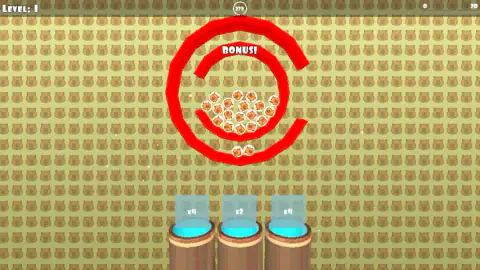
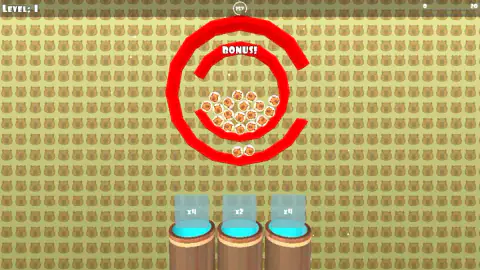
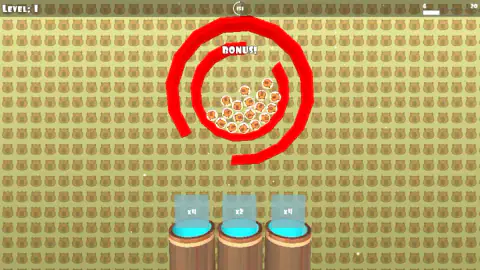
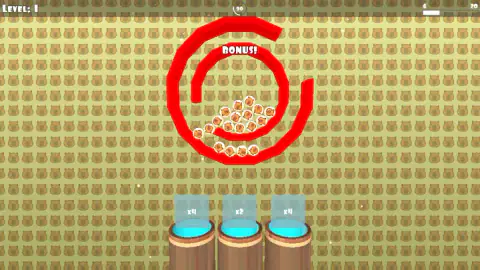
What you are looking at is a red spiral, two coils of it, drawn with the thickness of a marker pen and floating on wallpaper made of repeated capybara heads. Heaped in the bottom of the inner coil is a pile of balls — each one a cream disc with a capybara face on it, about twenty in all. Across the foot of the screen stand three wooden barrels brimming with turquoise water. The job is to get the capybaras out of the spiral and into a barrel.
You never touch a ball. The only thing you can move is the maze, and you move it by turning it: grab the outer rim, pull sideways, and the whole spiral rotates under a gravity that stays exactly where it was. That one detail is what makes this harder than it looks, and it is the subject of the second half of this page.
Headphone Turtle Studios made it. It has been available since March 2026, was last touched there in August — a respectable score for a game whose first screen is genuinely confusing.
We played it on a desktop with a mouse in late October: about four minutes, 28 attempts at turning the thing, and we did not finish. The level label read LEVEL: 1 from start to finish and the word "BONUS!" sat in the middle of the maze the entire time, so everything below describes one screen, seen closely.
The maze turns. Down does not.
There is a toy this game is clearly descended from, and comparing the two explains the whole thing. BRIO developed the tabletop Labyrinth in Sweden and first released it there in 1946. Some versions hang the maze surface on two axles with a knob for each, so you tip the floor forwards, backwards and sideways and steer a steel ball by aiming gravity at the part of the board you want it to go to.
Capyballra is that idea mirrored. The floor never tips. Down is always down the screen, no matter what you do, and the thing you rotate is the walls.
Two consequences follow, and both of them are visible in the screenshots above.
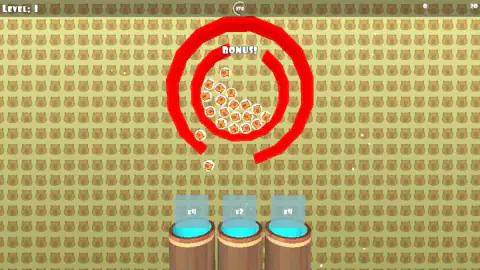
The first is that you cannot park a ball. On a tabletop labyrinth, levelling the board stops everything dead while you think. Here there is no level: any stretch of a spiral that is not perfectly horizontal is a slope, and a spiral is almost never horizontal. Look at any frame of this game and the heap sits in the lowest point of whichever coil it is in. It is always rolling somewhere.
The second is that the move is not to push the balls towards the exit — it is to bring the exit round to the balls. That sounds like the same sentence turned around, and it is not. Aiming gravity, as you do on the wooden toy, means thinking about where you want the ball to end up. Rotating walls under a fixed gravity means thinking about where the ball already is, and turning the corridor until the hole arrives underneath it. Once we gave up on tipping the heap downhill and started bringing the mouth of the coil round to it, the counter moved for the first time.
It is also why a spiral is the right shape for this and a grid would not be. A spiral has no junctions and no dead ends: there is exactly one route from the middle to the outside, so the puzzle is never about choosing a path. It is entirely about rotation and timing.
The barrel directly under the maze is the one that pays least
The three barrels are not interchangeable. Each has a pale translucent sign floating above it, and from left to right those signs read x4, x2 and x4. The middle one is the cheap one.
That is a deliberate little tax, because the middle barrel is also the one sitting directly beneath the maze: a ball that falls out of the spiral and is left alone lands there. Getting one into an outer barrel means it has to leave with some sideways speed, which means letting go of the rotation at the right moment rather than the safe one. The lazy drop is worth half the risky one.
Above it all runs the clock: a number inside a white ring at the top of the screen, ticking down one a second. It read 279 when we got our first clear look at the board and 90 when our session ended, which puts a full round at around five minutes. That is a long time for a browser game, and it tells you what kind of game this is — not a reflex test, but a slow emptying job where twenty balls have to go through a one-ball gap before the number runs out.
The third piece of the display is the counter in the top right, which reads a number against 20 above a thin progress bar. Ours sat at 0 for nearly two minutes and then jumped to 6 in one burst, and never moved again.
What the game says about itself, and what we saw
Three things get called three different names here, which is worth untangling before you play. The game's own catalogue description says you send the balls "into the pipe". The tutorial card inside the game says to make them "fall into the bag". What is actually on screen is neither: three barrels of water. Expect the words not to match the pictures.
The rest of what the description promises, we cannot confirm, and we would rather say so than repeat it. It advertises coins you earn and spend on unlocking Capyballra skins — classic, seasonal and rare animated ones. It says a bonus round turns up "once in a while" among the ordinary levels. We saw no shop, no coin move, no second level and no ordinary round at all: every frame we played was labelled level 1 and carried the word "BONUS!" in the middle of the maze. Whether we happened to land in the bonus round or whether the first level simply looks like that, we do not know.
What the description gets exactly right is the one line that matters: you rotate the maze, the balls roll, and that is the whole game. Four minutes was enough to find that out and not nearly enough to finish it, which is the honest summary of the first level.
More games where something rolls
TENKYU BALL is the closest relative we have: you tilt whole stages to walk a ball to a goal, which is the old wooden-labyrinth idea done properly in three dimensions. Rolling Balancer Ball keeps the ball and takes away the walls, leaving you a narrow bridge over water. Rotate Cups is the other game in our catalogue where the scenery turns instead of the player. If what brought you here was the animal rather than the physics, 100 Hidden Capybaras and Find Capybara: Valley of Monsters are both about hunting them down. Everything else of this kind is filed under arcade games.
Screenshots
How to play Capyballra - Capybara Ball Collector!
- Press play and wait out the loading bar. It runs across the capybara wallpaper and takes a few seconds before the maze appears.
- Read the tutorial card and then actually do what it says. It reads: "Drag the Edge of the Maze to Rotate it! Try to make the balls fall into the bag!" Close it with the blue "Got it !" button — ours came back a second time, which is worth knowing so you do not think the game has broken.
- Put the pointer on the thick red arm, near the rim, and drag sideways. The whole spiral turns. The further out you grab, the more leverage you have over it.
- Watch where the mouth of the inner coil is pointing. The balls can only leave through the gap, and the gap only works when the corridor behind it slopes downwards.
- Aim the falling balls at a barrel. All three catch them, but they are not worth the same.
What we only learned the hard way:
- Drag the edge, never the middle. We spent nearly two minutes pulling at the centre of the board with the counter stuck on zero. All six of the balls we banked came out in a single stretch once we started working the outer arm.
- Think about the gap, not about the balls. You cannot push a ball anywhere. You can only put the exit underneath it.
- The corridor is about one ball wide. Twenty balls means twenty separate passes through the gap, which is why the round is given minutes rather than seconds.
- Nothing warns you when it is going badly. We heard no failure sound and no reward sound in four minutes. The only thing keeping score is the small counter in the top right.
- The clock does not stop. There is no pause that we found, and nothing we did added a second back.
Controls
| Drag the outer edge of the maze with the mouse | Rotates the whole spiral, clockwise or anticlockwise. This is the only thing we found that moved it |
|---|---|
| Swipe | The same gesture on a touch screen, which is the control the game's own instructions give phone players |
| The blue "Got it !" button | Closes the tutorial card. It appeared twice in our session |
| Keyboard | Nothing we pressed moved the maze. Every rotation in our run came from a drag |
Features
- The maze is one continuous spiral corridor of two coils, not a grid of junctions: there is only ever one way out
- The corridor is about one ball wide, so a heap of twenty leaves in single file rather than all at once
- Rotating the spiral does not rotate gravity, so the balls always settle at the lowest point of the coil they are in
- Three barrels wait under the maze and the signs over them read x4, x2 and x4: the easy middle drop pays half of what the outer two pay
- A countdown runs in a white ring at the top of the screen, one tick a second — it stood at 279 when we got our first clear look and at 90 when we stopped
- A counter at the top right tracks balls banked against the round's target; ours read 0 of 20 for nearly two minutes before it moved
- Free, listed for desktop, mobile and tablet
Game details
- Developer
- Headphone Turtle Studios
- Release date
- March 2026
- Last updated
- October 23, 2026
- Added here
- January 2026
- Technology
- HTML5 (2D physics)
- Platforms
- Browser (desktop), Browser (mobile & tablet, touch)
- Saved progress
- Saving, when available, is managed by this game. Mava cannot confirm your level.
FAQ
How do you play Capyballra - Capybara Ball Collector?
You rotate a spiral maze until the balls trapped inside it roll out of the mouth and drop into one of three barrels below. On a desktop you drag the outer edge of the maze with the mouse to turn it; the game's instructions tell phone players to swipe. You never touch the balls directly, and they fall on their own the moment the corridor under them slopes.
Why will the maze not rotate in Capyballra?
Almost certainly because you are dragging from the middle of it. The game's own tutorial card says to drag the edge of the maze, and we ignored that for nearly two minutes with nothing to show for it. Put the pointer on the thick red arm near the rim and pull sideways, and the whole spiral turns.
What do the x4 and x2 signs mean in Capyballra?
They are multipliers on the three barrels under the maze. The two outer barrels are both marked x4 and the middle one x2, which matters because the middle barrel is the one directly below the maze and therefore the one balls reach by doing nothing clever. Steering a ball sideways to an outer barrel is worth twice as much as letting it drop straight down.
Is there a timer in Capyballra?
Yes, and it is the number in the white ring at the top of the screen, counting down one a second. We watched it go from 279 to 90 over the course of our session, which puts a full round at somewhere around five minutes. Nothing we did paused it or added to it.
How many balls do you need to collect in Capyballra?
The counter at the top right of the round we played read 0 out of 20, so twenty was the target and twenty is roughly how many are heaped in the middle of the maze at the start. We banked six of them before our session ended. Because the corridor is only about one ball wide, they leave in single file rather than pouring out together.
Who made Capyballra - Capybara Ball Collector?
Headphone Turtle Studios, credited, where the studio has three games listed: this one, Capybara Stack and Yokai Connect. It was published in March 2026 and was last updated in August 2026.
Does Capyballra have skins and coins?
The game says so. Its own description promises coins you spend on unlocking Capyballra designs, including seasonal and rare animated ones. We never got there: our whole session was spent on the first level and we never opened a shop or saw a coin change hands, so that part is the game's word rather than ours.
Can you play Capyballra on a phone?
It is listed for desktop, mobile and tablet, and the control its instructions describe is a finger drag, which suggests touch is what it was designed around. We played with a mouse on a desktop and did not try it on a small screen, so we cannot tell you how the rotation feels under a thumb.