












About Bump Bandit
Most top-down puzzle games let you walk one square at a time. You see the diamond, you walk to it, you pick it up. Bump Bandit takes that away. Its masked thief cannot stop when he likes: press an arrow and he slides across the room until something stops him. The diamonds are easy to see and hard to reach.
That one rule turns a small, quiet room into a puzzle. The only brakes are a handful of cyan pillars and the walls, so every diamond is really a question: which pillar can leave the thief standing on this tile? You stop thinking about where the diamonds are and start thinking about where the thief will end up.
The game is by Air Guslar, according to the game's listing. We played one session with the arrow keys, cleared the opening rooms and then got stuck on one. This page explains how the slides work, what the screen is telling you, and where we went wrong.
A puzzle older than the browser: slide until you hit something
Bump Bandit belongs to a family of puzzles with one shared rule: you move in a straight line and stop only when something is in the way. Many players first met it on ice. The Ice Path in Pokémon Gold and Silver is the classic case: step onto the frozen floor and your trainer skates until a rock stops them, so the way through is a chain of rocks, not a path.
The same idea runs a well-known board game. In Ricochet Robots, designed by Alex Randolph and first published in 1999, robots move in a straight line until they hit a wall or another robot, and players race to find the shortest chain of moves to a target square. Those puzzles teach the habit Bump Bandit needs: to reach a square, find what stands next to it.
That is why the diamonds in Bump Bandit sit where they do. In the first room, two of them sit right beside a pillar, so the pillar itself brakes the thief on the diamond. Later rooms put the diamonds in open floor, where nothing would stop him. The room is solved when you find the pillar, often far from the diamond, that leaves the thief lined up with it.
The room that stopped us
Our run ended in the room that came after the counter read 5/10. Three diamonds sit side by side on the second row from the bottom, the thief starts in the bottom-left corner, and there are only three pillars: one on the top row, one near the top-right corner and one on the bottom row towards the right.
We tried the obvious thing. Up sends the thief into the top-left corner, and down sends him straight back. From the top-left, right slid him along the top until the first pillar braked him, and down then took him to the bottom row. None of those slides ever stops on the diamonds' row, because nothing on that row can stop him.
That is the lesson of the room, even if we did not get past it: the stop has to come from a pillar somewhere else, which first parks the thief in line with the diamonds. Another room points the same way, with three diamonds standing in a column straight above a tile with a green arrow.
What the screen tells you
Between rooms, the board goes black except for a circle of light on the thief, and a speech bubble shows a number out of ten. Ours ticked from 1/10 to 2/10 after the first room and read 5/10 before the three-in-a-row room. We did not reach the end of the count, so we cannot say whether the story ends there or another set of rooms follows. The game's description promises a twist at the end. We did not get that far.
The light bulb in the side bar is the solve button. When we were stuck, a yellow card asked "STUCK? WATCH AD FOR SOLUTION?" with YES and NO. We did not take it. The level list, the green arrow tile and the touch controls are things we saw but did not try.
Who Bump Bandit is for
It suits anyone who likes to think a move ahead: children who enjoy a maze, adults who like a short logic puzzle, and anyone who remembers sliding across the ice in an old role-playing game. There is no timer, no guard to dodge and, in the rooms we played, no way to lose. A wrong slide costs nothing but an undo.
It is not a stealth game, despite the thief. Nobody chases you, and nothing happens until you press a key. If you want a heist game with guards, look elsewhere. If you like puzzles where the answer is a single short route, this is that, room after room.
More sliding puzzles
Ice Slide uses the same slide-until-stopped rule to paint every tile of a board. Slidey: Sliding Cat Puzzle moves whole rows of cats sideways, and Bank Robbery Puzzle keeps the thief theme with a different kind of puzzle. More are in puzzle games.
Screenshots


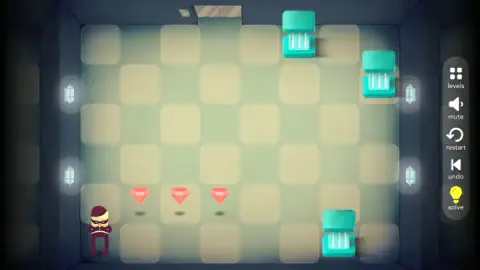
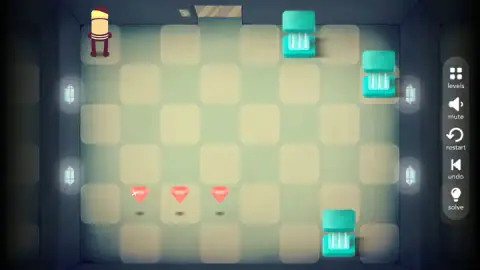
Taken by opening the game ourselves and letting it run — not supplied by the publisher, and not the same picture every other site shows.
How to play Bump Bandit
- Click into the game. The room is a checkered floor seen from above, eight tiles wide and six deep, with the thief, a few cyan pillars and some red diamonds on it.
- Press an arrow key. The thief slides in that direction and keeps going until a pillar or the wall is in the next tile. He never stops in open floor.
- Make him stop on each diamond. A diamond disappears when the thief ends a slide on its tile. In our first room, he slid right along the bottom, stopped against a pillar on a diamond, and that diamond was gone.
- Clear every diamond. When the last one goes, the screen fades to black around the thief and a bubble shows your progress out of ten before the next room.
- Use the bar on the right when you need it. It holds levels, mute, restart, undo and a light bulb marked solve.
Tips from our session:
- Read the pillars, not the diamonds. Before each move, trace the slide to its end. If the line ends at a wall, the thief will stop by the wall, not by the diamond you were aiming at.
- Corners are traps, not goals. We spent minutes sliding the thief between the top-left and bottom-left corners of one room. Each slide felt like progress. Neither corner had a pillar that sent him anywhere new.
- Undo is cheaper than restart. A wrong slide costs one press of undo. Restart throws away the good moves along with the bad one.
- Click after every ad screen. The ad screen came up often, between rooms and several times while we restarted. After it, a "Click to keep playing" tag sits at the top of the game, and the arrows do nothing until you click.
Controls
| Arrow keys (W A S D listed as well) | Send the thief in that direction. He keeps sliding until a pillar or the wall stops him |
|---|---|
| Swipe (phone or tablet) | Listed by the game as the touch version of the arrows; we did not play on a touch screen |
| undo button (Z listed) | Takes back the last slide |
| restart button (R listed) | Puts the room back as it started |
| solve button (light bulb) | Offers the answer to the room in exchange for watching an ad |
| Click the game | Needed after an ad screen, when a "Click to keep playing" tag sits at the top, before the arrows respond again |
Features
- A thief who never stops halfway: every move is a slide from where he stands to the next pillar or wall
- Diamonds that count only when the thief ends up on their tile, so the puzzle is choosing where he stops
- Cyan pillars that act as the only brakes in the room, plus a tile with a green arrow in a later room
- A counter out of ten between rooms, shown in a speech bubble over the thief in a circle of light
- Undo, restart, mute and a level list in a bar on the right, with a light bulb that offers the solution after an ad
Game details
- Developer
- Air Guslar
- Release date
- April 2026
- Last updated
- August 10, 2026
- Added here
- February 2026
- Technology
- HTML5 (2D)
- Platforms
- Browser (desktop, keyboard), Browser (mobile & tablet, touch)
- Classification
- Puzzle
- Saved progress
- Saving, when available, is managed by this game. Mava cannot confirm your level.
FAQ
How do you play Bump Bandit?
Use the arrow keys, or swipes on a phone, to send the thief across a tiled room. He does not take one step: he slides until a pillar or the wall stops him. Your job is to plan a chain of slides that makes him stop on, or run through, every red diamond in the room.
Why won't the thief stop where I want in Bump Bandit?
Because nothing in the room stops him except the cyan pillars and the walls. If a diamond sits in open floor, you have to find a pillar that will catch him on that row or column. Look at where each pillar would brake him before you press a key.
How many levels does Bump Bandit have?
Between rooms the game shows a counter out of ten in a speech bubble over the thief. Ours went from 1/10 after the first room to 5/10 by the room with three diamonds in a row. We did not reach the tenth room, so we cannot say whether more chapters follow.
How do you beat the three diamonds in a row level in Bump Bandit?
We did not beat it. The diamonds sit on a row with nothing to stop the thief, so every straight slide from the corners runs past them. The way in has to use a pillar in another row or column to park him in line with the diamonds first.
Can you undo a move in Bump Bandit?
Yes. The bar on the right has an undo button that takes back the last slide and a restart button that resets the room. The game also lists Z for undo and R for restart on a keyboard.
What does the light bulb do in Bump Bandit?
It is the solve button. When we were stuck, the game showed a STUCK? card asking whether to watch an ad for the solution, with YES and NO buttons. We did not take it and kept trying.
Who made Bump Bandit?
The developer is listed as Air Guslar. The game was published in April 2026. It is free to play in the browser on a computer or a phone.
Is Bump Bandit good for kids?
Yes, for children who enjoy thinking a move ahead. There is no timer, no enemy and nothing to read beyond a few labels, and we never saw a way to lose. The challenge is purely planning, and undo makes mistakes cheap.