




About Sugar Blast: Snowy Pop
Most sweet-matching games ask you to swap two neighbours and line up three. Sugar Blast: Snowy Pop asks for neither. There is nothing to drag. You click one sweet, and every sweet of the same kind that is joined to it disappears with it.
The part that is easy to miss is the word joined. Here it includes corners. Two green sweets that only touch diagonally count as neighbours, so a group can snake across the board in a way your eye does not pick up at first. Our best move of the session was a single click in the top right corner that emptied sweets all the way down to the bottom row.
We played for about four minutes with a mouse, all of it on Level 1, and we did not finish the level. We lost no lives and never used a bomb. So this page is about how the board behaves, which we saw plenty of, and not about how a level ends, which we did not see.
The game is credited to Nexand Studios. It has been available since September 2025.
The board is seven by five, and corners count as touching
The board holds 35 sweets, seven across and five down, each in its own square tile. There are five kinds: a round red candy, a ridged green one, an orange slice, a chocolate-chip cookie and a dark chocolate square with a swirl on it.
On a board that small, with five kinds, groups joined only along rows and columns would be short. The corner rule changes that. On our first clean board the greens made one chain that ran from the top right corner, down through the middle and into the bottom row, across four columns. Three of the joins that held it together were diagonal. Without them it would have been a group of six, a pair and two sweets standing alone.
Ten green sweets went in one tap. The columns closed up, new sweets dropped into the top rows, and the next board looked nothing like the last one.
That refill matters for how you think. The board is never emptied. Every pop deals you new sweets, so there is little point planning three moves ahead; the useful habit is scanning the fresh board for the longest chain.
The counter pays by the group, and not at a flat rate
In the top right corner, under a striped peppermint, sits a number with one decimal. It read 0.0 on the opening card and 0.1 when the board first stood clear.
The ten greens took it to 2.1. That looks like a simple rate, but it did not hold. Our next three pops were five chocolate squares, eight red candies and three cookies, and together they added exactly the same 2.0. Sixteen sweets earned what ten had earned before.
We could not work out the rule from one session. It may depend on the kind of sweet, or on something we did not notice. The last reading we took was 9.4, about four minutes in.
What the number is for, we cannot tell you from play. The level screen has an Upgrades button, and the listing describes upgrades you buy, so a currency is our guess. We did not open that screen.
What we did not see: the end of a level, a bomb, a lost life
Under the board a red plaque with snow on it shows two lines: the level and your lives. Ours read Level 1 and Life 3 the whole time.
Nothing on that screen says what Level 1 wants from you. There is no target, no bar filling up and no count of sweets left. We popped well over forty sweets and the level was still running when we stopped. The listing says each level needs a set number of sweets cleared; we never reached it, so we cannot say how many that is or what the win screen looks like.
The listing also says some sweets hide bombs that cost a life. None of ours did. Take that as luck over four minutes, not as proof the bombs are rare.
Down the left edge are five buttons. One shows a ball of sweets with a red 10 on it, which we take to be the stock of Sugar Bombs; the number never changed because we never pressed it. Below it, a film icon offers 2 more bombs for watching a video advert. We did not take the offer.
The tap-a-group rule comes from a 1985 Japanese magazine game
Clicking a cluster of matching pieces to remove it is older than the swap-three idea most sweet games use. It goes back to Chain Shot, written by Kuniaki Moribe in 1985 for Fujitsu home computers and published in the Japanese magazine Gekkan ASCII. From 1992 it spread to other machines under the name SameGame, and that is the name most versions still carry.
The original is a harsher puzzle. The board is dealt once and never refilled, only pieces that share a side count as joined, and the aim is to clear everything. In 2001 a group of computer scientists showed that deciding whether such a board can be fully cleared is, beyond the smallest sizes, one of the hard problems of computing.
Sugar Blast: Snowy Pop keeps the click and drops the harshness. The refill means you cannot paint yourself into a corner, and the diagonal rule makes large groups common. It is the gentle end of a forty-year-old idea.
Who it is for
It suits anyone who wants a matching game with no dragging and no pressure: one click per move, and no clock that we saw. The winter backdrop is quiet, a blue night with pines and a moon behind the board.
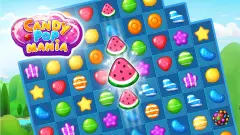
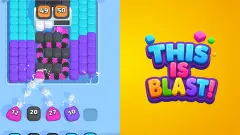
If you want the swap-and-line-up kind, Candy Pop Mania and Super Candy Jewels are that, with sweets, and Vegetables Match 3 does it with a fixed set of 36 levels. This is Blast is a different one-tap puzzle, where shooters chip a picture apart by colour. The rest are under puzzle games.
Screenshots
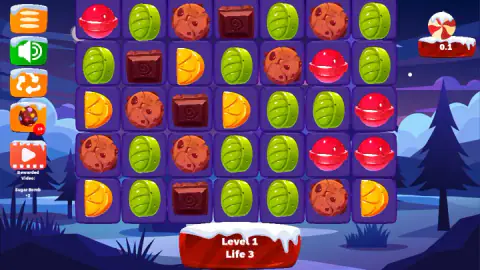
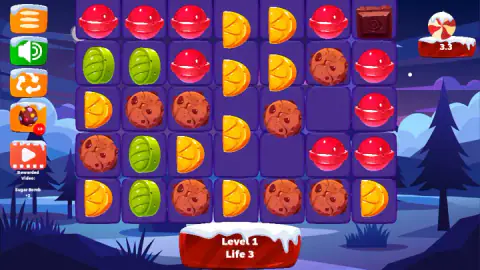
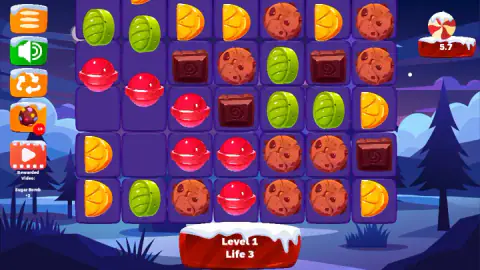
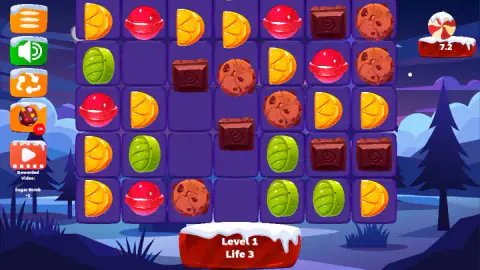
Taken by opening the game ourselves and letting it run — not supplied by the publisher, and not the same picture every other site shows.
How to play Sugar Blast: Snowy Pop
- Start the game and pick a level from the level screen. We picked 1.
- A card titled Gameplay covers the board, with the line Click and Continue. Click until it goes; one click was not enough for us.
- Look for sweets of the same kind that touch, along a side or at a corner.
- Click any sweet in that group. The whole group pops and the number in the top right corner goes up.
- Wait for the board to settle before you choose again. Sweets fall, and new ones drop in from above.
What four minutes taught us:
- Read the diagonals first. The big groups are the ones held together by corner joins. A sweet that looks cut off is often one diagonal step from six more.
- A lone sweet is a wasted click. We clicked a chocolate square with no other chocolate around it. It stayed where it was and the counter did not move.
- Any sweet in the group will do. We popped ten greens by clicking the one at the far end of the chain. You do not have to find the middle.
- Let it finish. A big group does not vanish in one frame. The sweets go a few at a time while the columns above are already dropping, and the board you click half a second later is not the board you were looking at.
- Nothing on screen rushed us. We saw no timer and no move limit. At one point we left the board alone for a full minute and nothing changed.
Controls
| Left click on a sweet | Pops that sweet and every sweet of the same kind joined to it, side by side or corner to corner |
|---|---|
| Left click on a sweet with no twin beside it | Nothing; the sweet stays and the counter does not move |
| Left click on the Gameplay card | Dismisses the opening card (it took us more than one click) |
| Buttons down the left edge | Menu, sound, a two-arrow button, the Sugar Bomb and a video offer; we left the last three alone |
Features
- A board of 35 sweets, seven across and five down, with nothing to drag or swap
- Five kinds of sweet, red candy, green candy, orange slice, cookie and chocolate square
- Groups that join diagonally as well as in rows and columns
- New sweets falling in from the top after every pop, so the board never runs dry
- Three lives shown under the board, and a counter with one decimal in the top right corner
- A Sugar Bomb button with a stock of 10, plus a video offer worth 2 more
- No clock and no move limit on screen during the level we played
Game details
- Developer
- Nexand Studios
- Release date
- September 2025
- Last updated
- August 10, 2026
- Added here
- July 2025
- Technology
- HTML5
- Platforms
- Browser (desktop)
- Classification
- Puzzle
- Download size
- 17.6 MB
- Ad requests
- 5 (some)
- Has a save
- Yes
- Saved progress
- Saving, when available, is managed by this game. Mava cannot confirm your level.
Measured by opening the game ourselves on 2026-09-11, not taken from the feed. Twelve seconds on a phone-sized screen, with ad requests counted and blocked rather than loaded.
FAQ
How do you play Sugar Blast: Snowy Pop?
Click a sweet that touches at least one more of the same kind. The whole connected group pops, the sweets above fall into the gaps and new ones drop in from the top. There is no swapping and no dragging; one click is a whole move.
Do diagonal matches count in Sugar Blast: Snowy Pop?
Yes. Two sweets of the same kind that touch only at a corner belong to the same group. In our run one click on a green sweet in the top right corner removed ten greens, and three of the joins in that chain were corner to corner.
What is the number in the top right corner of Sugar Blast: Snowy Pop?
It is a running total that goes up when you pop a group, shown with one decimal. It is not a clock, because it stood still for a full minute while we were not popping anything. Ten greens added 2.0 to it, but later groups paid less per sweet, and we could not work out the exact rule.
How do you lose a life in Sugar Blast: Snowy Pop?
We never lost one. The panel under the board read Life 3 from our first click to our last. The game's listing says some sweets hide bombs that cost a life, and that the run ends at zero, but no bomb turned up in the four minutes we played.
How many levels does Sugar Blast: Snowy Pop have?
The game's listing says 125. We spent our whole session on Level 1 and did not finish it, so we cannot confirm the total or say how the later levels differ.
Is Sugar Blast: Snowy Pop the same as the mobile game with a similar name?
No. This is a separate browser game, credited to Nexand Studios, with its own rules, a tap-to-pop board and a winter backdrop. Nothing on this page describes any other game that has Sugar Blast in its title.
Who made Sugar Blast: Snowy Pop?
It is credited to Nexand Studios. It was published on 1 September 2025 and last updated in August 2026.
Can you play Sugar Blast: Snowy Pop on a phone?
It is listed for PC, Android and iOS, in landscape. We played on a desktop with a mouse only, so the phone version is the listing's word and not something we tested.