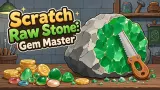
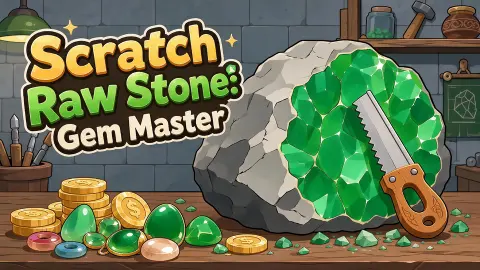




About Scratch Raw Stone: Gem Master
The first thing this game does is take your money. A hand points at one of four rough stones laid out on a wooden table, each with a paper tag hanging off it, and a card asks a single question: buy this rough stone for 1859? There is a green Accept, a red Reject, and no way at all to see inside the rock before you choose.
We accepted. The stone went onto a workbench, and a paper scroll unrolled in the top corner of the screen with the words Current Profit on it and, underneath, a figure in red: -1859. The exact price we had just handed over.
That is a different proposition from most games about running a shop. Those hand you a float and let you build upwards from nothing. Scratch Raw Stone: Gem Master starts you below the line, because the stock costs money before anybody knows whether it is worth anything. The rock on your bench is a bet you have already placed, and everything that follows is an attempt to climb back to the surface.
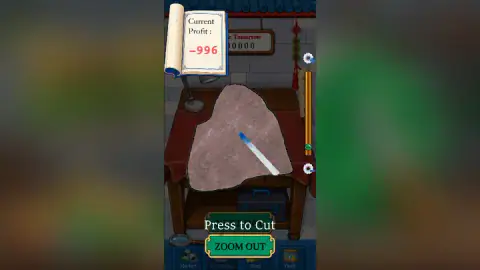
The climbing is done by hand. You hold and drag across the stone and its skin comes away in flakes, slowly, leaving a pale streak behind the tool. The words Press to Cut sit under the table for as long as the stone is unfinished, a green ZOOM OUT button sits under that, and a bar of four tabs runs along the bottom: Market, Workshop, Shop, Vault. Nothing counts down. Nothing threatens you. The only thing on screen that moves while you work is the red number.
The game is credited to Young Studio and dates it to August 2026, with its last update the month after.
A word on how far we got, because it matters for everything below. We played for about four minutes on a desktop, bought one stone, and spent the rest of the session scraping it without ever getting it open. So this page can tell you exactly what the first stone feels like and what the counter does while you work it. It cannot tell you what a finished gem looks like, what it sells for, or what the shop turns into.
The number in the corner is the whole game
Here is the single most useful thing we can tell you about Scratch Raw Stone: Gem Master, and we can tell you it because we watched it happen rather than because the game explains it anywhere.
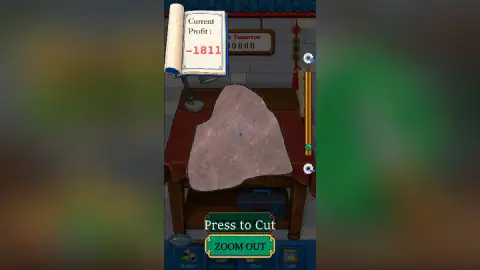
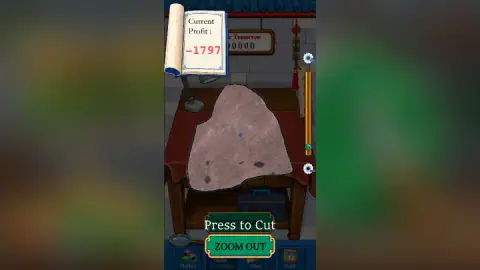
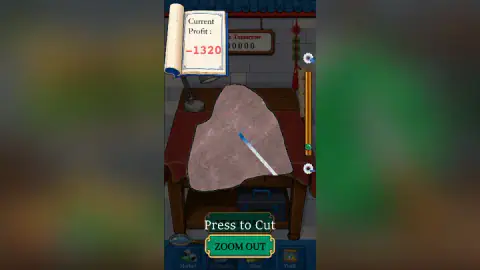
The counter did not start at zero. It started at minus the price of the stone, to the unit, and then climbed as the rock came apart. Across the four pictures on this page it reads -1811 with the stone still bare, then -1797 once a couple of small marks have appeared, then -1320 with the tool laid across it, and finally -996 with a longer streak scraped out behind the tool.
What that number is actually measuring, the game never says. It behaves like a running balance that opens with the purchase as a debit and recovers as value is uncovered, and the match between the opening figure and the price we paid is the reason we think so. We never reached the moment where it would have been settled, so we are not going to tell you it is the day's books or the stone's books or the shop's, because we do not know.
And so, when you play, the question in your head is never am I winning. It is how far back have I clawed, and is there anything left in this rock. There is no clock pushing you towards an answer. The only pressure in the game is the one you brought with you when you paid.
Buying a stone you cannot see into is a real trade
The shopfront gives the game away before any of the text does: blue roof tiles, a red tasselled knot hanging in the corner, cherry blossom by the table leg, a grey vase on the floor. This is the jade trade.
Most of the world's fine jadeite comes out of northern Myanmar, and it is sold while still wrapped in a weathered skin that hides what is inside. A boulder can be magnificent or worthless and look identical from the outside, so the buying is done on the rind, on experience and on nerve. In Chinese the practice has a name that translates as stone gambling, and the old line about it is that one cut can make a man and one cut can finish him. Dealers hedge by grinding a small window into the skin, a patch polished flat so a torch can be shone through it to judge colour and translucency before the money moves.
That is the exact shape of what the game asks you to do, with one mercy. In the trade the window is ground before the sale and the gamble is taken in a crowded market with other buyers waiting. Here the money is gone first, the window is the whole job, and you get to open it as slowly as you like. The game never explains any of this and never names the stone. It just draws the shop and lets the counter do the talking.
What this page cannot tell you
We never got a gem out of the rock. We never sold anything, never opened the Vault or the Shop tab, never pressed the NEXT DAY button we saw during the opening tutorial, and never bought a second stone. Four minutes bought us one rock and a counter that climbed from -1811 to -996 while we worked it, which is enough to describe the hook honestly and not enough to describe the shop.
If that sounds thin, it is also the most accurate thing about the game we can write down. The first stone is where this game makes its case, and the case it makes is that watching a loss shrink is a surprisingly good reason to keep dragging.
More shops, more things worth digging up
Supermarket Management Simulator is the same job with the mystery taken out: you can see every item you buy, and the difficulty is in keeping the shelves and the queue moving. Taxi Tycoon: Urban Transport Sim scales the idea up from one bench to a fleet, with the same basic arithmetic of spend first, earn back later. Treasure Hunter keeps only the part where the valuable thing is underground and getting it out is the problem. The Queen's Jewels is gems without the economics: a physics puzzle where the stones are the pieces. And if what you liked here was the slowness rather than the money, Vials: ASMR Sand Sort Puzzle is built entirely out of it, with no clock anywhere in it. The rest of the shelf is in strategy games.
Screenshots
How to play Scratch Raw Stone: Gem Master
- Pick a stone and answer the card. The market table carries four of them with price tags attached. Clicking one brings up a card asking whether you want it at that price, with Accept and Reject underneath. If none of them appeals, a RESTOCK button sits below the table.
- Send it to the bench. The stone you bought moves to a workbench under a desk lamp, with the tools lined up down the right-hand side.
- Drag, do not tap. Hold and pull right across the surface. Short pokes and repeated clicks in the same place left our stone exactly as it was.
- Watch the scroll, not the stone. The rock changes very slowly and it is hard to see progress in it. The red figure in the corner is the honest readout.
- Use ZOOM OUT when you lose the thread. The close view fills the screen with rock. Pulling back is the only way to see the bench, the tools and the tabs at once.
What our session actually taught us:
- The long drags are the ones that count. Every time we pulled the tool properly across the rock, a pale streak was left behind it and the number on the scroll moved. Small nudges did nothing we could see.
- The keyboard is not part of this game. We tried the arrow keys, letters and Enter. None of them cut anything or chose anything.
- It is quiet work. After the sound that played as the game opened, nothing we did in the whole session made a noise. No chime for progress, no thud for a mistake.
- There is a second readout and it is worth knowing about. Behind the scroll sits a small wooden sign. In our pictures the scroll covers most of it, and what is left reads ...e Tomorrow above a row of five zeros; the very first screen of our session read it as Due Tomorrow. Something in this shop is owed on a deadline. While we played, the amount owed was nothing.
Controls
| Left click or tap | Picks a stone in the market and answers the card that asks whether you want to buy it, with a green Accept and a red Reject |
|---|---|
| Hold and drag across the stone | Scrapes the surface away. This is the one thing that moved the counter for us |
| Press to Cut | The line of text that sits under the stone on the bench for as long as the stone is unfinished |
| ZOOM OUT | Green button under the bench. Pulls the view back off the stone |
| Market, Workshop, Shop, Vault | The four tabs along the bottom of every screen. We only ever used the first two |
| Keyboard | Nothing we could find. Arrow keys, letters and Enter all left the stone exactly as it was |
Features
- Your stock costs money before it is worth anything: the profit counter opens at minus the price of the stone you just bought, to the unit
- Four rough stones on the market table, each with a paper price tag and nothing else to go on, plus a RESTOCK button when you do not like any of them
- The work itself is a drag of the finger: the skin comes off the stone in flakes, and a pale streak is left behind the tool
- No clock, no lives, no fail screen. The only thing that moves while you work is the red number on the scroll
- A second readout sits behind the scroll with the word Tomorrow on it and a row of zeros: something is owed, and while we played the amount was nothing
- Made by Young Studio, who put it in August 2026
- In four minutes of steady scraping we moved the counter most of the way back towards zero and never once got the stone open
Game details
- Developer
- Young Studio
- Release date
- August 2026
- Last updated
- September 16, 2026
- Added here
- July 2026
- Technology
- HTML5 (2D)
- Platforms
- Browser (desktop, mouse), Browser (mobile & tablet, touch)
- Classification
- Strategy
- Saved progress
- Saving, when available, is managed by this game. Mava cannot confirm your level.
FAQ
How do you play Scratch Raw Stone: Gem Master?
You buy a rock you cannot see inside and then take it apart. The market lays out rough stones with price tags on them, a card asks whether you want the one you picked, and if you accept it goes onto a workbench. From there the job is to hold and drag across the surface, scraping the skin away a flake at a time while a counter in the corner keeps score of what the stone has cost you so far.
What does Current Profit mean in Scratch Raw Stone: Gem Master?
The game never explains it, so here is what it does. It appeared the moment we bought our stone, reading minus the exact price we had paid for it, and it climbed every time we scraped. In the four pictures on this page it goes from -1811 up to -996. Whether it is the balance for that stone, for the day or for the whole shop we cannot tell you, because we never finished the stone.
How do you scratch the stone open?
Long drags across the surface, not taps. Clicking the same spot over and over did nothing for us however many times we tried it, and neither did very short drags. Dragging the tool right across the rock is what left a visible pale streak behind it and what moved the number on the scroll.
Do you start Scratch Raw Stone: Gem Master in debt?
In effect, yes. The counter does not begin at zero and climb: it begins underwater by the price of your first stone and you spend the stone trying to get back. That is the tension the game runs on, and it is unusual for a shop game, which normally hands you a float and lets you build upwards from there.
What are Market, Workshop, Shop and Vault in Scratch Raw Stone: Gem Master?
They are the four tabs along the bottom of every screen. Market is where the rough stones are laid out with their prices and the RESTOCK button. Workshop is the bench where the stone you bought sits waiting to be scraped. We spent our whole session in those two and never opened the other two, so we cannot tell you what is behind them.
Is Scratch Raw Stone: Gem Master based on anything real?
It is not labelled as such, but the trade it draws on exists. Rough jadeite from northern Myanmar is sold while still wrapped in a weathered rind that hides the stone inside, and buying it is known in Chinese by a name that translates as stone gambling. Dealers grind a small window in the rind to peek. The game turns that window into a job you do slowly, with your money already spent.
Who made Scratch Raw Stone: Gem Master?
Young Studio, according to the game's listing. It went up in August 2026 and was last updated in September 2026. We found no studio website to check the name against a second source, so it rests on the portal alone.
Does Scratch Raw Stone: Gem Master work on a phone?
It is listed for Android and iOS as well as PC, and lists it as a portrait game as well as a landscape one, which matches the tall layout it draws. A game whose only real input is holding and dragging across a surface should suit a touchscreen better than a mouse. We played it on a desktop, so we have not checked that ourselves.