About Save the Kitten
Of 132 cats brought into New York's Animal Medical Center after falling out of a window, ninety per cent of the ones that needed treatment walked out again. Save the Kitten takes that statistic and refuses to accept it. Tom, the angry cat at the top of the tower, tips kittens off the parapet one after another, and your job is to make sure not one of them ever reaches the ground.
You do it with a trampoline strapped to your back. You run along the valley floor, get under the falling kitten, and the bounce sends it flying towards the basket mother cat is holding on the far side.
The detail that turns this into a game rather than a reaction test is the turn button. Your character faces one way at a time, and while you can move in either direction regardless, running the way you are not facing happens at exactly half speed — 150 pixels a second against 300. So every catch is two decisions: where to stand, and which way to be pointing when you get there. Press spacebar to spin around, or double-tap the same arrow on a touchscreen, which is what the game's own tutorial means by "double-tap to turn".
It started life in 2016 as an iPhone game called Catastrophe Cat, made by AppyApp, a small studio in Namangan, Uzbekistan that publishes on the App Store under the name Max Kochergin. The browser version went up on Yandex Games in May 2020 and has collected 4.6 out of 5 from 51,665 ratings there, making it the studio's best-reviewed game. This build still calls itself Catastrophe internally — open the console and the Phaser state is Catastrophe.MainMenu.
Cats really do fall off towers, and vets have a name for it
The premise sounds invented. It is not. Veterinary medicine has a term for it: high-rise syndrome, the pattern of injuries a cat picks up falling from a window or balcony.
The foundational paper is Whitney and Mehlhaff's High-rise syndrome in cats, published in the Journal of the American Veterinary Medical Association in December 1987. Over five months, 132 cats came into the Animal Medical Center in Manhattan after a fall. Ninety per cent had chest trauma, 57 per cent had facial injuries, 39 per cent had a broken limb. And 90 per cent of the cats that were treated survived.
The finding that made the paper famous is stranger. Cats that fell from below about six or seven storeys tended to be hurt worse than cats that fell from higher up. The proposed explanation is that a cat reaches terminal velocity — roughly 100 km/h, against about 210 km/h for a falling adult human — after around five storeys. Once it stops accelerating it stops bracing, relaxes, and spreads its legs flat like a parachutist, which slows it further and spreads the impact across the whole body instead of driving it through the legs.
Two honest caveats. Survivorship bias: a cat killed outright never gets carried to a vet, so the worst outcomes are missing from the sample. And a later study of 119 cases by Vnuk and colleagues found the opposite trend — more height, worse injuries. The seven-storey paradox is a real published result, not a settled law.
The mid-air turn is settled. In 1894 the French physiologist Étienne-Jules Marey photographed a cat dropped upside down, frame by frame, and published the sequence through the French Academy of Sciences. It ended an argument physicists had been having for decades, because the cat clearly rotates without pushing against anything: it bends at the waist and swings its front and rear halves at different moments, changing shape rather than acquiring spin. Air resistance has nothing to do with it. Nature printed the photographs and noted that the cat's expression at the end showed "a want of interest in scientific investigation".
Save the Kitten runs the whole thing backwards. Real cats survive long falls by shedding energy on the way down; your kittens survive because you put the energy back in at the bottom. And the game keeps the one piece of physics that matters — they always come down feet first onto the trampoline.
Why a falling kitten needs no tutorial
Rescue is the cheapest objective in game design. A kitten falling and a basket waiting explains itself in a second, with no text, no story and no cultural context. A score target has to be justified; a boss has to be introduced. This does not.
The proof is in the listing. On Yandex Games the page exists under 21 translated titles, from Arabic and Hindi to Japanese, Thai and Vietnamese, while the game itself ships two interface languages, English and Russian. Twenty-one audiences, two translations, and it still works.
The honest counterweight: strip the fur off and this is a positioning game about a moving catch box. The tower and the villain are set dressing. What keeps it going past five minutes is the turn cost and the shop.
What the coins buy: three pairs of sneakers and three trampolines
The shop has two shelves, three items each, and everything can be upgraded five times.
| Item | Price | What it does | Upgrades |
|---|---|---|---|
| Light sneakers | 300 | +10% running speed | +5% per level, 50 → 300 coins |
| Extra sneakers | 500 | +25% running speed | +5% per level, 100 → 500 coins |
| Super sneakers | 1,000 | +50% running speed | +5% per level, 150 → 700 coins |
| Trampoline speed | 400 | +10% running speed | +5% per level, 50 → 300 coins |
| Trampoline rescuer | 1,000 | Saves one kitten by itself every 10 seconds | −1 second per level, down to 5 |
| Trampoline magnet | 1,500 | Pulls falling kittens towards the trampoline | Widens the catch area, 500 → 3,000 coins |
Buy shoes first. Fully upgraded super sneakers add 300 to a base speed of 300, doubling how much ground you cover in a round, and speed is what limits your score at every level. The trampoline magnet is the best single item in the game — it widens your catch area from 80 pixels to 100, and each upgrade takes it to 120, 130, 140, 150 and finally 160 pixels, twice the default. It is also the most expensive thing here by a distance.
Ten levels, counted in kittens
There are ten levels, and you do not finish them, you accumulate into them. The counter is your lifetime kittens rescued: level 2 at 100, then 250, 500, 1,000, 2,500, 5,000, 7,500, 10,000 and level 10 at 15,000.
Each tier changes two things. Tom gains landing spots — two positions at levels 1 and 2, three at levels 3 and 4, four from level 5 onwards — which is what forces you to turn under pressure instead of parking in one place. And waves get longer: they start at four or five kittens, one every 600 milliseconds, and grow with the level. Round length grows too, from 30 seconds on your first round to a ceiling of two minutes.
Playing Save the Kitten unblocked
The game is one HTML5 page built with Phaser, drawn on a canvas at a fixed 960×540. No plugin, no installer, no login, which is why it survives on school networks and Chromebooks where anything heavier does not. Press play above and it runs inside this page.
One limitation on a phone: the build refuses to run in portrait. Turn the device sideways and the on-screen arrows appear at the bottom corners.
More rescue games
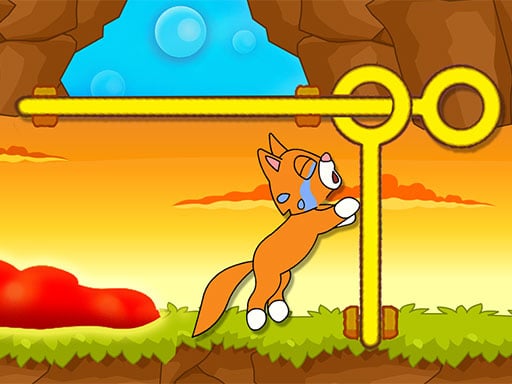
If the appeal is the verb rather than the cat, Hero Rescue Puzzle and Hero Rescue are the pin-pulling kind, where you work out which obstacle to remove before the lava reaches the prisoner, and Pull Him Out Online is the same idea with a blunter sense of humour.
For the same short-session arcade rhythm without the rescuing, try Relic Runway or Hunter Assassin, or browse the whole arcade category.
How to play Save the Kitten
- Watch the tower, not your feet. Tom winds up before each throw. That animation is your cue, and at higher levels it is the only warning you get.
- Run under the kitten and hold still. Your catching area is a strip about 80 pixels wide centred on the trampoline. Overshooting is the most common way to drop one.
- Face the basket. It sits on the right-hand hill, and the direction you face is what sends the kitten across. It is not cosmetic.
- Turn early. Spacebar, or a double-tap on the same on-screen arrow inside 600 milliseconds. Turning plays an animation, so do it while you wait, not while you chase.
- Bank the coins. Rescued kittens pay coins at the end of the round, and coins are the only route to a faster character.
Five things the game does not tell you:
- Running backwards halves your speed. This is the single biggest thing separating a good run from a bad one. If a kitten is falling to your left and you are facing right, you will not make it — turn first.
- Bombs are worth points. Catching one pays 99 points, the same as any booster, but it freezes your controls for about two and a half seconds. Early in a round, when kittens are sparse, taking a bomb is sometimes the right call. In the middle of a wave it costs you three or four kittens.
- The time booster adds exactly 15 seconds. Worth chasing on a round that only started with 30 or 40.
- Rescuing a kitten is worth ten times a bounce. A bounce scores 5; a kitten that reaches the basket scores 50. Points come from finishing the job.
- Coins fall too. Loose coins are worth 20 points on top of their value, and Tom drops them constantly once you have collected the magnet, sneakers and time boosters in a round.
Controls
| ← / → or A / D | Run left and right along the valley floor, carrying the trampoline |
|---|---|
| Spacebar | Turn around. Running backwards costs you half your speed, so this is the key that decides your times |
| Double-tap an arrow | The touch equivalent of spacebar — tap the same on-screen arrow twice inside 600 ms to face the other way |
| Touch | On a phone or tablet, hold the on-screen left or right arrow. The game refuses to run in portrait |
Features
- Ten difficulty levels, unlocked by lifetime kittens rescued — 100, 250, 500, 1,000, 2,500, 5,000, 7,500, 10,000 and 15,000
- Rounds start at 30 seconds and grow by ten seconds each time, up to a two-minute ceiling
- Tom drops five kinds of object — magnet, sneakers, extra time, coins and bombs, which stun you for about two and a half seconds
- A shop with three pairs of sneakers and three trampolines, from 300 to 1,500 coins, each with five upgrade steps
- Fully upgraded super sneakers double your running speed, from 300 pixels a second to 600
- Six standing missions, a timed prize chest, and a global scoreboard inherited from the game's social-network original
- Runs as a single 960×540 Phaser page with no download, no plugin and no account
Game details
- Developer
- AppyApp
- Release date
- May 2020
- Last updated
- March 21, 2023
- Added here
- March 2023
- Technology
- HTML5 (Phaser, Canvas, 960×540 landscape)
- Platforms
- Browser (desktop), Browser (mobile & tablet, landscape only), Chromebook
FAQ
How do you play Save the Kitten?
You run left and right under Tom's tower with a trampoline on your back, catching the kittens he throws off. Each kitten bounces on the trampoline and travels towards mother cat's basket on the far side of the valley. Rescue as many as you can before the round timer runs out.
How do you turn around in Save the Kitten?
Press the spacebar on a keyboard, or double-tap the same on-screen arrow within about half a second on a touchscreen. You can move in either direction whichever way you face, but running backwards happens at half speed.
How many levels does Save the Kitten have?
Ten. They are not stages you finish but difficulty tiers, and they unlock on your lifetime total of rescued kittens — 100, 250, 500, 1,000, 2,500, 5,000, 7,500, 10,000 and 15,000. Each tier gives Tom more places to throw from and longer waves.
What should I buy first in Save the Kitten?
Sneakers. Speed is what decides how many kittens you reach, and the cheapest pair costs 300 coins against 1,500 for the magnet trampoline. Buy shoes, upgrade them, then save for the trampoline magnet, which widens your catching area from 80 pixels to as much as 160.
Who made Save the Kitten?
AppyApp, a small studio based in Namangan, Uzbekistan, which publishes on the App Store under the name Max Kochergin. The game first appeared in 2016 as an iPhone app called Catastrophe Cat, and the browser version went up on Yandex Games in May 2020.
Is Save the Kitten free, and can I play it unblocked at school?
It is free and needs no account or download. The whole game is one HTML5 page, so it runs on a locked-down school Chromebook exactly as it does anywhere else, as long as this site is reachable on the network.
Do cats really survive falling off tall buildings?
Often, yes. A 1987 study at New York's Animal Medical Center looked at 132 cats brought in after falls from windows and balconies, and 90 per cent of the ones that were treated survived. The figure is skewed, though — cats killed outright rarely reach a vet, so they never enter the count.
Why do cats land on their feet?
Because they can turn in mid-air without pushing off anything. The French physiologist Étienne-Jules Marey photographed a falling cat in 1894 and showed that it bends at the waist and rotates its front and back halves in opposite order, changing its shape rather than gaining spin. Air resistance plays no part in it.