



About Game Mania
Most collections of mini-games give you a menu and let you pick. Game Mania never asks. It drops you onto a sheet of notebook paper, shows you a drawing for a second or two, and expects you to understand it before a little fuse in the corner burns down. Then it does it again with something completely different.
The idea fits on one line: a series of micro-games, each a single action, chained until you run out of hearts. One asks you to hit a torch three times on the beat. The next has you drag a handle across to slam a window. What makes it a game rather than a gallery is the cost of getting it wrong. You have three hearts per run, and every fumble crosses one out in red ink.
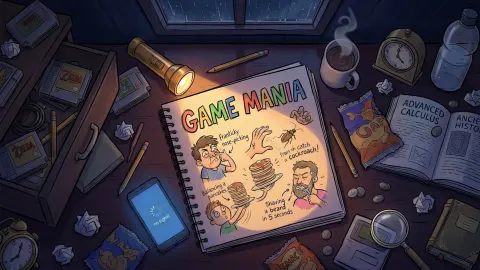
The framing is a story most people have lived through. It is the middle of the night, the power is out, the phone on the desk shows a crossed-out Wi-Fi signal, and you cannot sleep. So you pick up a pen, and every scribble turns into a game. The title page shows exactly that: a lit torch, a steaming mug, rain on a window with pine trees behind it.
Game Mania is by Konstantin Steinmiller, according to the game's listing, and it was published in September 2026.
Each micro-game explains itself in one drawing
There is no tutorial screen in Game Mania, because every micro-game carries its own. The card shows a tiny version of the scene, a hand doing the gesture and a short line of capitals: SMACK IT THREE TIMES IN RHYTHM, DRAG THE HANDLE ACROSS TO SLAM IT. The game itself sits right behind the card, so you can see what the drawing refers to before you touch anything.
That is a design choice with a cost. Because each game lasts only a few seconds, the time you spend reading is time off the fuse. The first time you meet a micro-game, the card does all the work. The second time, you recognise the red title and act before the card has finished appearing. Most of the improvement between runs comes from that.
What the night throws at you
The micro-games we met all belong to the same sleepless night. In SMACK! the page goes dark except for a circle of torchlight, and you hit the torch on the beat, the way you would thump a real one that keeps cutting out. SHUT! puts a dark window in front of you with rain blowing in, and you drag the latch across to slam it.
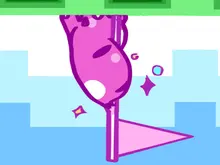
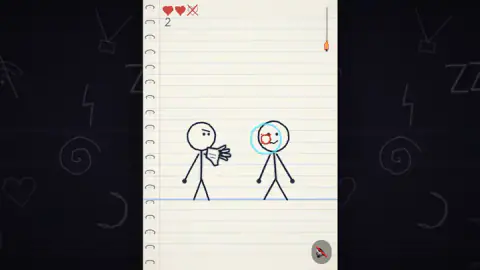
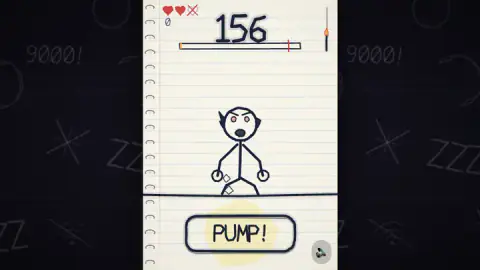
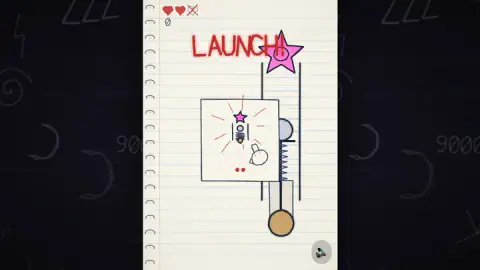
Others are pure comedy. One stick figure slaps another across the face with a glove. In PUMP! an angry stick figure with spiky hair stands over a big button while a counter climbs, ours reached 156, and a bar with a red mark shows how far you need to push it. In LAUNCH! a spring fires a ball up a tube at a pink star.
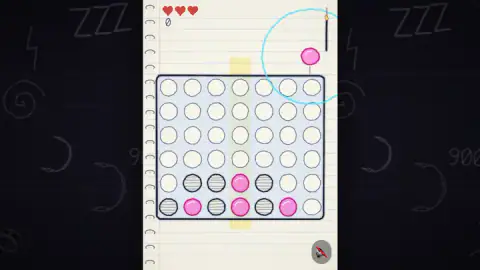
One micro-game sends you to the roof. A stick figure holds up a TV aerial in a storm of white static, with an empty circle in the sky where the signal should be. There was also a quieter puzzle among the chaos: a seven-by-six board for four in a row, with a pink disc waiting above it.
The fuzz on the screen was partly the sky
The aerial scene is a joke about something real. Before digital broadcasting, a television that lost its channel filled the screen with the black-and-white fuzz people called snow. Most of it came from the TV's own electronics and nearby interference. A small part, about one percent, was microwave radiation left over from the early universe, picked up by the aerial along with everything else.
So the stick figure in Game Mania, waving an aerial at an empty sky, is in a sense looking at the oldest light there is. The micro-game turns the old routine of turning the aerial until the picture comes back into a few seconds of aiming.
Tiny games have a long history
Chains of games lasting a few seconds became a genre of their own in 2003, when Nintendo released WarioWare for the Game Boy Advance. Its formula of a one-word instruction and a single gesture, repeated until you slip, is the one Game Mania follows. The difference is the setting. Instead of a cartoon world, everything here lives on lined paper and is drawn in ballpoint, as if you were inventing it on the spot.
How far we got
We played Game Mania for about four minutes with a mouse and started several runs. Every finished one ended on the Out of Hearts card. Our best put a 2 on the small counter under the hearts, and none lasted much more than a minute. We never reached the boss that the game's description promises at the end of the night, or the sunrise after it, so we cannot tell you what they are like.
The Out of Hearts card offers two buttons. Keep Going carries a video icon, which means a video plays before the run carries on; Main Menu goes back to the desk. We always took the menu, so every run we describe here started fresh with three hearts.
Who it is for
Game Mania suits anyone who likes short bursts and quick reactions: a run takes a minute or two, and losing costs nothing but the walk back from the menu. Children can follow it, since every instruction is a picture first and words second, though the speed may frustrate the youngest.
It is not a game for planning. Apart from the four-in-a-row board, there is almost nothing to think through in advance; you react, and you learn by failing. The screen is a tall portrait page, which suits a phone held upright, but we played with a mouse and did not try it on touch.
More quick-reaction games
Konstantin Steinmiller has other games in our catalogue, including Supa Tic Tac Toe, a card-driven take on noughts and crosses, and Epicrolla, where each tap flips the direction of a rolling ball. If what you liked was the split-second timing, Quick Draw Cowboys turns it into a western duel and Ghost Guard has you shooting ghosts before they reach you. The rest are in our arcade games.
Screenshots
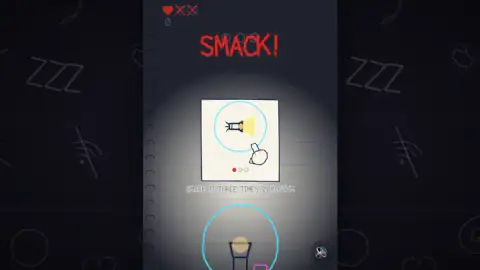
Taken by opening the game ourselves and letting it run — not supplied by the publisher, and not the same picture every other site shows.
How to play Game Mania
- Click or tap the title page to start a run. Three red hearts sit in the top left corner.
- Read the picture card. Each micro-game opens with a one-word title in red and a small drawing with a pointing hand, a few words underneath and a row of dots.
- Do what the card shows: mash, tap in rhythm, or drag and release. The fuse in the top right corner is your clock.
- Fail, and one heart is crossed out. The run moves straight on to the next micro-game.
- When the third heart goes, the Out of Hearts card appears. Main Menu takes you back to the notebook on the desk.
Tips from our runs
- Read the words under the picture, not only the picture. "Three times in rhythm" means three even hits, not as many as you can manage.
- The dots under the drawing are part of the instruction. On the torch card there were three, one for each hit.
- Look for the arrow. In the window micro-game a yellow arrow points from the handle to where it has to go, and the dashed red line on the card says the same thing.
- Do not use up a heart working it out. If a micro-game is new to you, copy the card exactly; experimenting is what the next run is for.
Controls
| Click or tap repeatedly | Mashes, for micro-games that ask you to pump or push something |
|---|---|
| Click or tap in time | Hits on the beat, for micro-games that ask for a rhythm |
| Drag and release | Slides, pulls or slams, for micro-games that show an arrow |
| Main Menu button (out of hearts card) | Ends the run and returns to the title page |
| Speaker button (bottom right) | Turns the sound on or off |
Features
- A chain of very short micro-games, each with its own one-word title such as SMACK!, PUMP!, SHUT! and LAUNCH!
- Every micro-game opens with a small picture card that shows the gesture, with a few words underneath
- Three hearts per run; each failed micro-game crosses one out in red
- A burning fuse in the top corner shows how much time is left in the current micro-game
- Everything is drawn in ballpoint on lined notebook paper, with stick figures doing the work
- The story is a power cut at night: no Wi-Fi, no sleep, a torch and a notebook
Game details
- Developer
- Konstantin Steinmiller
- Release date
- September 2026
- Last updated
- September 17, 2026
- Added here
- September 2026
- Technology
- HTML5 (2D)
- Platforms
- Browser (desktop, mouse), Browser (mobile & tablet, touch)
- Saved progress
- Saving, when available, is managed by this game. Mava cannot confirm your level.
FAQ
How do you play Game Mania?
Game Mania throws a series of tiny games at you, one after another. Each starts with a picture card showing what to do, such as tapping three times in rhythm or dragging a handle across the screen. Do it before the fuse in the corner burns out and the next one starts; fail and you lose one of your three hearts.
How many lives do you get in Game Mania?
You get three hearts per run. Each failed micro-game crosses one out, and when all three are gone an Out of Hearts card appears. From there you can go back to the main menu and start again.
What kinds of micro-games are in Game Mania?
The ones we played asked us to smack a torch in rhythm, slap a stick figure, hold up a TV aerial in a storm of static, pump up an angry stick figure, slam a window shut in the rain, fire a spring launcher at a star and drop a disc on a four-in-a-row board. In our session, each new run opened with a different one.
How do you continue in Game Mania after losing all your hearts?
The Out of Hearts card offers a Keep Going button marked with a video icon, meaning a video plays before the run carries on, and a Main Menu button. We always took the main menu, so we can only say what the card offers.
Is there an ending in Game Mania?
According to the game's description, the night ends with a boss and then the morning sun. We did not get that far in our session, so we cannot describe either.
Who made Game Mania?
Konstantin Steinmiller is listed as the developer. The game was published in September 2026.
Can you play Game Mania on a phone?
It is listed for desktop, mobile and tablet, and the screen is a tall portrait notebook page that suits a phone held upright. Every micro-game uses taps, mashing or a drag, which all work with a finger. We played with a mouse and did not test touch ourselves.