
About Doodle Guard: Draw to Save
The first thing this game taught us was that a roof is not a shelter.
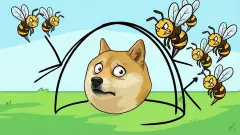
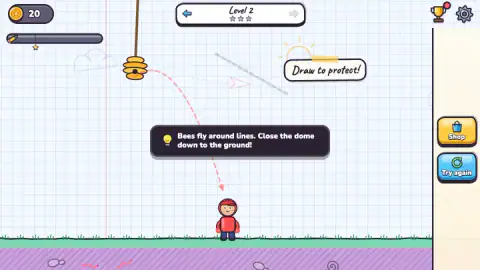
We had drawn a tidy grey beam over the small red figure standing on the grass. The hive hanging above him on its brown rope let the bees out, they came down the dashed red curve the game had already sketched for us, and then they went round the ends of the beam and stung him anyway. A black box appeared across the middle of the page with the correction in it: Bees fly around lines. Close the dome down to the ground!
That is Doodle Guard in one failure. You draw on pale graph paper, the kind with a red margin line down the left, and the thing you draw is not a magic wand or a wall that exists because you wished for it. Press, drag, let go, and your stroke stops being a drawing. It becomes an object with weight, and it falls. If you drew it with a gap, the gap is still there when the bees arrive.
Then there is the second rule, the one that makes this a puzzle rather than a doodling toy. A dark bar sits in the top left corner with a yellow pencil on its end, and it empties as you draw. Under it, about a third of the way along, somebody has drawn a tiny gold star. That star is the real score. Solving the level is the easy half; solving it with most of the bar still full is the half you will replay for.
We spent about ten minutes with it, reached the fourth level, and never once took all three stars. Our best card read two gold and one grey.
The ink bar is the score
Most drawing puzzles ask you for the right shape. This one asks for the right shape drawn cheaply.
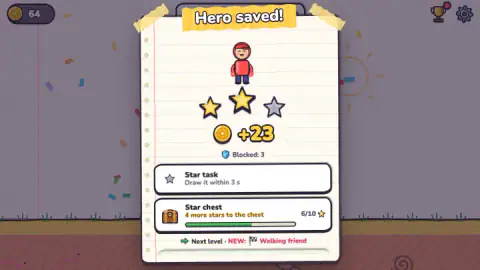
Stars are the currency of progress and each level carries three of them, drawn empty in the pill at the top until you earn them. One comes from solving the level. One comes from the clock — the result card after our best run spelled out its condition in four words, draw it within three seconds. And one comes from the bar, because the gold star marked under it is the line you are meant to stay to the left of.
Those stars then go somewhere. The win card stacks them into a star chest with a green bar across it and tells you plainly what it still wants: four more stars to the chest, it said, sitting at six of ten. We never filled it, so the chest is one of several things here we can describe the outside of and nothing more.
Coins arrive on the same card and they arrive quickly. We opened with 20 in the purse and left with 87, and a single good level paid 23 of that. A bright yellow Shop button sits on the right rail of every screen. We never pressed it, so what coins buy — the game's listing mentions a set of pens to collect — is its claim and not our report.
Why the dome has to reach the ground
The game's instruction is a drawing instruction. It happens to be a structural one too, and that is worth knowing, because it is the oldest trick in building.
An arch holds itself up by squeezing. Every block in it leans on its neighbour, the load travels down the curve rather than through it, and nothing in the arch is being pulled apart. That is why arches were built in stone for two thousand years while stone beams stayed short: a flat beam sags, and a sagging beam is stretched along its underside, which is exactly what stone and brick are worst at. Curve the same material and the stretching disappears.
But the squeeze has to go somewhere. An arch does not push straight down at its feet — it pushes down and outwards, and that outward shove, which builders call thrust, has to be met by something immovable. A cathedral meets it with buttresses, a bridge with the river banks. An arch whose feet stand on nothing spreads, drops its middle and becomes a pile.
So when Doodle Guard tells you to close the dome down to the ground, it is asking for the shape a real builder would need anyway, even though the game's own reason is simpler: the bees go round the ends. Both reasons want the curve finished and the feet planted, and both treat an arc that stops in mid-air as a line rather than a shelter.
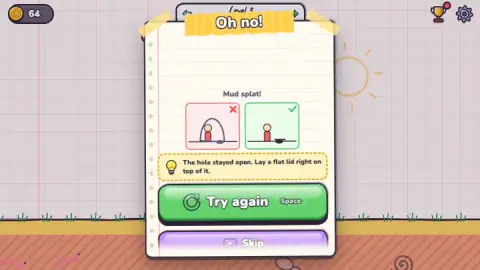
The mud level is the other half of the lesson. A hole does not need an arch over it — it needs a lid across it, which is a beam, and a beam is fine when the span is short and the thing landing on it is a splat of mud rather than a cathedral roof.
Three levels, three different questions
The early run changes its question faster than we expected.
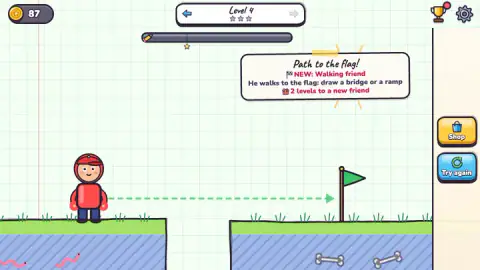
The bee level is pure shelter: the hive hangs, the dashed curve shows where the bees will come, and your job is to roof and wall the hero in one stroke. The mud level moves the danger to the floor — the hero stands beside a hole, and the thing you draw has to cap it flat rather than vault it. Then the fourth level drops the defending idea entirely. A card appeared reading Path to the flag!, announcing a new character, a walking friend, and explaining him in a sentence: he walks to the flag, draw a bridge or a ramp. The hero was on one ledge, a green flag on another, a channel of blue pencil hatching between them with bones in the water.
That is the same tool doing the opposite job. For three levels the line is a barrier; on the fourth it is a road. The card added a counter under it, two levels to a new friend, which is the game telling you where the next change comes from.
The listing promises more of the same escalation — water balloons, tomato cannons, bowling balls and watermelons, eleven heroes, a stack of pens — and we met none of it. We got the bees, the mud and the flag. Partway through, the game also stopped us with its own update notice, a panel of news with a green Play button to dismiss it, which is the sort of thing a game still being worked on does.
What it feels like
Gentle, and not in a thin way. There is no health bar, no lives counter, no punishment beyond being asked to go again. The failure page is not a game-over screen; it is a teacher, and it offers to show you the solution outright if you would rather be told.
What it asks from an older player is restraint. Any level here can be brute-forced with a long, generous, expensive line. The star under the ink bar is the game quietly asking you not to.
More drawing puzzles worth your ink
If the bee level is the part that hooked you, Save The Pets: Draw to Save runs that problem with a dog in the hero's place, and Draw And Save The Stickman widens it to falling rocks and spikes. Happy Glass - Draw to Fill is the same physics turned into plumbing, your lines steering water instead of blocking bees, and Draw Bridge - Brain Game stretches the fourth-level idea into a whole game. The rest are in puzzle games.
Screenshots
How to play Doodle Guard: Draw to Save
- Press the mouse button anywhere on the paper and drag. A line follows your pointer, and it sets into a solid object when you let go.
- Look at what is threatening the hero first. The game marks the danger with a dashed line showing the path it will take.
- Shape your line to that threat. A closed arc with both feet on the ground stops things that fly around obstacles; a flat lid over a hole stops something falling into it.
- Watch the ink bar as you draw. The gold star under it marks how little you are supposed to use.
- Survive the countdown. Holding out until the number in the corner reaches zero is the whole win condition.
What only sitting in front of it teaches:
- Draw the feet, not the roof. The most expensive habit here is drawing a line above the hero. An arc that stops short of the grass is an open door with a lid on it.
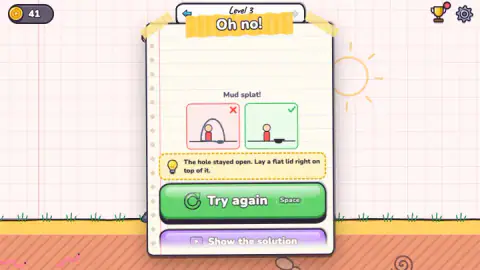
- A hole wants a flat cover, not an arch. The same curve that saves you from bees drops you into mud. The failure card draws both cases side by side: the arch crossed out in red, the flat lid ticked in green.
- Speed is one of the stars. Our result card named the extra task outright — draw it within three seconds — so a level you have already solved is worth replaying fast rather than carefully.
- Running dry is not losing. When the bar empties a black notice reads Out of ink!, and Try again is still sitting there on the right.
- The back arrow is a real button. The level pill has an arrow on each side, and once a level is behind you the forward one turns green. Old levels stay open for the stars you missed.
Controls
| Press and drag the mouse | Draws your line on the paper. Let go and the line stops being a drawing and becomes an object with weight |
|---|---|
| A finger, on a touchscreen | Does the same job. The game's listing says it is built for mouse and touch alike; we played with a mouse |
| Space | Takes the Try again button on the failure card. The game prints the key on the button itself |
| R | Restarts the level you are on, per the game's own listed controls |
Features
- Your line is not a magic wand: let go of the mouse and it turns into a solid object with weight, which then falls wherever the drawing put it
- The game grades the ink, not the drawing: a bar at the top left empties as you draw, and a small gold star marks the point you have to stay under
- Each level is worth three stars and we never took all three, finishing our best run with two of them and a shield reading Blocked: 3
- Winning pays in coins — our purse went from 20 to 87 across three levels, with 23 of them arriving on a single result card
- Failing is a lesson rather than a loss: the card names the mistake, draws the wrong shape with a red cross and the right one with a green tick, and hands you Try again on the Space key
- Stars pile into a chest that wants ten of them, and the result card counts how many you still owe it
- The level pill at the top has arrows on both sides, so you can walk back into a level you have already beaten and try for the stars you missed
- Everything is drawn on pale graph paper, the cards are torn notebook pages held down with sticky tape, and the water is blue pencil hatching
Game details
- Developer
- Partner studio
- Release date
- October 2026
- Last updated
- October 25, 2026
- Added here
- October 2026
- Technology
- HTML5 (2D physics)
- Platforms
- Browser (desktop), Browser (mobile & tablet, touch)
- Saved progress
- Saving, when available, is managed by this game. Mava cannot confirm your level.
FAQ
How do you play Doodle Guard: Draw to Save?
You press and drag to draw a line on the graph paper, and when you let go the line becomes a solid object and drops. The job is to put that object between a small red hero and whatever is coming for him, and to keep him alive until the level's timer runs out. Later levels change the question and ask you to draw a bridge or a ramp so the hero can walk to a flag instead.
Why do the bees get past the line in Doodle Guard?
Because a roof is not a shelter. The game says so itself in a hint box: bees fly around lines, so you have to close the dome down to the ground. A beam across the top leaves two open sides, and the bees simply come in around the ends of it. The shape that works is a closed arc with both feet on the grass.
What is the ink bar in Doodle Guard?
It is the dark bar at the top left with a pencil on its end, and it is how much line you have left to draw. Every stroke eats into it, and when it is gone a black notice reading Out of ink! appears and you cannot add anything else. A small gold star is marked underneath the bar about a third of the way along, which is the amount you are supposed to stay under.
How do you get three stars in Doodle Guard?
Three stars means solving the level and meeting its extra conditions rather than just surviving it. The result card names one of them outright — ours read Draw it within 3 s — and the star marked on the ink bar sets another, which is to spend less ink than that mark. We finished our best level with two stars of three, so the third is something we can describe rather than something we earned.
What is the star chest in Doodle Guard?
It is a collection target that sits on the result card after a win. Stars from individual levels pile into it, and the card tells you how many are left: ours read four more stars to the chest, with a green bar showing six of ten. We never filled it, so what the chest actually hands over is something we did not see.
What happens when you fail a level in Doodle Guard?
Nothing is taken away from you. A torn notebook page drops over the level, names the mistake — ours was Mud splat! — and explains it in one line, with two little drawings showing the wrong shape crossed out in red and the right one ticked in green. Underneath sits a green Try again button that also works on the Space key, and below that either a button offering to show the solution or one offering to skip the level.
Does Doodle Guard: Draw to Save work on a phone?
The game's own listing says it is built for mouse and touch alike, and drawing with a finger is the obvious fit for a game whose only input is a drag. We played it on a computer with a mouse, so the phone version is the listing's claim rather than our experience. The layout is wide, with the buttons gathered on a strip down the right edge.
Is Doodle Guard: Draw to Save free, and who made it?
It is free and it runs in a browser with nothing to install. The studio behind it is not recorded anywhere we can check, so this sheet names no author rather than guessing one. It reached our catalogue on 24 October 2026, which makes it days old at the time of writing.